Walk into almost any Shinto shrine in Japan and you will pass the same things in roughly the same order: a gate with no doors, a long path, a stone basin of water, a pair of stone beasts, a thick straw rope, and finally a wooden hall with a bell and an offering box. Most visitors photograph them one by one, but together they form a kind of sentence: a sequence that leads you step by step from the everyday world toward the place where a kami (a Shinto god or sacred spirit) is believed to dwell.
This guide teaches you to read that sentence. Following the route a worshipper takes, from the first gate to the innermost sanctuary, it explains what each element is, where it came from and what it is believed to mean. Where scholars and shrines disagree, and they often do, we say so.
In this article
- The shrine as a journey inward
- Torii: the gate with no door
- Sando: the approach and the kami’s path
- Temizuya: washing before you meet the kami
- Komainu, foxes and other guardians
- Shimenawa and shide: rope and paper that mark the sacred
- Haiden and honden: why you never see the kami
- Sacred trees, rocks and forests
- The amulet counter: omamori, ema and goshuin
- Practical etiquette: reading the shrine with your feet
- Trivia: the rope that twists the other way
- In closing
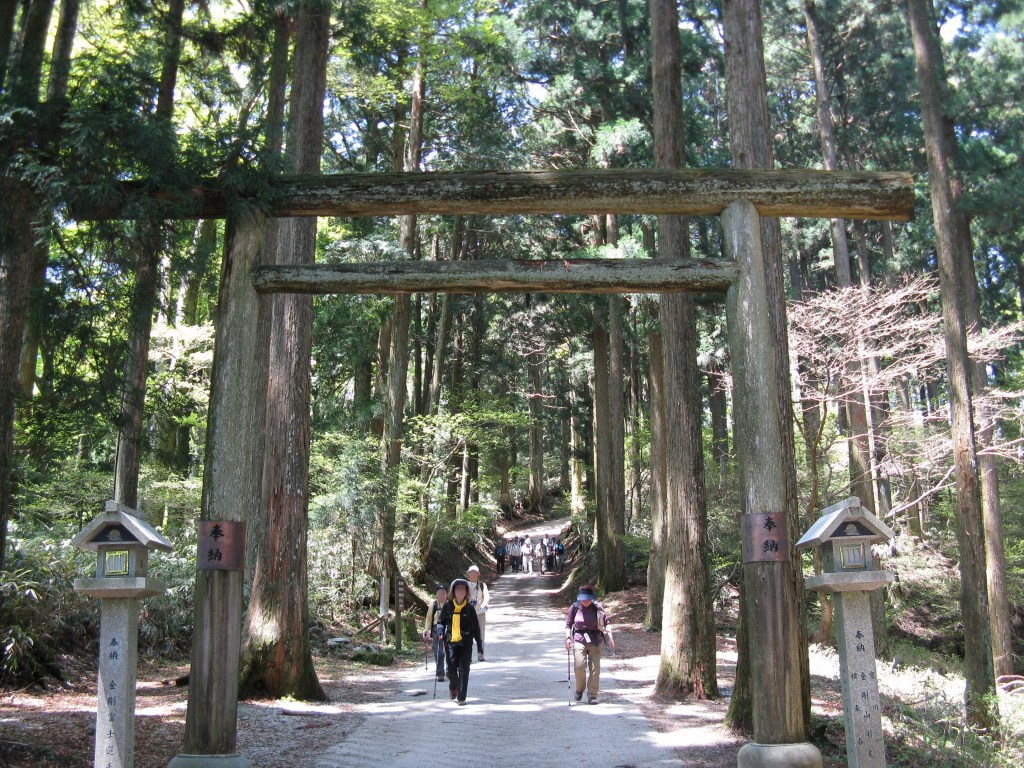
The shrine as a journey inward
A Shinto shrine (jinja) is not a single building but a whole sacred precinct. As Japan’s Association of Shinto Shrines (Jinja Honcho) tells visitors, once you pass through the torii you are in a sacred area. Everything you meet after that point does one of three jobs. Some mark a boundary (gates, ropes, fences), some purify you as you cross it (water, the walk itself), and some guard or house the kami (statues, halls, sacred trees and rocks).
Keep those three jobs in mind and the layout makes sense: each gate, rope and fence brings you a step closer to the main sanctuary, the one place you may not enter. (New to the idea of kami? Start with What Is a Kami? For how shrines differ from Buddhist temples, see Shrine vs. Temple in Japan.)
Torii: the gate with no door
The torii (shrine gate) is the best-known symbol of Shinto, so much so that Japanese maps use it as the symbol for a shrine. Yet it has no doors, no walls on either side and nothing to stop you walking around it. Its job is not to keep anyone out. In the words of the Jinja Honcho, it represents “the border between the secular and the sacred worlds.”
A basic torii has two pillars topped by an upper beam (kasagi), with a tie beam (nuki) set a little lower to hold them together. Where there are several, the outermost, the ichi no torii (“first torii”), is usually the largest; the ones that follow mark increasing degrees of holiness as you approach the main sanctuary.
Where did the torii come from?
Nobody knows for certain. The Kokugakuin University Encyclopedia of Shinto states that no single theory has gained general acceptance. Some scholars point to the torana, the ceremonial gateways of early Buddhist sites in India; others see links to gates in China or Korea; still others argue for a purely Japanese origin. The name is just as debated: one theory reads it as “bird perch,” another derives it from a phrase meaning “to pass through and enter.”
What we do know is that torii were in wide use by the mid-Heian period: the earliest reliable written record dates to 922. The oldest surviving stone torii, at a Hachiman shrine in Yamagata Prefecture, dates to around the mid-12th century, and the oldest surviving wooden one to 1535.
Shinmei or myojin? How to tell the two main styles apart
There are dozens of torii designs, but most belong to one of two families:
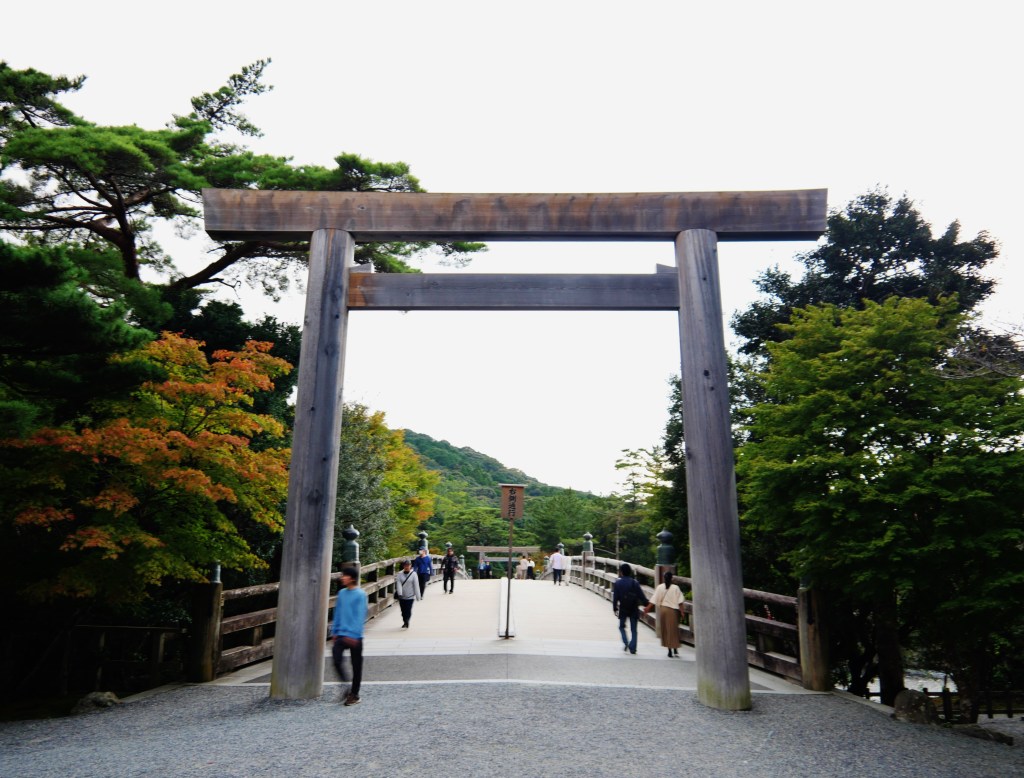
- Shinmei torii: the simplest form. Every piece is straight: two pillars, a straight top beam and a tie beam, with no second beam under the top one. This is the family of the gates at Ise Jingu, often called Japan’s most sacred shrine, and it is usually left as plain, unpainted wood.
- Myojin torii: the most common style in Japan, which developed around the 9th century. Its top beam curves upward at the ends, and a second beam (the shimaki) runs directly beneath it. The tie beam sticks out past the pillars, the pillars lean slightly inward, and a short central post often carries a plaque with the shrine’s name.
A quick rule of thumb: look at the top beam. Straight means the shinmei family; curving upward means the myojin family. Many myojin torii are not red at all: the great unpainted wooden torii at Meiji Jingu in Tokyo, which the shrine describes as the largest wooden myojin-style torii in Japan, stands 12 meters tall.
Why are so many torii vermilion?
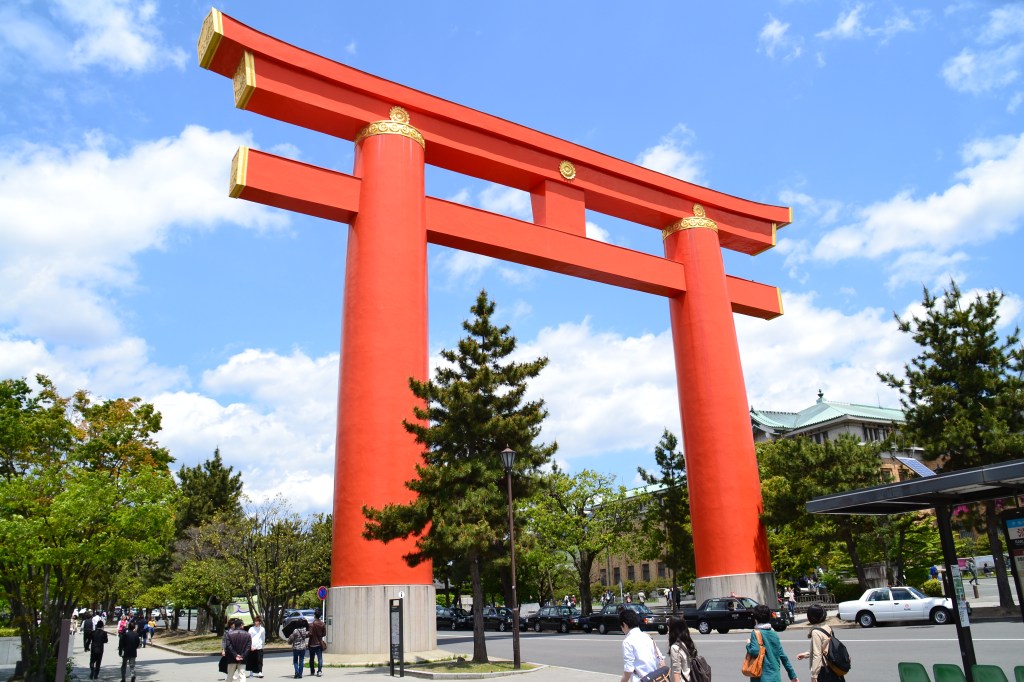
The bright red-orange gate is what most visitors picture. Yet the Jinja Honcho says only that torii are “sometimes” painted vermilion, and a Shinto priest writing for nippon.com goes further: painting the entire torii vermilion is limited to certain shrine lineages, while unpainted wood is typical of most. Vermilion is eye-catching, but it is not the only “correct” color.
As for why vermilion, the clearest explanation comes from Fushimi Inari Taisha, home of the most famous red torii. The shrine explains that vermilion “is considered an amulet against evil forces” and, at Fushimi Inari, also expresses the abundant harvests granted by the kami Inari. There is a practical side too: the traditional pigment, made with mercury, helps preserve the wood. The shrine’s roughly 10,000 torii were donated by worshippers, a custom that had become widespread by the start of the Edo period (1603–1868) as a way of offering a prayer, or thanks for one answered.
One more surprise: torii are not exclusive to shrines. The Encyclopedia of Shinto notes that some Buddhist temples have them too, a reminder of the more than one thousand years in which kami and buddhas were worshipped together (see our article on shinbutsu-shugo).
Sando: the approach and the kami’s path
Beyond the torii runs the sando (approach path), often paved with stone or covered in gravel and lined with stone lanterns (toro), many of them donated by worshippers as offerings. Walking it is part of the visit, a chance to leave daily concerns behind before you reach the kami.
Many shrines regard the center of the path, called seichu, as a route reserved for the kami. That is why many Japanese visitors walk slightly to one side rather than straight down the middle, an easy courtesy to copy.
Notice, too, what surrounds the path. Older shrines usually stand inside a grove called the chinju no mori (“forest of the guardian kami”). These woods are considered dwelling places of the kami, and, as one Shinto priest puts it, it is forbidden to remove even a single fallen leaf from them. The trees are not decoration around the shrine; in a real sense they are part of it.
Temizuya: washing before you meet the kami
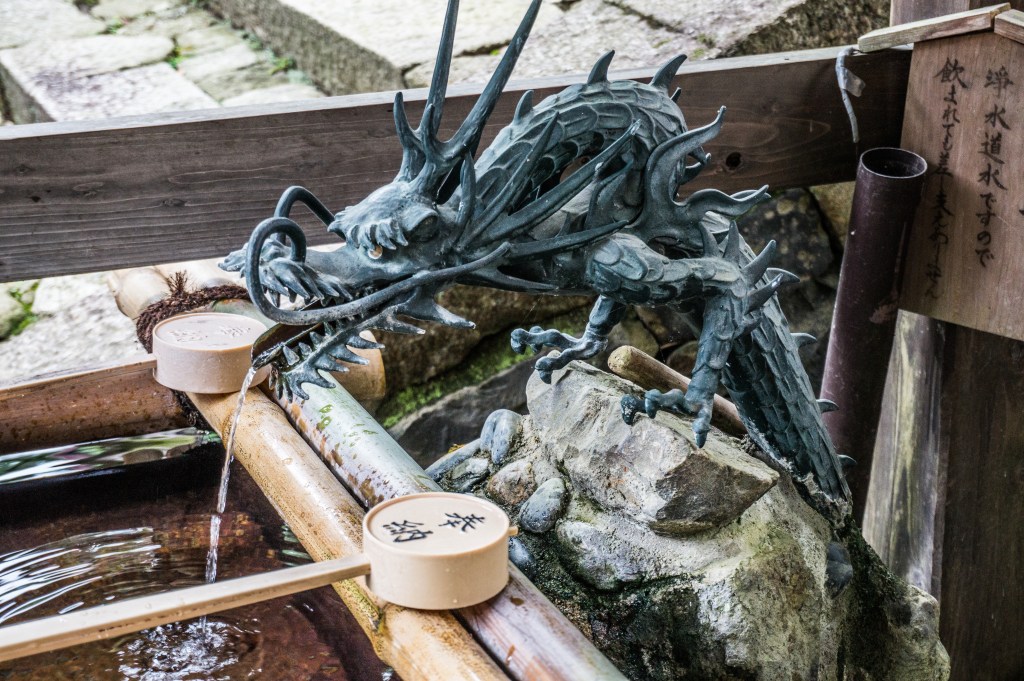
Somewhere along the approach you will find the temizuya (also called chozuya), a roofed basin of water with wooden ladles. It exists because of a central idea of Shinto, purity: before approaching a kami, you should be clean in spirit as well as body.
The model comes from myth. In the Kojiki (Japan’s oldest surviving chronicle, completed in 712), the god Izanagi returns from the land of the dead and washes away its pollution by bathing at a river mouth. From this grew misogi, full-body purification in a river, waterfall or the sea, which devoted practitioners still perform today. The temizuya is a shortened, everyday form of misogi: rinsing the hands and mouth stands in for washing the whole body.
Originally, worshippers washed at natural springs or streams inside the shrine grounds, and at Ise Jingu they still use the Isuzu River, which flows through the precinct. Buddhist temples have similar basins. Professor Koji Suga of Kokugakuin University notes that cleansing the body with water probably took root in Japan long before Shinto and Buddhism blended, though the exact origin of the basins needs more study.
In short, with a single ladleful you rinse your left hand, your right hand and your mouth (from your cupped left hand, never from the ladle), then your left hand again. How to Visit a Japanese Shrine walks through it step by step. Since the COVID-19 pandemic, many shrines have removed the ladles or switched to running water; if so, simply rinse your hands in the flow.
Komainu, foxes and other guardians
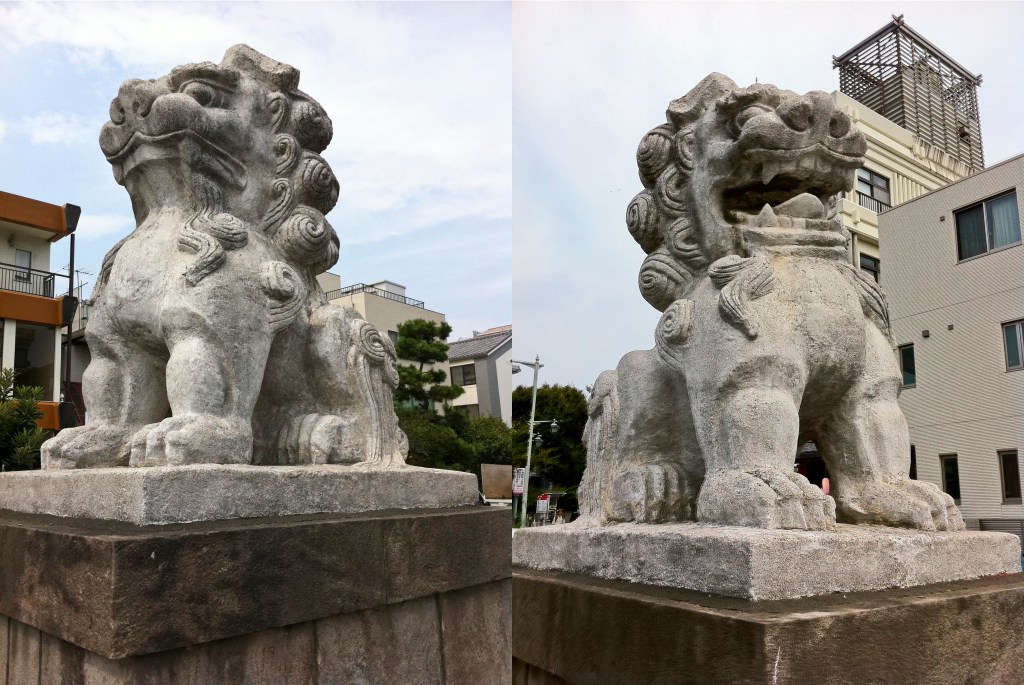
Flanking the approach or the entrance to the halls you will usually find a pair of stone creatures that look half lion, half dog. These are komainu (guardian lion-dogs). According to the Encyclopedia of Shinto, they “are believed to symbolize the eradication of evil and the protection of the area around the kami.”
Look closely and you will usually see that one has its mouth open and the other has it closed. This pairing is called a-un, and it is borrowed from Buddhist symbolism: “a” is the first sound of the Sanskrit alphabet, made with an open mouth, and “un” the last, made with the lips closed. Together they stand for the beginning and the end of all things. Some pairs, though, have both mouths open, and one of the two may carry a single horn.
That horn is a clue to their history. In the early Heian period, the pair was seen as two different animals: an open-mouthed shishi (lion) and a closed-mouthed, dog-like creature, sometimes horned, which was the original komainu. In time, the name komainu came to cover both. Koma was an old name for Goguryeo, an ancient Korean kingdom, so the name is often translated “Korean dogs.” But the Encyclopedia of Shinto suggests that “koma” may simply have meant “foreign”: the figures came by way of Korea, but their model was the guardian lion of Tang-dynasty China, and their deeper roots may lie in India or even Egypt.
The stone pairs you see outdoors today are a relatively late development. According to the Kyoto National Museum, in the Heian and Kamakura periods komainu stood indoors, inside gates and halls, and so were carved in wood; painted wooden examples survive at Yakushi-ji in Nara and at Itsukushima Shrine. Stone pairs set outdoors along the approach became widespread only in the Edo period. Guardian lions also appear at Buddhist sites: a pair of stone lions carved in 1196 by stonemasons from Song-dynasty China stands inside the Great South Gate of Todai-ji in Nara.
When the guardian is a fox, a deer or a monkey
At some shrines the guardians are not lion-dogs but the animal linked with that shrine’s kami, called shinshi (divine messengers). A few you are likely to meet:
- Foxes (kitsune) at Inari shrines. Fushimi Inari Taisha explains that its foxes are invisible spirit messengers of the kami Inari, and that this “does not mean that Inari Okami is a fox.” The stone foxes often hold a jewel or a key in their mouths, the key commonly explained as that of a rice granary.
- Deer at Kasuga Taisha in Nara. According to legend, Takemikazuchi, the first of the shrine’s kami, came from Kashima Shrine in eastern Japan riding a white deer.
- Oxen at Tenmangu shrines dedicated to the scholar Sugawara no Michizane, worshipped as Tenjin. Several legends link him to oxen; see our article on Dazaifu Tenmangu.
- Monkeys at Hiyoshi Taisha in Shiga Prefecture and its branch shrines, including Hie Shrine in Tokyo.
- Wolves at Mitsumine Shrine in the mountains of Saitama.
- Crows at the Kumano shrines, linked with Yatagarasu, the three-legged crow that in myth guided Jimmu, the legendary first emperor; and doves at Hachiman shrines.
So if the guardians are not lion-dogs, take it as a clue: the statue is telling you which kami lives here.
Shimenawa and shide: rope and paper that mark the sacred
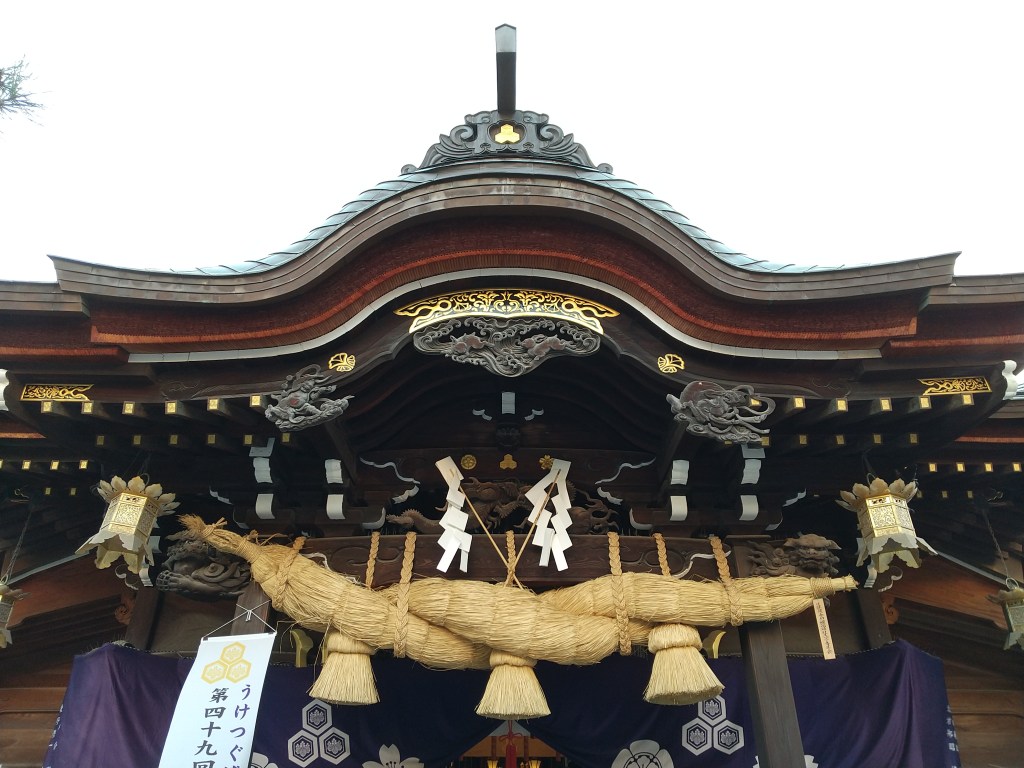
Hanging across the front of the worship hall, from a torii, or wrapped around a giant tree, you will see a thick twisted rope, often with zigzag strips of white paper hanging from it. The rope is a shimenawa (sacred rope) and the paper strips are shide (paper streamers).
The Encyclopedia of Shinto defines a shimenawa as a straw rope “hung before or around a site to demarcate sacred or pure space.” In ancient times, shime meant a marker of ownership, a sign that a place was claimed and off-limits to others, and rope was the most common way to make one. A shimenawa says something similar: this place belongs to the kami.
Myth offers a famous precedent. In the Kojiki, when the sun goddess Amaterasu is lured out of the cave where she has hidden, the god Futotama draws a rope behind her and tells her she must not go back in. This rope is often cited as the model for the shimenawa: a line that separates two worlds.
Shimenawa were traditionally woven from hemp, but legal restrictions on growing hemp have made it scarce, and rice or wheat straw is more common today. When a rope hangs in front of a sanctuary, its thicker end is normally on the right as you face it (see the Trivia section below for a famous exception).
The shide were once made of yu, a rough cloth woven from paper-mulberry fiber; today they are almost always paper. They are cut and folded in several traditional patterns, and they also hang from the wooden wand that priests wave during purification rites. On a rope, says the Encyclopedia of Shinto, they “symbolize sacred borders.” Many popular guides add that the zigzag shape represents lightning, which brings rain and good harvests. The encyclopedia does not mention this idea, so treat it as a popular interpretation rather than established teaching.
The same pairing appears in sumo: a yokozuna (grand champion) wears a rope hung with shide around his waist during his ring-entering ceremony.
Haiden and honden: why you never see the kami
At the end of the approach stand the main buildings, and here first-time visitors are often confused: what looks like the “main hall” usually is not.
The haiden: where people pray
The building you walk up to is normally the haiden (worship hall). This is where you drop a coin into the offering box (saisen-bako), ring the bell if there is one, and pray. Inside, priests perform formal prayers and purification rites for people who request them, usually in return for an offering.
The haiden may not be an ancient part of Shinto. Historians have proposed several origins, including the worship halls of Buddhist temples, the stages used for sacred dances and the places where Buddhist sutras were recited, but there is no single agreed answer.
The honden: where the kami dwells
Behind the haiden, often raised, fenced off and partly hidden, stands the honden (main sanctuary), the most sacred building in the shrine. Its doors usually stay closed except during festivals, and only priests enter it. At larger shrines a third building, the heiden (offering hall), may connect the two.
Inside the honden is the shintai (also called goshintai), a sacred object in which the spirit of the kami is believed to reside, such as a mirror, a sword or a stone. It is never shown to visitors, and it is understood not as the kami itself but as the place where the kami dwells. Here lies a key difference from a Buddhist temple: Shinto had no tradition of images of its kami, and the few kami statues that exist were made under Buddhist influence from the Heian period on. (Compare our guide to Buddhist statues.) At a shrine, you pray toward a presence you are not meant to see.
Fences called tamagaki (sacred fences) often surround the honden, each marking a further boundary between sacred and profane. At the Inner Shrine of Ise Jingu there are four, one inside another; ordinary visitors pray from outside the inner fences and see little more than the rooftops.
Reading the roof
The honden roof can tell you something too. The Jinja Honcho traces the oldest sanctuary styles to two lines: shinmei-zukuri, modeled on ancient raised-floor rice granaries and seen at Ise Jingu, and taisha-zukuri, modeled on ancient dwellings and seen at Izumo Taisha. On older-style roofs, look for chigi, crossed boards forking up like a V at each end of the ridge, and katsuogi, short logs laid across it. A popular saying holds that chigi cut flat (horizontally) at the tips and an even number of katsuogi mean a female kami, while vertical cuts and an odd number mean a male kami. It is fun to check, but it is not a reliable rule, and Ise itself breaks it: the Outer Shrine honors a female kami, Toyouke, yet its roof has vertically cut chigi and nine katsuogi.
Sacred trees, rocks and forests
Some of the most important things in a shrine are not buildings at all. An enormous old tree bound with a shimenawa is a shinboku (sacred tree). A rock or group of rocks is an iwakura, which the Encyclopedia of Shinto defines as a rock formation “to which a kami is invited to descend for worship.” Rock worship in Japan goes back to the prehistoric Jomon period. At some shrines, rocks within or behind the sanctuary seem to have been the focus of worship before any building was put up. In other words, the hall came later; the sacred place came first.
The most striking example is Omiwa Shrine in Nara Prefecture, which describes itself as one of the oldest shrines in Japan. It has no honden at all. Instead, worshippers face Mount Miwa itself through a distinctive triple torii (mitsu-torii) behind the worship hall, a form of worship the shrine says preserves the earliest way of honoring the kami. Wherever you see a rope around a tree or a rock, remember: the rope does not make it sacred; it tells you that it already is.
The amulet counter: omamori, ema and goshuin
At the shrine counter (juyosho) you can receive omamori (amulets), ema (wooden plaques for writing wishes), omikuji (paper fortunes) and often a goshuin (a hand-written shrine seal). The Jinja Honcho reminds visitors that omamori “are not simple souvenirs” but embodiments of the power of the kami. See Omamori and Ema and Goshuin: Japan’s Sacred Seals.
Practical etiquette: reading the shrine with your feet
Shrine etiquette is less a set of strict rules than a way of showing that you understand where you are. In brief:
- On the way in: bow slightly before passing through the torii, walk a little to one side of the center of the sando, and purify your hands and mouth at the temizuya.
- At the haiden: the standard form is two deep bows, two claps and one final bow. Some shrines have their own forms: Izumo Taisha, for example, uses two bows, four claps and one bow. There is no fixed amount for the coin offering.
- Do not enter buildings or fenced or roped-off areas without an invitation, even if they look open, and avoid sitting on the steps or standing in front of the hall while others are waiting to pray.
- Photography of buildings and grounds is usually allowed, but some areas forbid it. Follow the signs, and do not photograph priests or people at prayer without consent.
- Treat roped trees and rocks as sacred. Don’t climb on them or pull at the rope, and don’t take away leaves, stones or branches.
Trivia: the rope that twists the other way
The shimenawa on the Kaguraden (sacred dance hall) at Izumo Taisha in Shimane Prefecture is, according to the shrine, the largest in Japan: 13.6 meters long, 8 meters around and 5.2 metric tons. Volunteer weavers from the town of Iinan in central Shimane remake it every six to eight years.
At most shrines, the rope begins on the right as you face the hall, so the thick end is on the right. At Izumo it is the reverse: the twist begins on the left, so the blunt end is on the left and the tapering end on the right. The shrine simply calls this feature peculiar to Izumo; why it differs is not settled. Next time you stand before a shimenawa, check which way it runs.
In closing
A shrine can look like a collection of separate curiosities. Read in order, they tell a single story. The torii announces a boundary. The sando and the forest give you distance from the everyday. The water cleans you. The guardians protect the space. The rope says “this belongs to the kami.” And the honden, closed and unseen, reminds you that the most sacred thing here is not meant to be looked at, only approached.
Once you can read that story, you will notice how each shrine tells it differently, with a fox instead of a lion or a mountain instead of a hall, and each difference tells you something about the kami who lives there.


コメントを残す