On a wooded hill above the small town of Hiraizumi in Iwate Prefecture, at the top of a steep, cedar-lined slope, stands a building not much bigger than a large room that is covered almost entirely in gold. The Konjikido (Golden Hall) of Chuson-ji was completed in 1124. Beneath its altars lie the mummified remains of the four lords who, for about a century, made this corner of northern Japan a rival to the imperial capital, Kyoto.
Chuson-ji is often introduced simply as “the temple with the golden hall.” That is true, but it misses the real story. Hiraizumi was built by a man who had lost his father, his wife and his children to war, and who set out to create a Buddhist pure land (a realm of peace presided over by a buddha) here on earth, for the living and the dead alike. This guide explains who the Northern Fujiwara were, what you see inside the Golden Hall, how their world ended in 1189, and how to plan your visit. Where historians disagree, we say so.
In this article
- Chuson-ji at a glance
- The Northern Fujiwara: four generations, one century
- Why build a pure land in the north?
- Inside the Konjikido, the Golden Hall
- A Tendai temple with a Pure Land heart
- 1189: Yoshitsune, Yoritomo and the end of Hiraizumi
- Basho at the Hall of Light
- World Heritage, 2011 and a message for Tohoku
- Nearby: the Pure Land garden of Motsu-ji
- Practical info: visiting Chuson-ji
- Trivia: the lotus that waited 800 years
- In closing
Chuson-ji at a glance
Chuson-ji stands on Kanzan, a forested hill on the northern edge of Hiraizumi, in the Tohoku region of northeastern Japan. Today it is the head temple in Tohoku of the Tendai school of Buddhism. According to temple tradition, it was founded in 850 by Ennin, a leading monk of Mount Hiei near Kyoto, though the temple explains that this is an honorary title given in Ennin’s memory.
The Chuson-ji we know was built from 1105 by Fujiwara no Kiyohira, the first lord of the Northern Fujiwara clan. At its height, the temple says, it had more than 40 halls and pagodas and over 300 monks’ lodgings, almost all later lost, many in a great fire recorded in 1337. Only the Golden Hall survives from Kiyohira’s time. In 2011 Chuson-ji became the centerpiece of a UNESCO World Heritage Site.
The Northern Fujiwara: four generations, one century
A frontier at war
In the 11th century, northern Honshu was a frontier. The imperial court in Kyoto claimed it, but real power lay with local clans descended in part from the Emishi, the northern peoples whom the court had long treated as outsiders. Two wars shaped everything that followed.
In the Former Nine Years’ War (1051–1062), the court sent the warrior Minamoto no Yoriyoshi against the powerful Abe clan of central Iwate. He won only with the help of the Kiyohara clan of neighboring Dewa Province (today’s Akita). Fighting on the Abe side was a regional official, Fujiwara no Tsunekiyo, who had married a daughter of the Abe chief. When the Abe fell, Tsunekiyo was captured and executed. His son, Kiyohira, was about six years old.
Kiyohira’s mother was then remarried to Kiyohara no Takesada, and the boy grew up in the clan that had helped destroy his father. Two decades later, a succession quarrel among the Kiyohara heirs became the Later Three Years’ War (1083–1087), and Yoriyoshi’s son, Minamoto no Yoshiie, intervened. During the fighting, Kiyohira’s half-brother Iehira set fire to his residence and killed his wife and children. Kiyohira, allied with Yoshiie, emerged in 1087 as the last man standing. He took over the lands of both the Abe and the Kiyohara, and returned to his father’s surname, Fujiwara.
By about the age of thirty, then, Kiyohira had lost his father, his wife and his children to wars in which he himself had fought. This is the key to everything he built.
The four lords
- Kiyohira (1056–1128), the founder. Sometime between the mid-1090s and the early 1100s (sources differ), he moved his base south from Esashi to Hiraizumi.
- Motohira, the second lord (his exact dates are uncertain), who built the great temple of Motsu-ji.
- Hidehira (died 1187), the third lord, under whom Hiraizumi reached its peak. He built Muryoko-in, a temple modeled on the Phoenix Hall of Byodo-in near Kyoto, and sheltered the famous warrior Minamoto no Yoshitsune.
- Yasuhira (died 1189), the fourth and last lord.
Their wealth came above all from gold mined in the region and from trade. UNESCO describes Hiraizumi in the 11th and 12th centuries as the political and administrative center of northern Japan, a city that “rivalled Kyoto.” That wealth paid for the gold leaf you will see on the Golden Hall.
Why build a pure land in the north?
In Pure Land Buddhism, the Pure Land is the Western Paradise of Amida (Amitabha), the buddha of infinite light, who vowed to welcome all who call on him with faith. In late Heian Japan (the Heian period lasted from 794 to 1185), this hope burned especially bright. Many believed that the world had entered mappo, the “latter days of the Buddhist law,” a dark age thought to have begun in 1052, in the middle of the Former Nine Years’ War. Nobles in Kyoto built Amida halls to help them be reborn in paradise, the most famous being the Phoenix Hall of Byodo-in.
Kiyohira’s vision was different. In 1126 a great dedication ceremony was held at Chuson-ji. The prayer offered in Kiyohira’s name, known as the Chuson-ji Kuyo Ganmon (dedication prayer), survives only in 14th-century copies, and scholars still debate exactly which hall it dedicated. In it, Kiyohira looks back on the wars of the north. Many soldiers on both sides, the court’s armies and the northern peoples, have died here over the ages, he says, along with countless animals, and their bones are still dust in this land. He prays that the sound of the temple bell will guide all of their souls to the Pure Land.
Hiraizumi’s official heritage site sums up his purpose as mourning “all the souls of the people, both enemies and allies, who lost their lives in the repeated battles.” For a man who had fought on both sides of the north’s divisions, the goal was reconciliation, not victory.
Kiyohira’s first act, according to the temple and later records, was symbolic. Along the main road running the length of the north, from the Shirakawa Barrier (in today’s Fukushima) to Sotogahama (in today’s Aomori), he is said to have set up a small memorial stupa about every 100 meters, each painted with a golden image of Amida, with Chuson-ji’s hill near the midpoint. Whatever the exact details, the idea is clear: Hiraizumi was to be the center of a whole region at peace.
Inside the Konjikido, the Golden Hall
The Golden Hall is surprisingly small: about 5.5 meters on each side and about 8 meters tall. The year 1124 is inscribed on its ridgepole. Its pyramid-shaped roof is covered with wooden boards shaped like roof tiles, and the hall is gilded inside and out, a style called kai-konjiki (“all gold”). It brings together the finest lacquerwork, metalwork and sculpture of its age. According to the Japanese government, almost 90 percent of its original structure and materials still survive.
Gold, shell and ivory
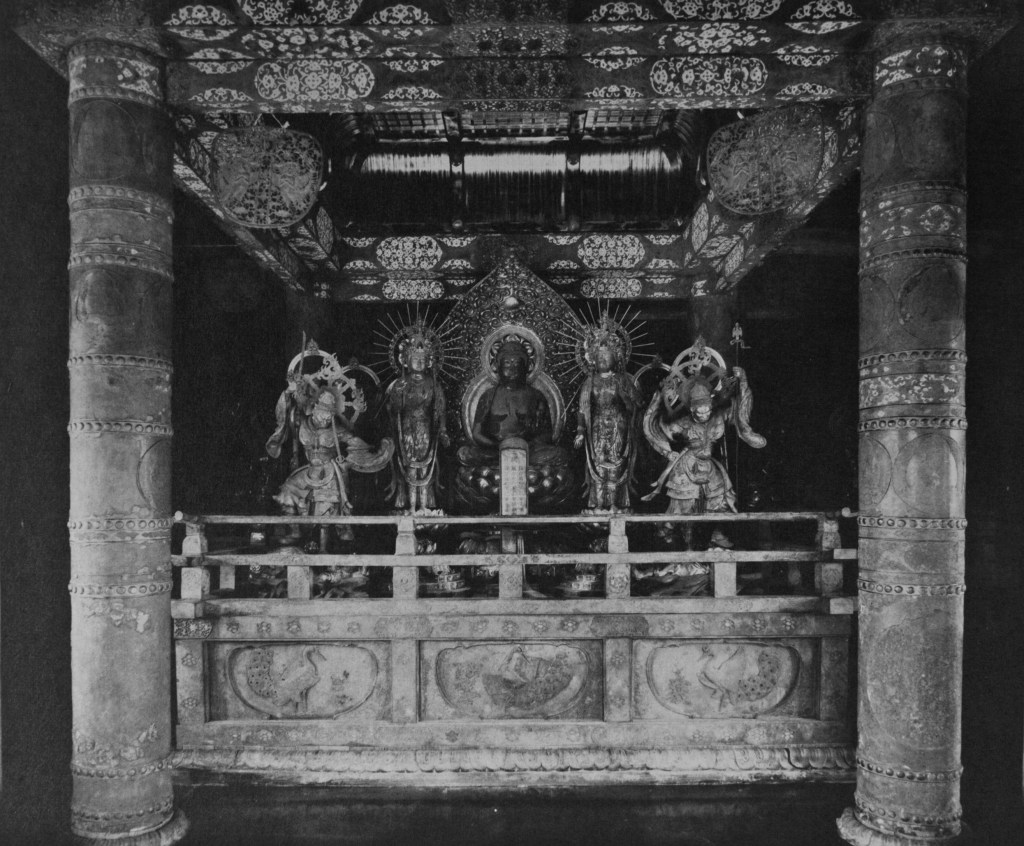
The inner sanctuary’s pillars and altars are decorated with raden (mother-of-pearl inlay) made from the shell of the great green turban snail, which the temple says came from far southern seas. There are also ivory and precious stones. The four inner pillars are decorated in maki-e (lacquer sprinkled with gold powder). The altar platforms carry peacocks hammered out of metal and gilded, and gilt copper plaques show karyobinga, half-human birds said to sing in Amida’s paradise. Every detail is a picture of the Pure Land.
Three altars and 32 statues
The hall has three altar platforms (shumidan). Each was arranged in the same way: a seated Amida at the center, flanked by the bodhisattvas Kannon (compassion) and Seishi (wisdom); six standing figures of Jizo, the bodhisattva who rescues beings in every realm of rebirth; and, in front, two guardian kings, Jikokuten and Zochoten. That makes eleven per altar, but one figure is missing, so 32 statues remain today. According to Iwate Prefecture, this pairing of an Amida triad with six Jizo is found nowhere else in Japan. (See our guide to Japanese Buddhist statues.)
The four lords beneath the altars
What makes the Konjikido unique lies inside those altars. Kiyohira died in 1128, and his body was placed in a gold-decorated coffin within the central altar. The two side altars, added later, hold the coffins of Motohira and Hidehira and a container with the head of the fourth lord, Yasuhira. The temple says all four still rest there today.
A scientific team examined the remains in 1950, and a 2021 study in the journal PLOS ONE calls them the oldest known mummified human remains in Japan. Researchers have never agreed whether the bodies dried out naturally or were deliberately preserved. Temple tradition long held that the head belonged to Yasuhira’s younger brother, Tadahira. But its wounds match the Azuma Kagami, a chronicle of the Kamakura shogunate (Japan’s first warrior government), which records that Yasuhira’s head was pierced with an iron nail. Today it is generally identified as Yasuhira’s.
A hall inside a hall
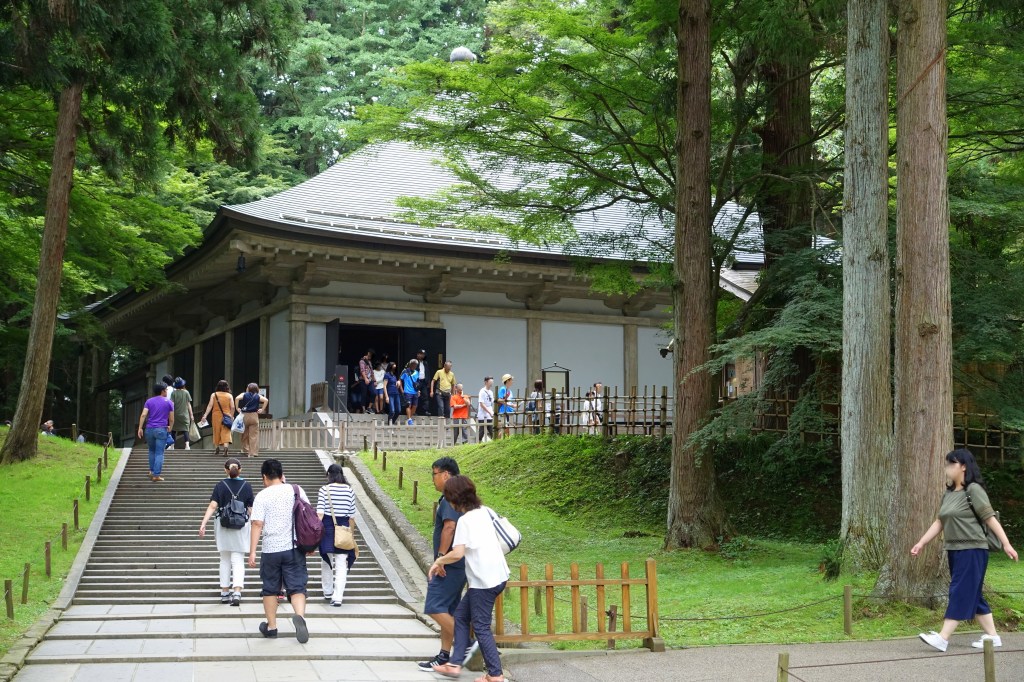
A gilded wooden building should not have survived 900 northern winters in the open, and it did not have to. According to the Agency for Cultural Affairs, a simple shelter was added under the eaves soon after it was built, and a full covering hall followed in the Kamakura period (1185–1333). Tradition dates that covering hall to 1288, but the wooden Old Outer Hall that survives today is thought to date from around the 15th century. When a modern concrete hall replaced it in the 1960s, the old one was moved nearby, and you can still walk through it.
Between 1962 and 1968 the Golden Hall was taken apart and fully restored. Today it stands behind glass inside the modern outer hall. In 1951, under Japan’s postwar law for the protection of cultural properties, it was designated a National Treasure; the temple notes that it was the first building on that list.
A Tendai temple with a Pure Land heart
It may seem odd that a hall devoted to Amida belongs to Tendai rather than to one of the Pure Land schools. But in the 12th century those schools did not yet exist as separate organizations. Pure Land devotion grew up largely inside Tendai, on Mount Hiei, where the monk Genshin wrote his influential guide to rebirth in paradise, the Ojoyoshu (“Essentials of Salvation”), in 985. Kiyohira’s Chuson-ji, like Byodo-in, belongs to that world. (Our introduction to Japanese Buddhist schools explains how Pure Land later became independent.)
The Fujiwara lords commissioned complete sets of the Buddhist scriptures copied in gold, and even in alternating lines of gold and silver on indigo paper, a project the temple says was otherwise possible only for the imperial family and top nobles. In the late 16th century, under the Toyotomi regime, more than 4,000 of these scrolls were taken away; most are now kept at Koyasan, and some at Kanshin-ji in Osaka Prefecture.
The link to Mount Hiei, home of the Tendai head temple Enryaku-ji, remains strong. In 1958 a flame was brought to Chuson-ji from Enryaku-ji’s “inextinguishable lamp of the Dharma,” and the temple was recognized as Tendai’s head temple for Tohoku. The flame burns in the Hondo (main hall), rebuilt in 1909, whose principal image is a large seated Shaka (the historical Buddha).
1189: Yoshitsune, Yoritomo and the end of Hiraizumi
The Northern Fujiwara’s downfall is bound up with one of Japan’s best-loved heroes, Minamoto no Yoshitsune (1159–1189). As a young man he spent about six years in Hiraizumi under Hidehira’s protection. In 1180 he left to join his half-brother, Minamoto no Yoritomo, in the Genpei War (1180–1185) against the Taira clan, and won its most famous victories. Yoritomo came to see him as a threat, and Yoshitsune became a fugitive. In 1187 he fled once more to Hidehira in Hiraizumi.
Hidehira died later that year. In 1189 his son Yasuhira, under heavy pressure from Yoritomo, attacked Yoshitsune’s residence at Koromogawa, and Yoshitsune took his own life. Popular stories add that his loyal warrior-monk, Benkei, died on his feet guarding the gate, struck by countless arrows. The hill of Takadachi, a short distance from Chuson-ji, is traditionally identified as the site; a small hall built there in 1683 houses a statue of Yoshitsune.
This did not save Yasuhira. Later in 1189 Yoritomo marched north with a large army. Yasuhira fled and was killed by one of his own retainers, and the Northern Fujiwara came to an end. The Azuma Kagami describes Yoritomo entering a Hiraizumi already burned and empty of people. Impressed by its temples, he modeled a new temple in Kamakura, Yofuku-ji, on Chuson-ji’s two-story great hall, and ordered one of his vassals to keep Hiraizumi safe. Chuson-ji survived, but without its patrons it began a long decline.
Basho at the Hall of Light
In 1689, five hundred years after Yoshitsune’s death, the haiku poet Matsuo Basho set out from Edo (today’s Tokyo) with his companion Sora on the journey he described in Oku no Hosomichi (“The Narrow Road to the Deep North”). They reached Hiraizumi on the 13th day of the 5th month, June 29 in the Western calendar.
Basho first climbed Takadachi, above the Kitakami River and the fields where Hidehira’s mansion had stood. Three generations of glory, he wrote, had vanished like a single dream. He recalled the Chinese poet Du Fu’s line about a ruined country where only the mountains and rivers remain, spread his hat on the ground, sat and wept. Here he wrote his famous haiku on the “summer grasses,” all that remain of the warriors’ dreams.
He then went up to Chuson-ji, where he called the Golden Hall the Hikarido, the “Hall of Light,” and wrote:
Samidare no / furinokoshite ya / Hikarido
Matsuo Basho, Oku no Hosomichi (1689). Our translation.
“Have the summer rains / fallen everywhere but here? / The Hall of Light.”
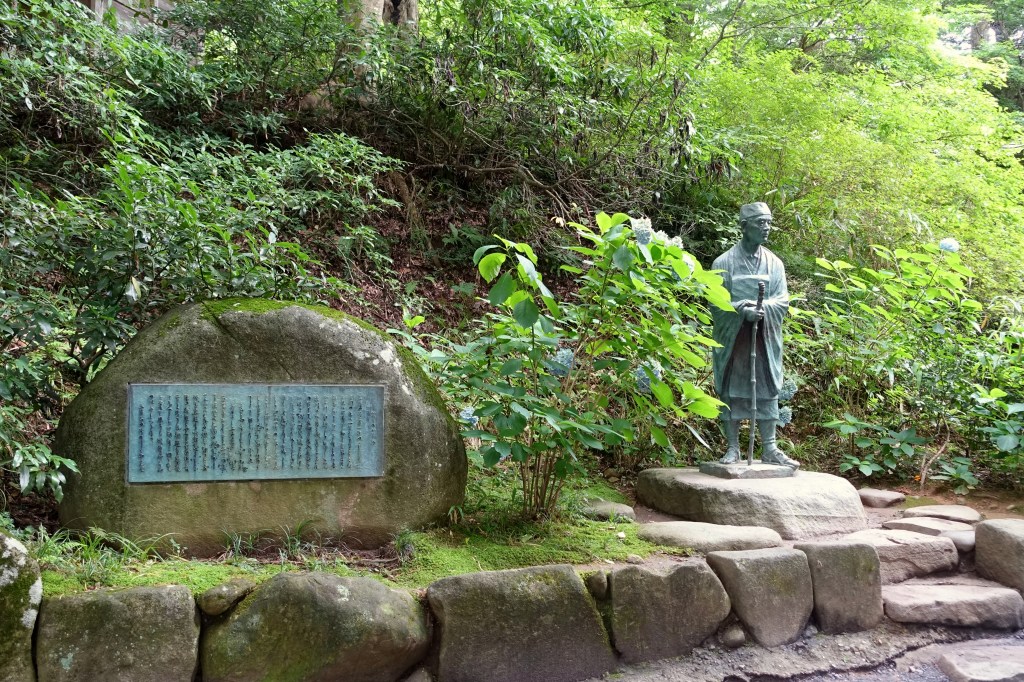
Samidare are the long rains of early summer. The poem imagines that centuries of rain have rotted everything in Hiraizumi except this one hall. Basho saw the Golden Hall inside the old wooden covering hall that you can still walk through today. A statue of Basho stands beside that Old Outer Hall, and a stone carved with this haiku, set up in 1746, stands near the Golden Hall.
World Heritage, 2011 and a message for Tohoku
In June 2011, UNESCO’s World Heritage Committee inscribed “Hiraizumi – Temples, Gardens and Archaeological Sites Representing the Buddhist Pure Land” on the World Heritage List. The property has five parts: Chuson-ji; Motsu-ji; the remains of two lost temples, Kanjizaio-in and Muryoko-in; and Mount Kinkeisan, a small sacred hill around which the town’s temples and gardens were planned. UNESCO calls the Golden Hall “a remarkable survival” and sees in the gardens “a concept of planning and garden design that was unique to Japan.” An earlier, larger nomination had been deferred in 2008.
The timing gave the listing a meaning far beyond tourism. It came just over three months after the Great East Japan Earthquake and tsunami of March 11, 2011, which devastated the Pacific coast of Tohoku. Hiraizumi lies inland and was not directly hit, but the whole region was in mourning. The governor of Iwate and the mayor of Hiraizumi called the listing “a great encouragement for all the people living in the disaster areas,” and many saw an echo of Kiyohira’s prayer for all who had died.
Nearby: the Pure Land garden of Motsu-ji
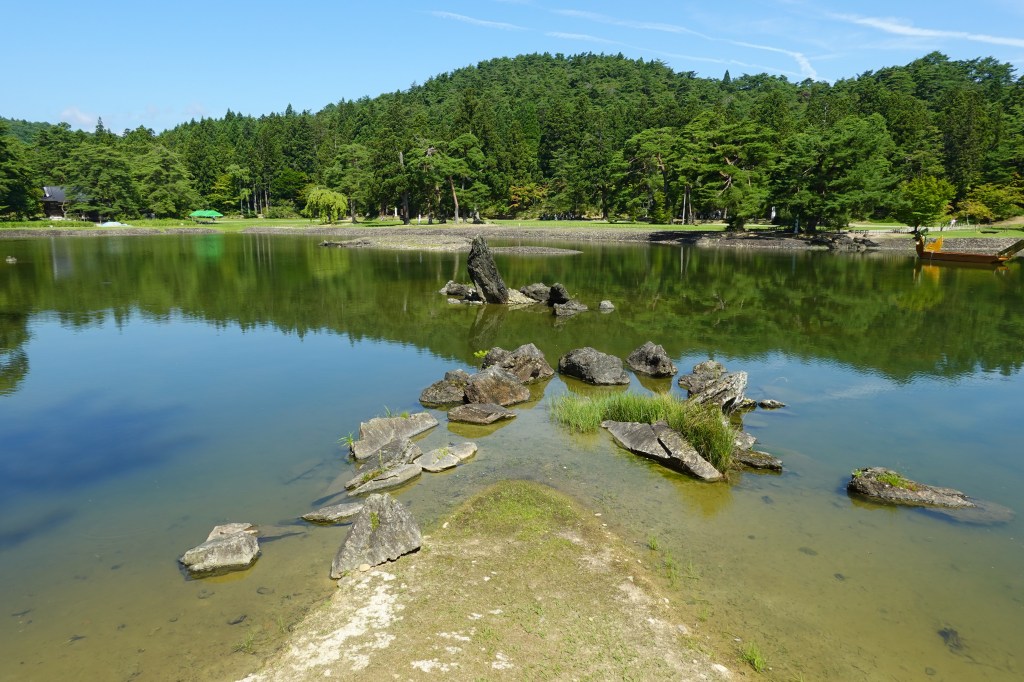
If Chuson-ji shows you the Pure Land in gold, Motsu-ji shows it in water and stone. Its great halls were built by Motohira and completed by Hidehira. They were later lost to fire, but the garden survived. It is laid out around a large pond, Oizumi-ga-ike, whose beaches, peninsulas and rugged rocks are thought to represent a seacoast, following the Sakuteiki, an 11th-century Japanese manual of garden design. The garden is protected as both a Special Historic Site and a Special Place of Scenic Beauty, Japan’s highest ranks in each category. Irises bloom here from late June into early July.
Nearby lie the remains of Muryoko-in, Hidehira’s copy of Byodo-in’s Phoenix Hall, built so that Mount Kinkeisan rose directly behind its Amida hall to the west, the direction of Amida’s paradise. Only foundation stones and the outline of the pond remain.
Practical info: visiting Chuson-ji
- Getting there: Tohoku Shinkansen from Tokyo to Ichinoseki (about 2 hours 20 minutes), then the JR Tohoku Line to Hiraizumi (about 9 minutes). From Hiraizumi Station, take a bus (5 to 10 minutes, including the “Runrun” loop bus) or walk for 20 to 30 minutes. The “Runrun” loop bus runs only on weekends and public holidays from mid-April to late November (in 2026, April 11 to November 29, plus daily from August 13 to 16); on weekdays, take the regular route bus or walk (about 1.6 km), and check the current timetable before you go.
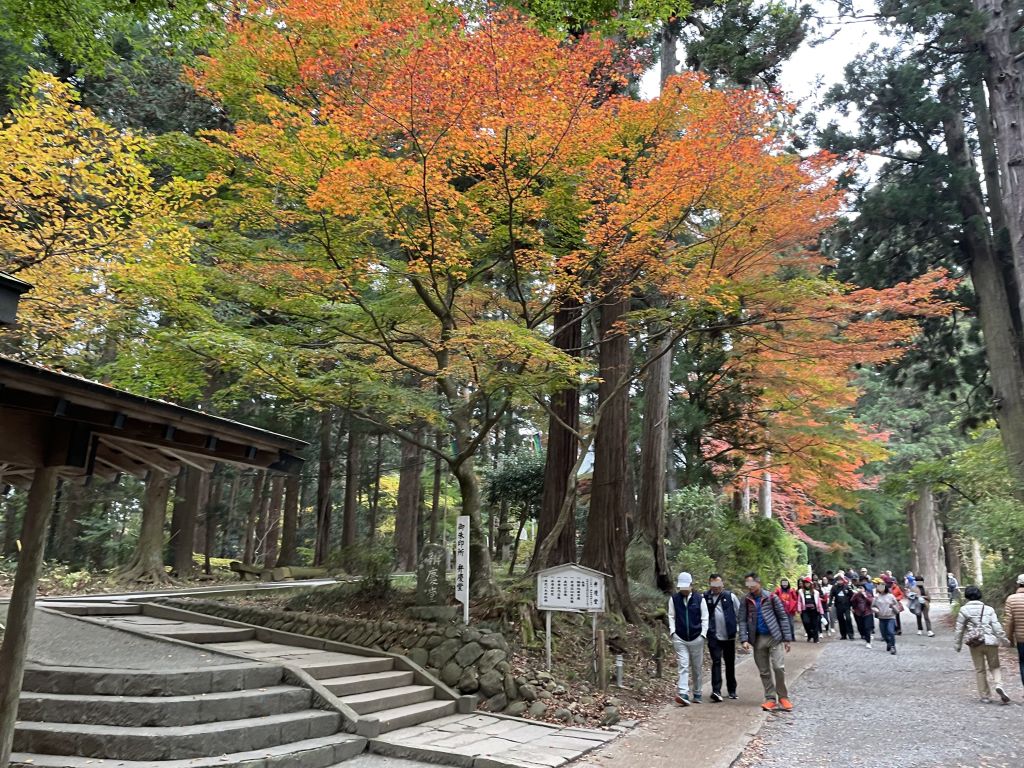
- Tsukimizaka: The main approach, Tsukimizaka (“moon-viewing slope”), climbs from the Chuson-ji bus stop to the Hondo under tall cedars planted by the Date lords of the Sendai domain centuries ago. It is steep in places, so wear good shoes. Visitors with limited mobility can use the parking lot at the top of the slope, about 240 meters from the Hondo.
- Hours: 8:30–17:00 from March 1 to November 3; 8:30–16:30 from November 4 to the end of February. Ticket sales end 10 minutes before closing.
- Admission: The standard ticket (1,000 yen for adults) covers the Konjikido, the Sankozo treasure museum, the Kyozo (sutra repository) and the Old Outer Hall. Prices change, so check the temple’s website.
- Rules: Photography of the Konjikido is not permitted. Keep your voice low: the Golden Hall is a mausoleum as well as a work of art.
- How long: Allow one to two hours for Chuson-ji alone, or most of a day if you add Motsu-ji (adult admission 700 yen), Takadachi and the Muryoko-in remains.
- Best season: Autumn, when the maples along Tsukimizaka and around Motsu-ji’s pond turn red, is especially popular. During the Spring Fujiwara Festival (May 1 to 5), a costumed procession re-enacts Yoshitsune’s arrival in Hiraizumi. Summer brings Motsu-ji’s irises and the Chuson-ji lotus (see Trivia).
Trivia: the lotus that waited 800 years
During the 1950 investigation of the remains, researchers found about 100 lotus seeds in the container that held Yasuhira’s head. Decades later, a former student of the lotus scientist Ichiro Oga managed to grow them. According to the temple, they first flowered in 1998, some eight centuries after the seeds were placed beside the last Fujiwara lord.
The plants are now known as the Chuson-ji lotus, and they bloom each year from mid-July to mid-August. In Buddhism the lotus, rising clean from muddy water, is a symbol of purity and of rebirth in the Pure Land. It is hard to imagine a more fitting flower to bloom again in Hiraizumi.
In closing
It is easy to stand in front of the Konjikido and see only gold. But the hall makes most sense if you remember who built it and why: a survivor of two wars who chose to spend his fortune on a prayer for everyone who had died, friend and enemy, human and animal. His family’s world lasted less than a century and ended in fire. The prayer, in a sense, has lasted nine hundred years.
So walk up Tsukimizaka slowly. If you arrive with Basho’s summer grasses, Yoshitsune’s last refuge and Kiyohira’s dream of a pure land in mind, the small golden room at the top will mean far more than any photograph could.


コメントを残す