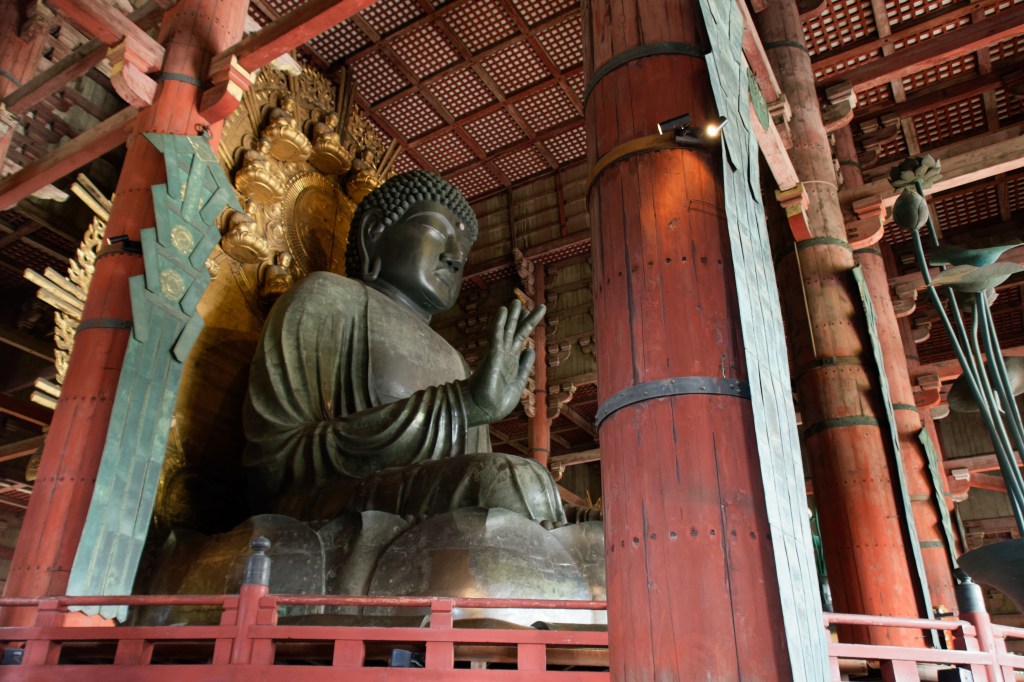
Step into the main hall of a large Japanese temple and you meet a crowd of figures: a serene seated Buddha at the center, slender attendants in jeweled crowns, a snarling fire-wreathed guardian off to one side, and armored warriors crushing demons underfoot. They can look like a bewildering pantheon. In fact they belong to just four families, arranged in a clear order—and once you know the order, you can read almost any statue in Japan at a glance.
This guide explains those four ranks—Nyorai, Bosatsu, Myoo, and Ten—and the visual clues that separate them: dress, hair, expression, the objects in their hands. It is less a catalogue of names than a way of seeing.
In this article
- The four ranks, and the logic behind them
- Nyorai: the awakened Buddha
- Bosatsu: the crowned helper
- Myoo: the wrathful wisdom king
- Ten: guardians borrowed from India
- A quick field guide
- Trivia: the Buddha who kept his crown
The four ranks, and the logic behind them
Japanese Buddhist statues are traditionally sorted into four groups, and the sequence mirrors a spiritual journey. At the top is the Nyorai, a being who has attained full enlightenment—a Buddha. Below is the Bosatsu, or bodhisattva, one who could become a Buddha but stays behind to help others. Then come the Myoo, fierce “wisdom kings” who force the stubborn toward salvation, and finally the Ten, a broad class of guardian gods absorbed from older Indian religion.
The useful part is that each rank dresses the part. Enlightenment means letting go of the world, so a Nyorai wears almost nothing; a Bosatsu, still working within the world, is dressed like a prince; a Myoo shows the world its most frightening face; a Ten wears the armor of a soldier. Nearly everything else—the hair, the pose, the objects held—follows from where a figure sits in this order. Knowing the sect a temple belongs to helps too, since different schools of Japanese Buddhism favor different central images.
Nyorai: the awakened Buddha
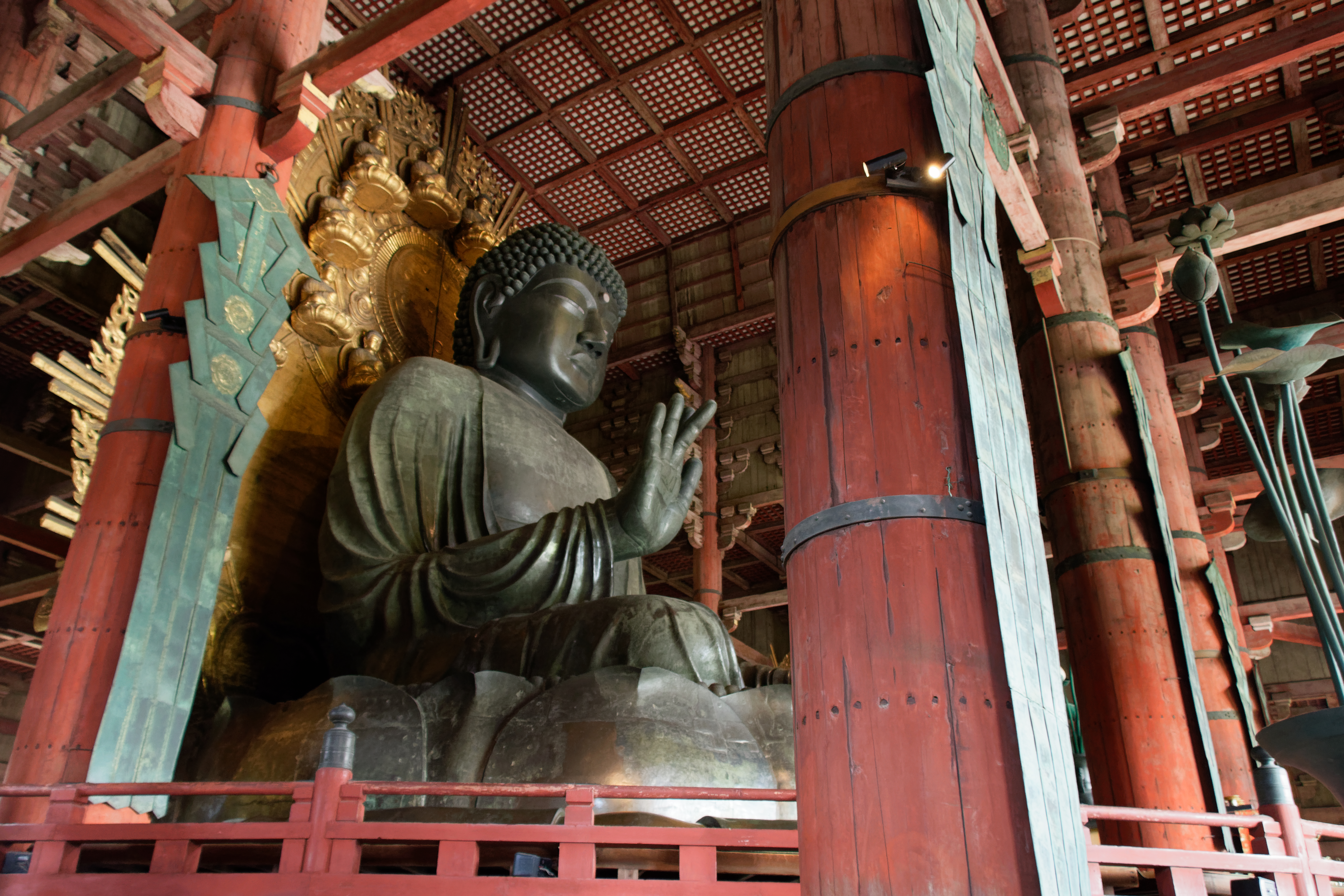
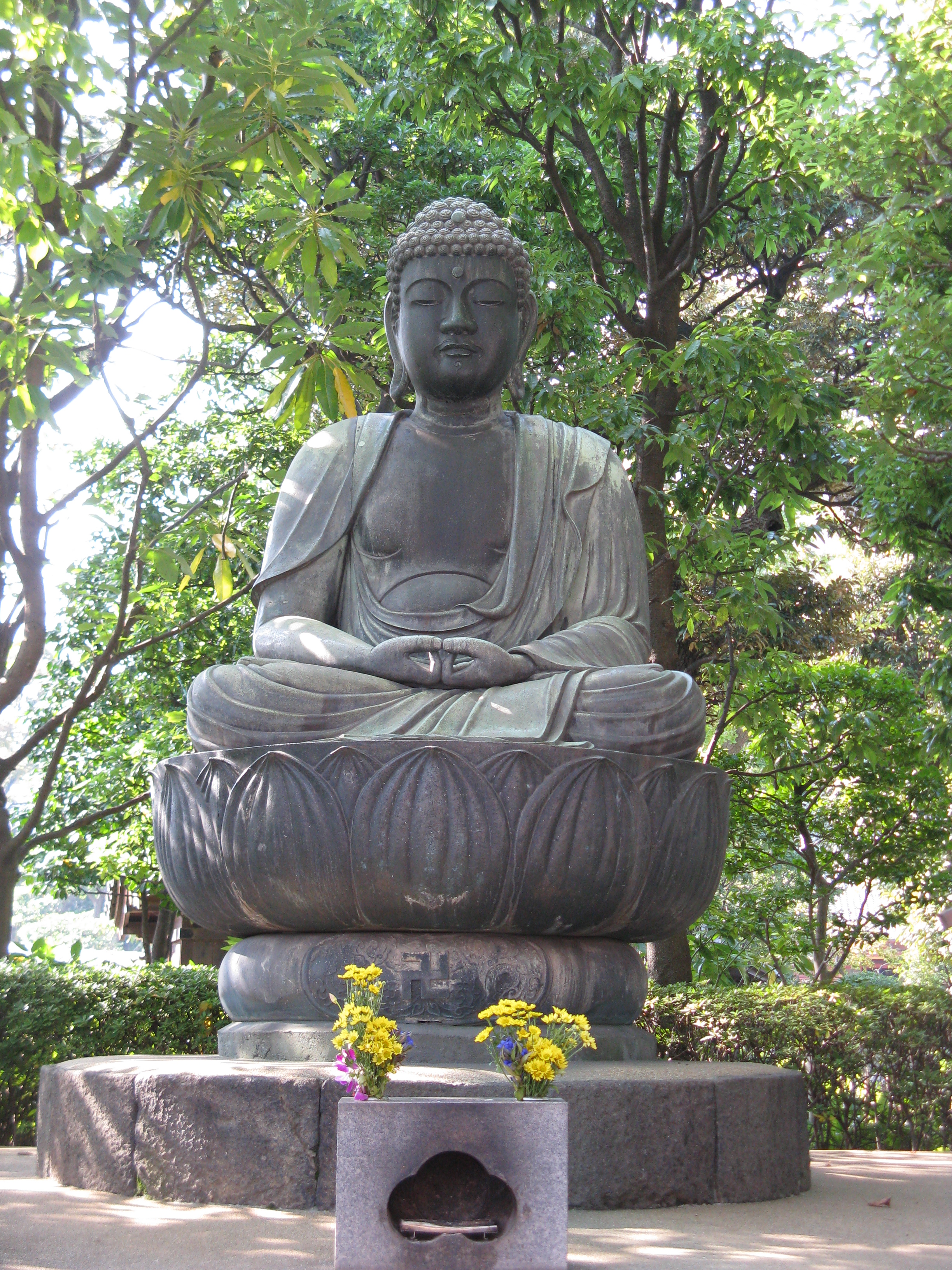
The Nyorai is the simplest to recognize precisely because it is the simplest in appearance. Having renounced all worldly things, a Buddha wears only a plain monastic robe (noe), with no crown, no jewelry, and no ornament. What looks like decoration is actually a set of bodily marks said to distinguish a Buddha: tight snail-shell curls of hair (rahotsu), a raised mound on the crown of the head signifying wisdom (nikkei), and a small curl of white hair between the eyebrows that emits light (byakugo). These are among the traditional “thirty-two marks” of a Buddha.
You tell one Nyorai from another by posture and by what the hands do. Shaka Nyorai, the historical Buddha Shakyamuni, is the plainest of all. Amida Nyorai, the Buddha of the Pure Land who welcomes souls after death, characteristically holds his hands so that thumb and fingertip meet in a ring. Yakushi Nyorai, the Buddha of healing, is the easy one: he cradles a small medicine jar in his left hand. The colossal bronze Buddha at Todai-ji in Nara is a Nyorai of cosmic scale—Vairocana, the Buddha from whom all others radiate.
There is one famous exception, and it is worth holding in mind: Dainichi Nyorai, the supreme cosmic Buddha of esoteric Buddhism, breaks the rule by wearing a crown and jewelry like a bodhisattva. We will return to why at the end.
Bosatsu: the crowned helper
A Bosatsu, or bodhisattva, has vowed to postpone final Buddhahood in order to save others, and remains active in the world—so it is shown in the world’s finery. The model is the historical Buddha as a young prince, before he renounced his palace. Look for a jeweled crown (hokan), strings of necklaces and ornaments (yoraku), long celestial scarves (ten’e), and a skirt-like lower garment. Where a Nyorai is bare, a Bosatsu glitters.
The most beloved is Kannon, the bodhisattva of compassion, who is said to take thirty-three different forms to reach those in need—among them the eleven-headed Kannon and the thousand-armed Kannon. A reliable tell is a tiny seated Buddha (kebutsu) set into Kannon’s crown. Kannon is the central image at Senso-ji in Asakusa and at countless temples along Japan’s pilgrimage routes. Other major bodhisattvas include Miroku, the Buddha of the future, often shown in a gently pensive pose with one leg crossed and a fingertip near the cheek; Monju, the bodhisattva of wisdom, who rides a lion and carries a sword; and Fugen, who rides a white elephant.
The exception here is one you will meet everywhere: Jizo, the protector of travelers and of children, who—though a bodhisattva—appears as a plain, shaven-headed monk holding a ringed staff (shakujo) and a wish-granting jewel. The small stone Jizo figures in red bibs along roadsides and in cemeteries are the same rank as the crowned Kannon; only the guise is humble.
Myoo: the wrathful wisdom king
The Myoo, or “wisdom kings,” arrived with esoteric Buddhism—the Shingon and Tendai traditions—and they look nothing like the calm figures above. Their faces are contorted in wrath (funnuso), often with bared fangs; their hair may stand on end or rise in flames; and they are typically backed by a halo of fire (kaen-kohai) and armed with weapons. The anger is not cruelty. It is the force needed to cut through delusion and to frighten toward salvation those who will not be gently persuaded.
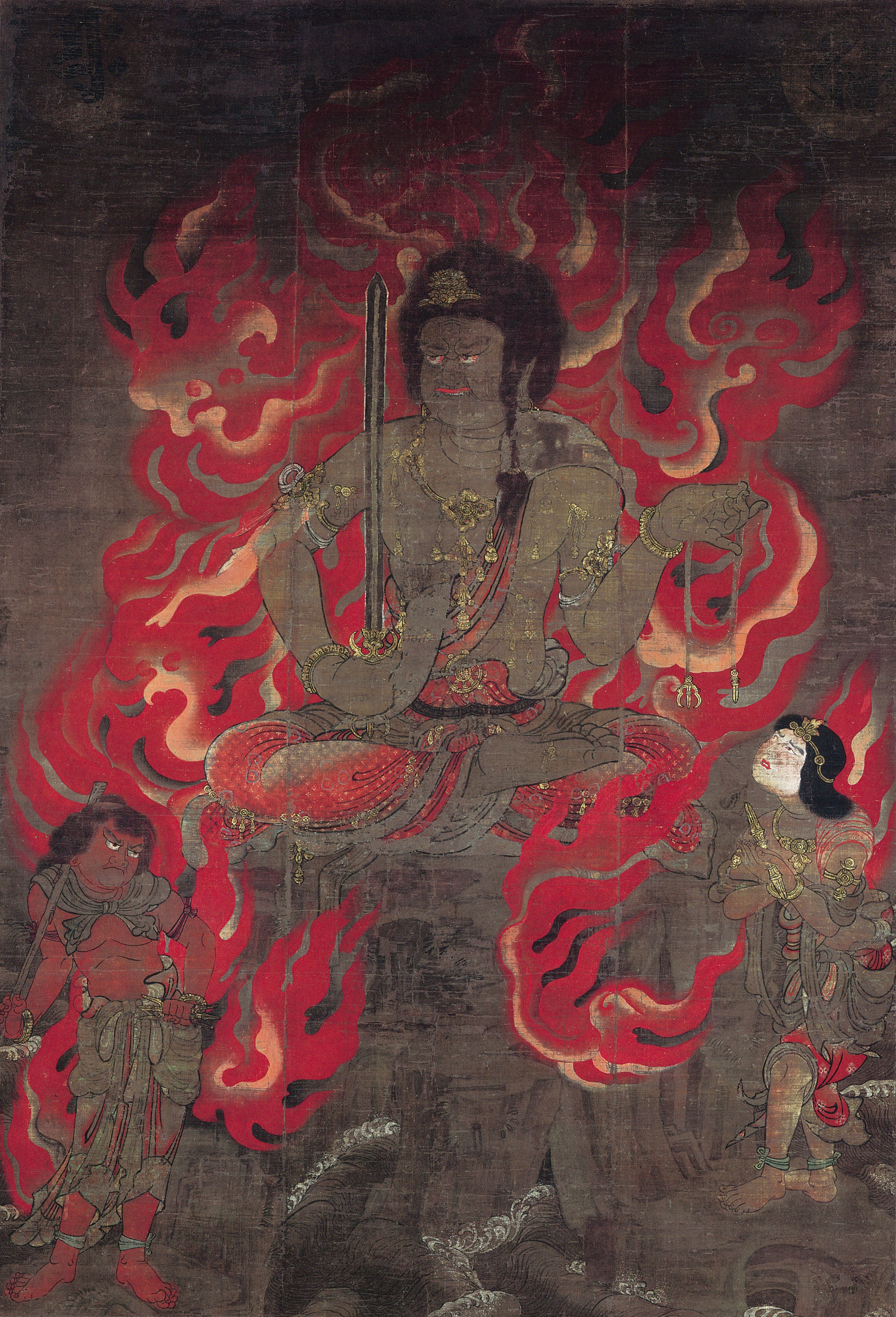
By far the most common is Fudo Myoo (Acala, “the Immovable”), understood as a fierce emanation of Dainichi Nyorai himself. He holds an upright sword in his right hand to cut ignorance and a coiled rope (kensaku) in his left to bind and haul back the wayward, and he sits amid flames on a rough rock, glaring, one fang pointing up and one down. Fudo is a favorite of mountain ascetics and a fixture of Shingon temples such as those on Mount Koya. Where you see fire and fury, you are almost always looking at a Myoo.
Ten: guardians borrowed from India
The Ten, or Tenbu, are the most varied group of all, because they were not originally Buddhist at all. They are the gods of ancient India—deva—absorbed into the Buddhist order as protectors, which is why the same category can hold armored generals, muscular strongmen, and graceful goddesses. Their shared role is to guard the Buddhist world rather than to be its central object of worship.
The classic examples are warriors. The Shitenno, or Four Heavenly Kings, stand guard at the four corners of an altar in armor, brandishing weapons and trampling small demons (jaki) underfoot. When the northern king of that group, Tamonten, is worshipped on his own he is called Bishamonten and holds a miniature pagoda. At many temple gates you meet the Nio (also called Kongo Rikishi), a pair of bare-chested, heavily muscled guardians—one with mouth open, one closed—whose most celebrated example flanks the Great South Gate of Todai-ji. Gentler members of the class include Benzaiten, a goddess of music and eloquence who carries a lute, derived from the Indian river goddess Saraswati.
A quick field guide
When you stand before an unfamiliar figure, run through five quick questions and the rank usually reveals itself:
- What is it wearing? A plain robe with no ornament means a Nyorai; a crown and jewelry mean a Bosatsu; armor means a Ten.
- What is its face doing? Serene points to a Nyorai or Bosatsu; a snarling, fanged glare points to a Myoo; a stern, alert scowl points to a guardian Ten.
- Is there fire? A halo of flames almost always means a Myoo.
- What is in the hands? A medicine jar suggests Yakushi Nyorai; a lotus or a crown-Buddha suggests Kannon; a sword and rope suggest Fudo Myoo; a monk’s staff suggests Jizo; a pagoda suggests Bishamonten.
- What is it standing or sitting on? A lotus pedestal suits a Nyorai or Bosatsu; a jagged rock suits Fudo; a trampled demon marks a guardian Ten.
Two honest cautions. Remember the exceptions—crowned Dainichi Nyorai and monk-like Jizo Bosatsu—which deliberately dress against their rank. And note that a central Buddha is often flanked by two attendants (kyoji): Amida with Kannon and Seishi, or Shaka with Monju and Fugen. Reading the trio together often confirms who the main figure is.
Trivia: the Buddha who kept his crown
Why does Dainichi Nyorai—a fully enlightened Buddha—wear the crown and jewels of a bodhisattva, breaking the very rule that makes Nyorai easy to spot? Because in esoteric Buddhism Dainichi (Mahavairocana) is not one Buddha among many but the cosmic ground of all reality itself, the source from which every other Buddha, bodhisattva, and even the wrathful Fudo Myoo emanates. Ordinary Buddhas shed the world’s ornaments to show they have transcended it; Dainichi wears them to show that the entire adorned universe is his body. The exception, in other words, is the deepest expression of the rule—a reminder that in Japanese Buddhist art, how a figure is dressed is always an argument about what it is.
In closing
The next time a temple hall confronts you with a room full of gilded figures, you need not know every name to understand what you are seeing. Read the dress, the face, the hands, and the seat, and the four ranks fall into place: the still Buddha who has arrived, the jeweled helper who stays behind, the burning king who compels, and the armored guardian at the door. The statues were made to be read this way—each one a sermon in wood and bronze for worshippers who could not read a word of scripture.
Visiting a shrine instead? Our companion guide, How to Read a Japanese Shrine, does the same for torii, komainu, shimenawa and the hidden main hall.


コメントを残す