Most of Japan’s great temples belong to a single school of Buddhism, and most keep their most sacred image on view for worshippers to see. Zenkō-ji (善光寺) in Nagano does neither. It has stood for roughly fourteen centuries without ever choosing a sect, and its principal image has never once been shown — not to pilgrims, not to emperors, not even to the priests who serve it. For that reason it has drawn believers of every persuasion from across Japan, immortalized in the old saying that everyone, sooner or later, ends up making the journey to Zenkō-ji.
This article looks past the crowds on the temple approach to the things that make Zenkō-ji genuinely unusual: an image so hidden it is called an absolute hidden Buddha, a pitch-black tunnel where pilgrims grope for the key to paradise, a ceremony held only about once every six years, and a history of welcoming women and outsiders at a time when many sacred places shut them out. Along the way we will flag the places where legend and documented history part company — because at Zenkō-ji, they often do.
In this article
- A temple that belongs to no one school
- The founding legend and its hidden Buddha
- The absolute hidden Buddha
- Two ways pilgrims reach the sacred
- The main hall: a giant in wood
- A temple open to women
- Visiting Zenkō-ji
- In closing
- Trivia: led to the temple by an ox
A temple that belongs to no one school
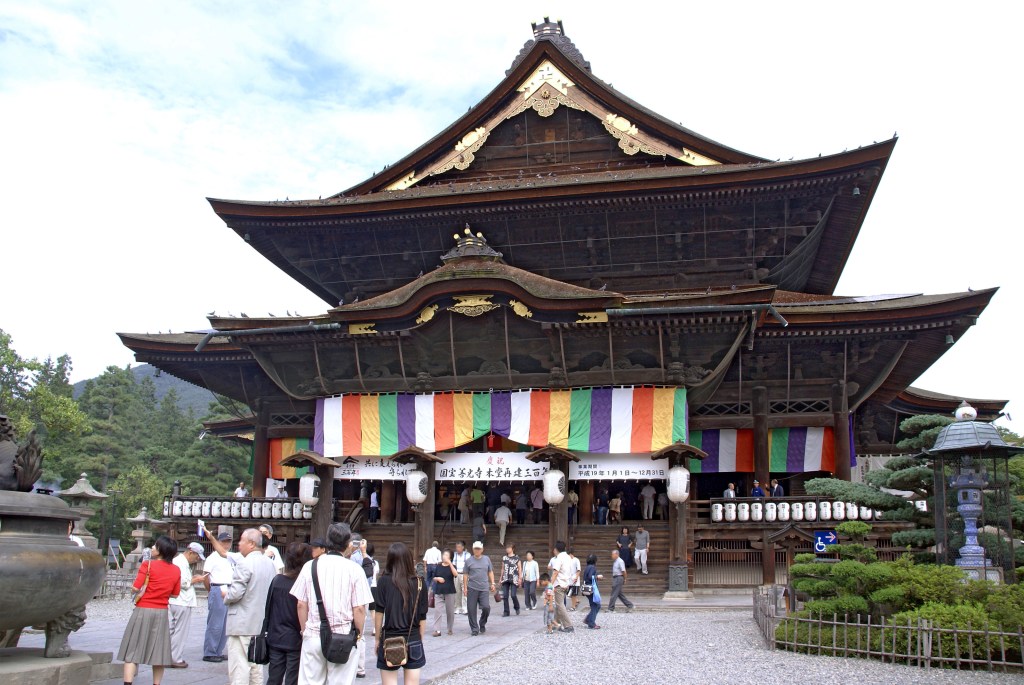
Zenkō-ji sits in the heart of the city of Nagano, at the end of a long approach lined with shops and lodging temples. It is one of the most visited temples in Japan, and unusually for such a famous site, it is non-sectarian (無宗派, mushū) — it does not belong to any one branch of Japanese Buddhism.
The reason is chronological. Zenkō-ji’s origins are traced to the seventh century, long before the schools that dominate Japanese Buddhism today had taken their familiar shape — before the Tendai and Pure Land (Jōdo) traditions had fully separated into the distinct sects we know now. Because the temple predates those divisions, it was never absorbed into any of them. Instead, it came to be administered jointly by two institutions of different schools: Daikanjin (大勧進), a temple of the Tendai school, and Daihongan (大本願), a convent of the Jōdo (Pure Land) school headed by a woman. To this day the two share responsibility for Zenkō-ji, and the daily morning service is led in turn by clergy from each. A pilgrim praying before the main altar is, in effect, worshipping in two traditions at once.
That arrangement is not a modern compromise but the practical shape of a much older idea: that Zenkō-ji belongs to all believers rather than to any single institution. It helps explain why the temple became a national pilgrimage destination drawing people who would never have agreed on much else.
The founding legend and its hidden Buddha
The temple’s story begins not with a building but with a statue. According to tradition, the image at the heart of Zenkō-ji is the very first Buddhist icon ever brought to Japan — a small gilt-bronze triad sent from the Korean kingdom of Baekje to the Japanese court along with the official introduction of Buddhism. Japanese sources traditionally date that introduction to either 552 or 538; the two dates come from different early chronicles, and historians still treat the question as unsettled, so it is fair to call it disputed rather than fixed.
What is not in doubt is that Buddhism’s arrival provoked a bitter power struggle at court between families who embraced the foreign religion and those who saw it as an insult to the native kami (gods). Legend holds that during one anti-Buddhist backlash the new image was thrown into a canal at Naniwa (modern Osaka). There, the story goes, it was recovered by a man named Honda Yoshimitsu (本田善光), who carried it home to the Shinano region. The temple takes its name from him: read with different characters, “Yoshimitsu” can be pronounced Zenkō, giving Zenkō-ji — “Yoshimitsu’s temple.” Traditional accounts place the image’s arrival in Shinano around 642 and the founding of the temple halls around 644.
This is a founding legend, not a documented chronicle, and the writer’s duty is to say so plainly: the earliest records of the temple come well after the events they describe, and the tale of the statue’s rescue belongs to the world of sacred story. What the legend reliably conveys is how Zenkō-ji understood itself — as the guardian of Japan’s oldest Buddhist image, entrusted to an ordinary layman rather than to a powerful monastery, and open from the start to common people.
The absolute hidden Buddha
The image at the center of all this is the Ikkō Sanzon Amida Nyorai (一光三尊阿弥陀如来): a triad of the Buddha Amida flanked by two attendant bodhisattvas, all sharing a single halo — that is what ikkō sanzon, “one light, three honored ones,” means. Amida is the Buddha of the Western Pure Land, and devotion to him is at the core of Zenkō-ji worship.
Many Japanese temples keep a hibutsu (秘仏), a “hidden Buddha” revealed only on rare occasions. Zenkō-ji goes further. Its principal image is a zettai-hibutsu (絶対秘仏), an absolute hidden Buddha, which by rule is never shown to anyone at all — not to the public, not to the emperor, not even to the head priests of the temple that houses it. No one living has verified what stands inside the innermost sanctuary. So complete is this concealment that, during the Edo period, the shogunate is said to have ordered an official inspection simply to confirm that the image existed; a monk reported back on its dimensions, but the statue itself is said to have remained wrapped and unseen.
This is worth pausing on, because it inverts what most visitors expect from a temple. Elsewhere, the sacred object is something you go to see. At Zenkō-ji, the sacred object is defined precisely by the fact that you cannot. Faith here is not a matter of looking but of trusting in a presence you take on the temple’s word.
Two ways pilgrims reach the sacred
If the true image can never be seen, how does a pilgrim make contact with it? Zenkō-ji answers with two remarkable practices — one available every day, the other only once in several years.
The Okaidan-meguri: feeling for the key to paradise
Beneath the main altar runs the Okaidan-meguri (お戒壇めぐり), a narrow passage in total darkness. Pilgrims descend a staircase and edge along the pitch-black corridor with one hand on the wall, unable to see anything at all. Somewhere along the way, fixed to the wall directly below the hidden Buddha, hangs a metal fitting often called the “key to the Pure Land” (極楽の錠前, gokuraku no jōmae). To touch it in the darkness is said to form a direct bond with Amida and to secure one’s rebirth in the Pure Land.
The experience is deliberately disorienting. Stripped of sight, the pilgrim is meant to rely on faith and touch rather than vision — a physical enactment of the same lesson the hidden Buddha teaches. Reaching the key, unseen beneath an image that is itself unseen, is as close as anyone comes to the heart of Zenkō-ji.
The Gokaichō: the substitute Buddha and the sacred post
Because the true image stays hidden, the temple periodically displays a stand-in. This is the Gokaichō (御開帳), held in spring roughly once every six years — “once every seven years” by the traditional Japanese way of counting inclusive years. For a period of about two months, a substitute image known as the maedachi honzon (前立本尊), a duplicate made to represent the sealed original, is brought out for public veneration. It is the only Buddha at Zenkō-ji that pilgrims are ever permitted to see.
At the center of the ceremony stands a tall wooden post in the temple forecourt, the ekō-bashira (回向柱), rising roughly ten meters. A cord runs from the post to the hands of the displayed image, so that a pilgrim who touches the post is understood to be touching the Buddha itself, at one remove. During a Gokaichō the forecourt fills with people waiting to lay a hand on the pillar. The most recent Gokaichō ran in 2022 (extended because of the pandemic), and the next is scheduled for April 4 to June 19, 2027.
The main hall: a giant in wood
The building that shelters all of this is the Hondō (本堂), or main hall — itself one of the reasons Zenkō-ji matters. The present structure was completed in 1707, after fire destroyed earlier halls (the temple burned and was rebuilt many times over the centuries). It is designated a National Treasure, the highest rank of protection for a cultural property in Japan, and it ranks among the largest wooden buildings in eastern Japan, measuring roughly 24 meters wide, 54 meters deep and 26 meters tall.
Its most distinctive feature is its plan. Rather than a simple rectangle, the hall joins its inner Buddha sanctuary to the worship hall in a T shape, a layout called shumoku-zukuri (撐木造) after the T-shaped wooden mallet used to strike a temple bell. The roof is finished in hiwada-buki, layered strips of cypress bark rather than tiles, a labor-intensive technique reserved for the most important buildings. Approaching along the main path, a visitor passes first through the great Sanmon (山門) gate and, before it, the Niōmon (仁王門) guardian gate, so that the enormous hall reveals itself only gradually.
A temple open to women
One further point sets Zenkō-ji apart. For much of Japanese history, many of the country’s holiest sites were governed by nyonin kinsei (女人禁制), a religious prohibition that barred women from entering sacred ground — the monastic complex of Kōyasan, among others, kept women out until 1872. Zenkō-ji, by long tradition, did not. It welcomed women as pilgrims when many mountains would not admit them, and the fact that one of its two governing institutions, Daihongan, has always been led by a woman underscored that openness.
For female pilgrims in earlier centuries, this made Zenkō-ji one of the few major destinations they could reach on equal terms — a practical reason, beyond the famous hidden Buddha, why the temple drew such devotion from across the whole of society.
Visiting Zenkō-ji
Zenkō-ji is an easy walk or short bus ride from Nagano Station, which is reached from Tokyo in under two hours by Hokuriku Shinkansen. The temple grounds are open and free to enter; a combined ticket covers the inner sanctuary, the Okaidan-meguri passage and the temple’s museum. A few things reward a slower visit:
- Arrive early for the morning service (o-asaji), held daily at dawn, when the two head priests process to the hall and passing pilgrims kneel to receive a blessing with their prayer beads.
- Do the Okaidan-meguri, but go in expecting genuine darkness; keep your right hand on the wall and move slowly.
- Look for the Binzuru statue at the front of the hall — a worn wooden figure of one of the Buddha’s disciples, which visitors rub in the place where they are ailing in hope of healing.
- Walk the approach (omotesandō), lined with lodging sub-temples and old shops selling oyaki, the grilled Nagano dumplings, on the way to the gate.
If your trip can be timed to it, the 2027 Gokaichō will be the temple at its most alive — though also its most crowded.
In closing
Zenkō-ji rewards a certain patience. Its greatest treasure cannot be seen, its central rite is performed in the dark, and its most public ceremony comes only once in several years. Yet these are not obstacles laid in the visitor’s path so much as the temple’s argument made physical: that the sacred is a matter of trust rather than sight, and that it belongs to everyone equally — whatever their sect, their standing, or, in an age that often forgot it, their gender. Fourteen centuries of pilgrims have found that argument worth the journey.
Trivia: led to the temple by an ox
Zenkō-ji gave Japanese a proverb still in use today: “Ushi ni hikarete Zenkō-ji mairi” (牛に引かれて善光寺参り) — “making the Zenkō-ji pilgrimage led by an ox.” The legend behind it tells of an irreligious old woman who was drying a length of cloth outside when a passing ox caught the cloth on its horn and ran off. Chasing the animal in a fury, she followed it all the way to Zenkō-ji, where night fell and she found herself, almost against her will, drawn into faith. The phrase survives as an everyday saying for being led to something good by an unexpected accident — a small, wry monument to a temple that always held its doors open to whoever happened to arrive.
Related reading
- Byōdō-in: The Phoenix Hall on Japan’s 10-Yen Coin — another great temple of Amida and the Pure Land.
- Japanese Buddhist Schools: Zen, Pure Land, Shingon and Beyond — the Tendai and Jōdo traditions that jointly run Zenkō-ji, explained.
- Koyasan: Mount Koya and the Saint Who Never Died — a sacred mountain that, unlike Zenkō-ji, long barred women from its slopes.


コメントを残す