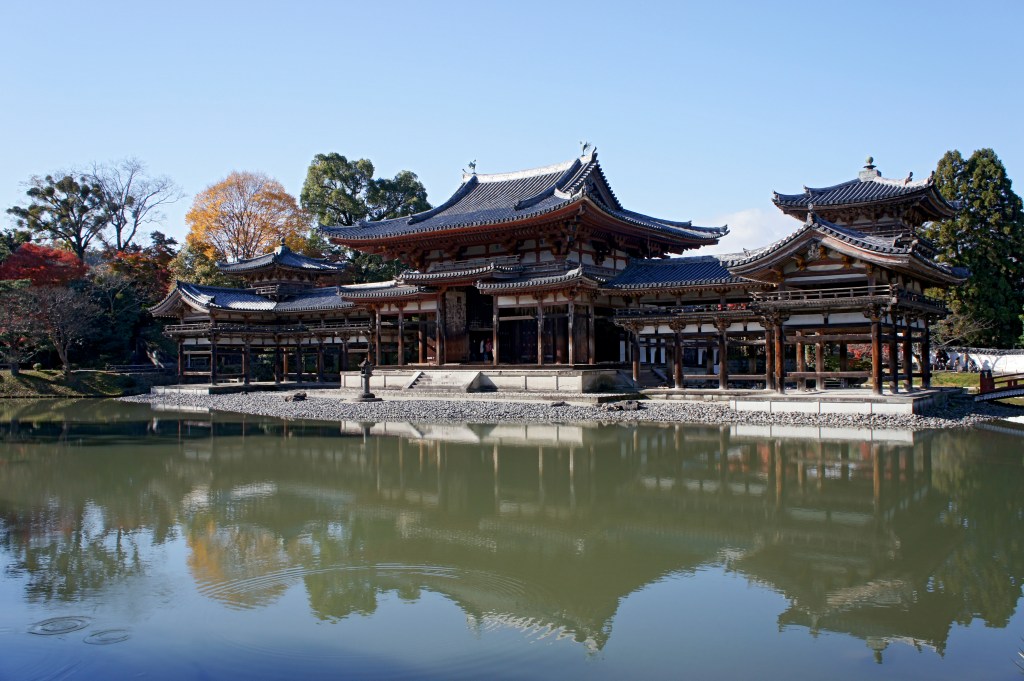
Almost every person in Japan has held a picture of Byōdō-in in their hand, whether or not they know its name. The graceful hall stamped on the ten-yen coin is the Phoenix Hall of this temple in Uji, just south of Kyoto—and the phoenix on the ten-thousand-yen banknote is one of the two birds perched on its roof. Nearly a thousand years ago, at a moment when many believed the world was entering its final, degenerate age, the most powerful family in Japan tried to build paradise where they could see it. The result still stands, reflected in its pond, largely as it was in 1053.
This guide explains why Byōdō-in was built for the “end of the world,” how its hall was designed to look like the Buddhist heaven, and why the Buddha inside it changed the course of Japanese sculpture.
In this article
- A temple you already know
- Built for the end of the world
- Paradise made visible
- Jōchō’s Amida and a revolution in wood
- The hall that survived
- Visiting
- Trivia: the temple on two kinds of money
A temple you already know
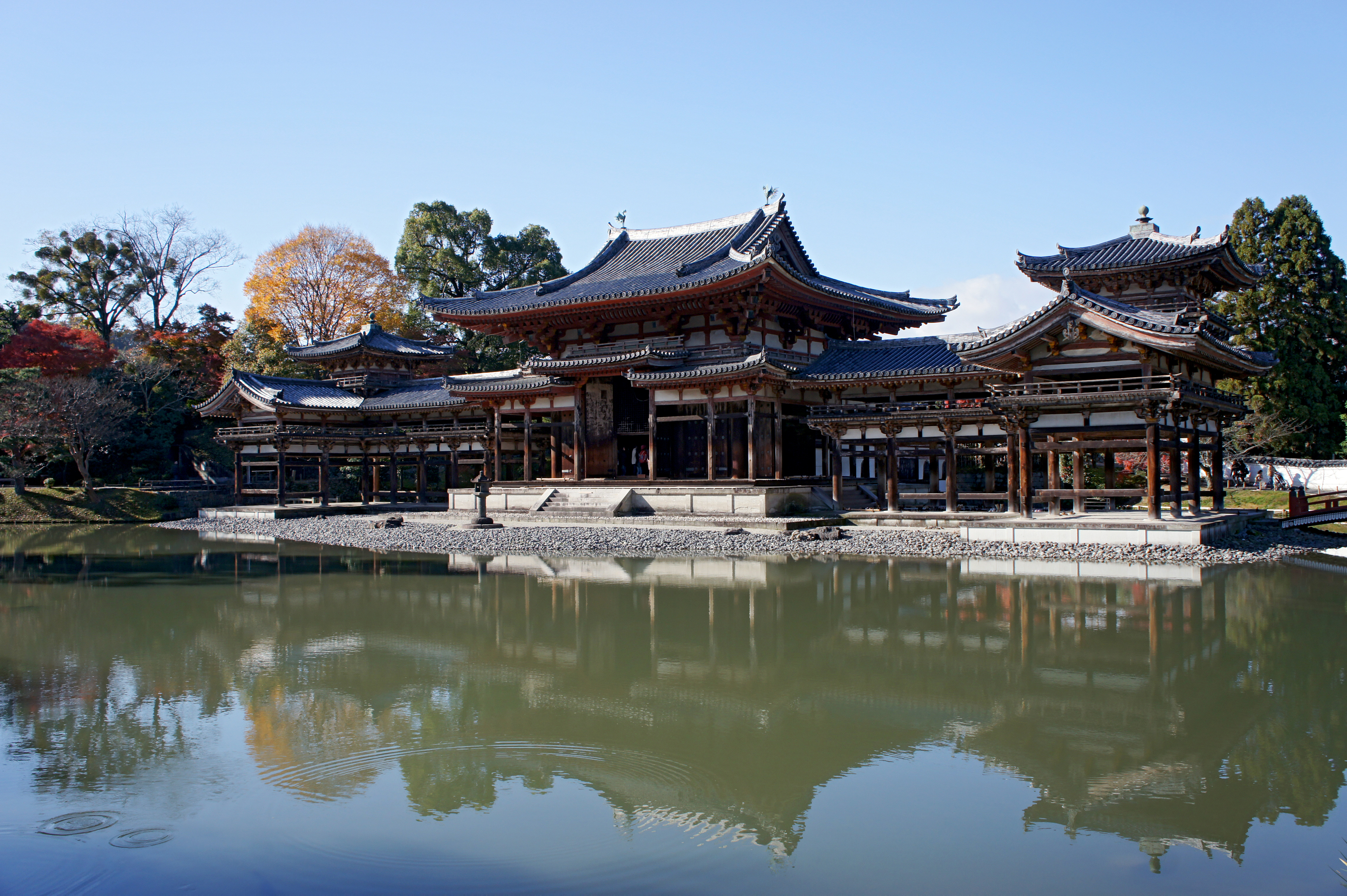
Byōdō-in (平等院) sits on the bank of the Uji River in the town of Uji, a half-hour south of Kyoto famous for its green tea. Its centerpiece, the Phoenix Hall, is one of the most recognized buildings in the country precisely because it is money: the reverse of the ten-yen coin has shown it since 1951, so it passes through hundreds of millions of hands. Understanding what that hall actually is turns a coin you have ignored your whole life into a small window onto the medieval Japanese idea of heaven.
Built for the end of the world
The land began as an aristocrat’s country villa and passed to Fujiwara no Michinaga, the towering statesman whose family effectively ruled Heian Japan. In 1052 his son, the regent Fujiwara no Yorimichi, converted the villa into a temple and named it Byōdō-in. The date was not incidental. By a widely held reckoning, 1052 was the first year of mappō (末法), the “Latter Day of the Law”—a prophesied age in which the world would decay and enlightenment through one’s own effort would become impossible.
That anxiety gave enormous force to Pure Land (Jōdo) Buddhism, which taught that one could still be saved by relying on Amida Buddha, who vowed to welcome the faithful into his Western Paradise after death. The idea had been spread influentially by the monk Genshin of Mount Hiei, and it would later flower into the great Pure Land schools mapped in our guide to the schools of Japanese Buddhism. For an aristocrat facing the end of the age, the logical thing to build was not a monastery but a glimpse of paradise itself.
Paradise made visible
That is exactly what the Phoenix Hall (Hōō-dō, 鳳凰堂), completed in 1053, was meant to be. Set on a small island in a pond, it has a central hall flanked by two symmetrical wing corridors and a tail corridor behind, so that the whole building seems to spread like a bird about to take flight—or like the mythical phoenix, two gilded statues of which stand on the rooftop. Its reflection doubles it in the still water. To a Heian worshipper standing on the far bank, the hall was not merely a picture of Amida’s Western Paradise; it was that paradise, made briefly visible on earth.
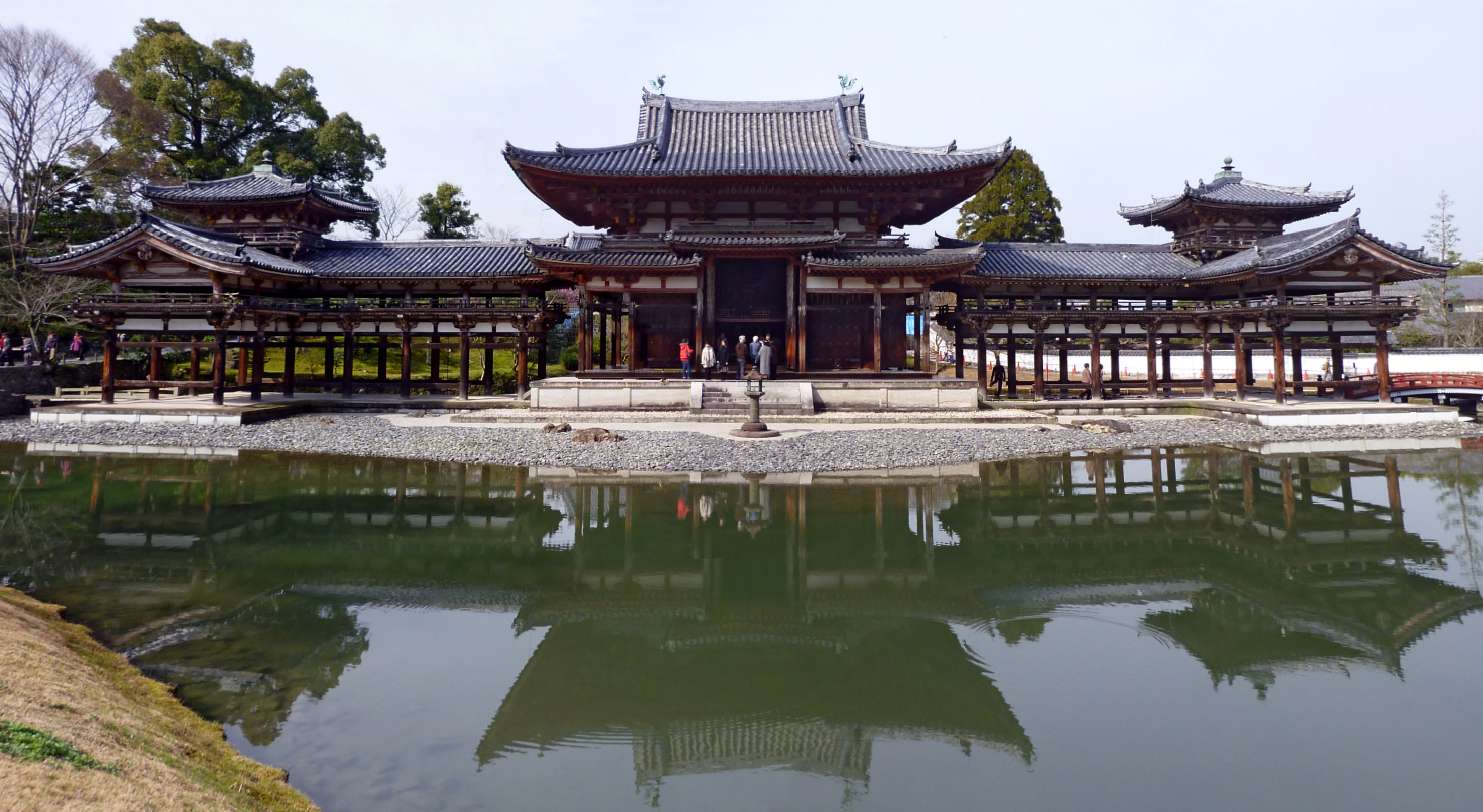
The interior deepened the vision. The great doors and walls were painted with raigō scenes—Amida and his host of bodhisattvas descending on clouds to carry a dying believer to the Pure Land—among the earliest masterpieces of native Japanese yamato-e painting. High on the walls float fifty-two small wooden bodhisattvas seated and dancing on clouds, the Unchū Kuyō Bosatsu, playing instruments as if the air itself were full of celestial music.
Jōchō’s Amida and a revolution in wood
At the center sits the reason the hall exists: a great gilded image of Amida Nyorai, about three meters tall, carved by Jōchō (定朝), the most celebrated sculptor of the age. It is his only securely documented surviving work, and a designated National Treasure. (For how to recognize an Amida and the other ranks of Buddhist figures, see our guide to identifying Buddhist statues.)
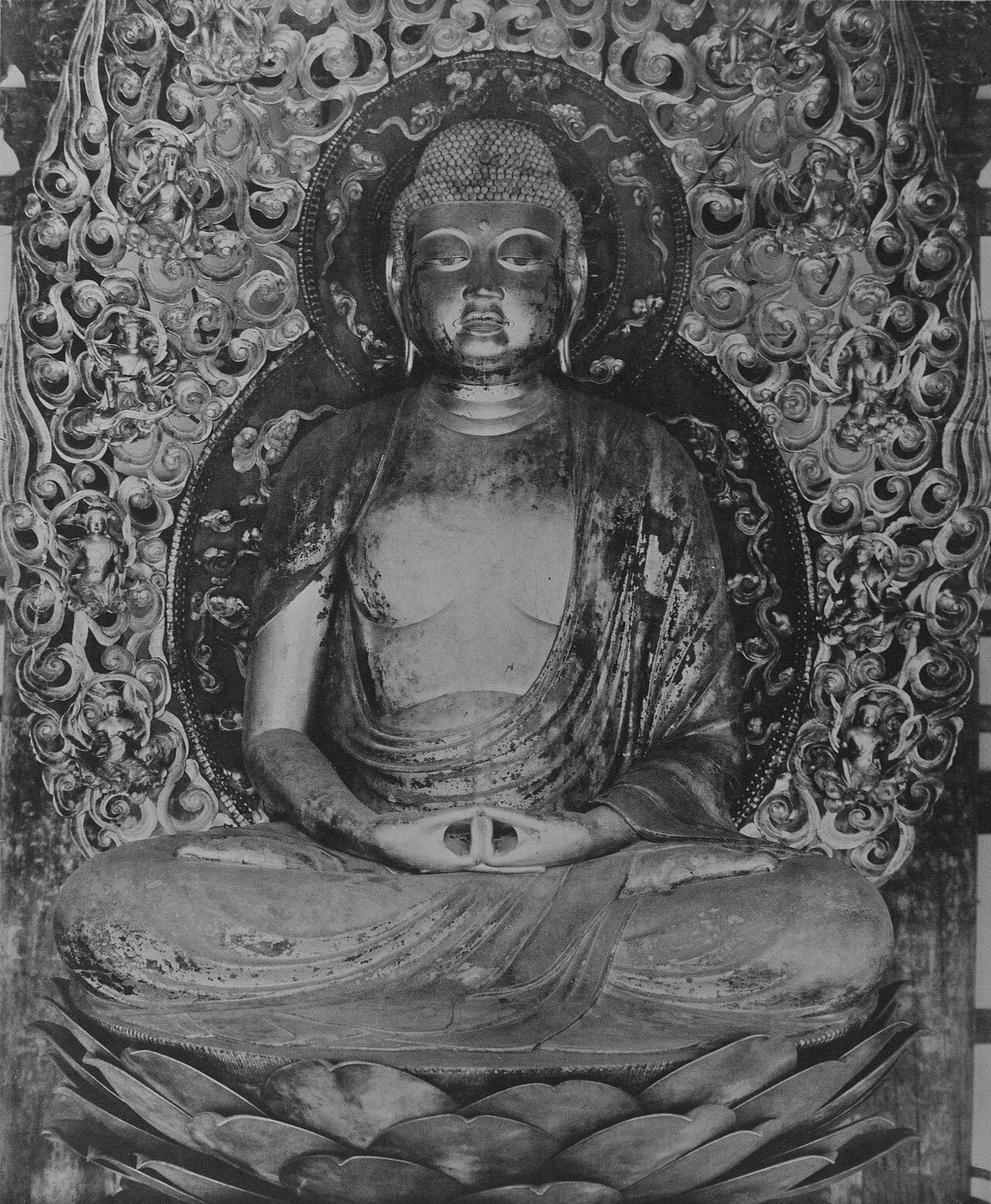
Its importance is not only devotional but technical. Jōchō perfected yosegi-zukuri (寄木造), the “joined-woodblock” method, in which a statue is built up from many separate blocks of wood, each hollowed out and fitted together, rather than carved from a single trunk. The technique let workshops produce large, light, crack-resistant images quickly and in teams—and it made possible the serene, balanced, softly rounded “Jōchō style” that became the model for Japanese Buddhist sculpture for generations afterward. The Amida of Byōdō-in is, in effect, the fountainhead of a whole tradition.
The hall that survived
What makes Byōdō-in extraordinary among Japanese temples is simply that it is still here. Most of the great Heian-period halls were lost long ago to fire and war; Byōdō-in’s other buildings burned in a civil-war conflict in the fourteenth century. But the Phoenix Hall itself came through, and it remains an original structure of 1053—one of the very few genuine Heian buildings left standing. The hall and its Amida were designated National Treasures in 1951, and in 1994 Byōdō-in was inscribed on the UNESCO World Heritage list as one of the Historic Monuments of Ancient Kyoto. When you look at it, you are looking at the actual object a Fujiwara regent gazed upon nearly a thousand years ago.
Visiting
Byōdō-in is an easy day trip from Kyoto or Nara, reached by train to Uji, a town equally famous as the historic home of Japanese green tea and as the setting of the final chapters of The Tale of Genji. General admission covers the garden and the grounds, with the Phoenix Hall’s exterior and pond reflection as the highlight; entry into the hall to see the Amida up close is a separate timed ticket with limited numbers, so it is worth arriving early. The modern Hōshōkan museum on site displays the original roof phoenixes, a temple bell, and some of the cloud bodhisattvas in climate-controlled conditions. Spring wisteria and autumn colors are the busiest and most beautiful seasons.
Trivia: the temple on two kinds of money
Byōdō-in may be the only place in Japan that appears on two different pieces of the nation’s currency at the same time. The Phoenix Hall is engraved on the ten-yen coin, while a phoenix modeled on the pair perched on that very roof spreads its wings on the ten-thousand-yen banknote—the lowest-value coin in common use and the highest-value note, linked by a single temple. Next time you get change in Japan, look at the little building on the copper coin: it is a nine-hundred-year-old vision of heaven, hiding in your pocket.
In closing
Byōdō-in rewards the visitor who sees past the postcard. Built at the dreaded dawn of the Latter Day of the Law, it is a Heian aristocrat’s attempt to make the unreachable Pure Land tangible: a phoenix-shaped hall mirrored in water, a Buddha who defined how Japan would carve the divine, and paradise offered to anyone standing on the near shore. That it has survived, almost intact, to circulate on the coins in our pockets is its final quiet miracle.


コメントを残す