Most sacred places in Japan are a building: a hall, a gate, a single great statue. Koyasan is a whole town, sitting in a bowl of forested peaks, that has been given over entirely to one purpose for more than twelve hundred years. Some 800 metres up and long walled off by forest, more than a hundred temples share the mountaintop with shops, a post office, and schools, and at its far end lies a cemetery so vast and so old that generals who spent their lives trying to kill one another now lie a short walk apart, among cedars the width of a car.
At the heart of it is a claim that Koyasan has never given up: that the monk who founded the mountain, Kūkai, did not die here in the year 835 but entered an endless meditation, and that he is still present, still waiting, behind the doors of his mausoleum. This article looks at where that idea came from — the man, the strange new form of Buddhism he carried back from China, the mandala he built out of a pagoda, and why, twice a day, monks still carry a hot meal to a man who has been “away” for nearly 1,200 years.
In this article
- A monastery the size of a town
- The monk who brought esoteric Buddhism home
- What makes Shingon different
- Danjo Garan: a mandala you can walk into
- Okunoin and the saint who never died
- The mountain that once turned women away
- Staying the night: shukubo and temple food
- Visiting Koyasan
- In closing
A monastery the size of a town
Koyasan (高野山, “Mount Koya”) is not a single mountain but a high basin in the Kii Mountains of Wakayama Prefecture, south of Osaka, ringed by peaks that tradition likes to compare to the eight petals of a lotus flower — a fitting image, as we will see, for a place laid out as a Buddhist diagram. Roughly 800 metres above sea level and long cut off by forest, the plateau became the mountain headquarters of Shingon (真言宗), one of the two great schools of esoteric Buddhism that reshaped Japanese religion in the early 9th century.
Some 117 temples still stand on the mountain today, the survivors of a community that once numbered in the thousands. In 2004 Koyasan was inscribed on the UNESCO World Heritage list as part of the “Sacred Sites and Pilgrimage Routes in the Kii Mountain Range,” together with the Kumano shrines and the old pilgrim trails that thread the peninsula. To understand why a remote mountaintop became one of the holiest addresses in Japan, you have to start with the man who chose it.
The monk who brought esoteric Buddhism home
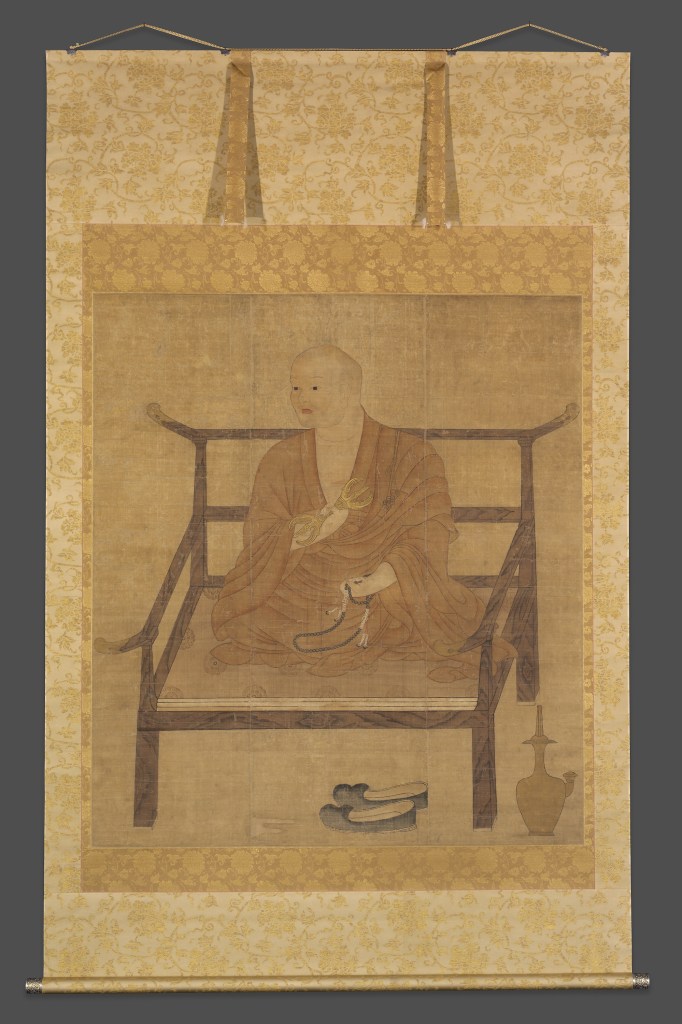
Kūkai (空海, 774–835) was born in Sanuki Province, on the island of Shikoku, into a provincial aristocratic family. Sent to the capital to train as a government official, he abandoned that path for Buddhism, and in 804 he sailed for Tang-dynasty China as part of an official embassy. In the great cosmopolitan capital of Chang’an he found what he was looking for: a master named Huiguo, one of the leading teachers of esoteric Buddhism — a tradition (known in Japanese as mikkyo, 密教, “the secret teaching”) that transmitted its most important instruction not through public texts but privately, from master to disciple, through ritual initiation.
By the accounts of his own school, Huiguo recognised Kūkai at once as his successor, initiated him fully in a remarkably short time, and named him the eighth patriarch in the line of transmission before dying soon after. Kūkai returned to Japan in 806 carrying scriptures, ritual implements, mandalas and images, and set about establishing his teaching as an independent school. In 816, the emperor Saga granted him a remote mountain in Kii on which to build a monastic centre far from the distractions of the capital; construction began around 819. That mountain was Koya. Kūkai also came to head To-ji in Kyoto, giving Shingon both a mountain retreat and a base in the city.
Kūkai became one of the most influential figures in all of Japanese history — remembered not only as a religious founder but as a calligrapher, engineer, and educator, the subject of a thousand folk legends. In 921, nearly ninety years after his death, the court granted him the posthumous title by which he is most widely known and revered today: Kōbō Daishi (弘法大師), “the Great Teacher who Spread the Dharma.”
What makes Shingon different
To see why Koyasan looks and feels the way it does, it helps to know what its Buddhism is actually about. The Buddhism most people picture — the historical Buddha teaching, disciples meditating toward a distant enlightenment — is only one strand. Esoteric Buddhism starts from a different centre. Its supreme figure is not the historical Buddha but Dainichi Nyorai (大日如来, “Great Sun Buddha,” Sanskrit Mahāvairocana), understood as the cosmic buddha whose body is the whole universe. Everything that exists is, in this view, an expression of Dainichi.
From that starting point comes the school’s most striking teaching: sokushin jōbutsu (即身成仏), “becoming a buddha in this very body.” Where other traditions saw enlightenment as the work of countless lifetimes, Shingon held that a practitioner could realise buddhahood in the present life by aligning body, speech and mind with Dainichi — through ritual gesture (mudra) with the hands, sacred sound (mantra — the “true words” that give Shingon its name) with the voice, and visualisation of the cosmic buddha in the mind. The two great mandalas Kūkai brought from China — the Womb Realm (Taizōkai) and the Diamond Realm (Kongōkai) — are maps of that universe, diagrams of how the buddhas and their energies are arranged around Dainichi at the centre.
This is why Shingon fits so naturally with the older Japanese landscape of local gods. If the whole cosmos is the body of Dainichi, then the kami of a Japanese mountain could readily be understood as another face of the same reality — one root of the long fusion of Shinto and Buddhism known as shinbutsu-shugo. Koyasan even honours a local mountain deity, Niutsuhime, as the god who is said to have led Kūkai to the site. (For the wider distinction between the two religions, see our guide to shrines and temples.)
Danjo Garan: a mandala you can walk into
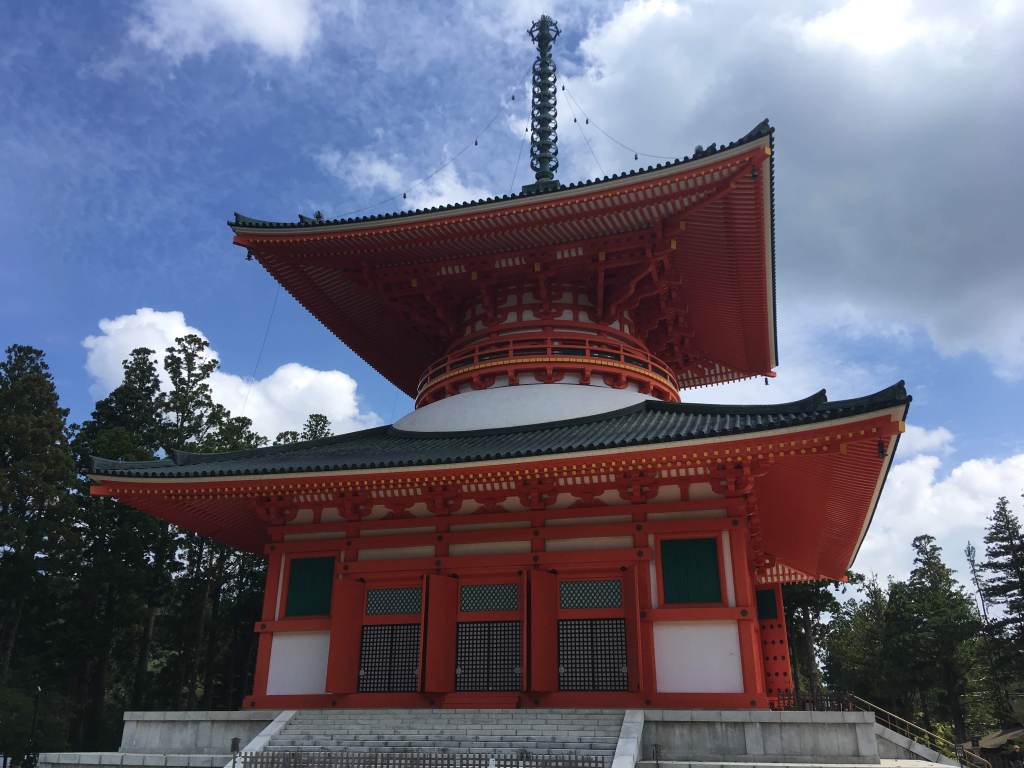
Kūkai did not simply build a temple on Koya; he laid out the mountain’s central precinct, the Danjō Garan (壇上伽藍), as a mandala rendered in wood and space. Its dominating structure is the Konpon Daitō (根本大塔), the “Fundamental Great Pagoda,” a vermilion tower some 48.5 metres tall. Kūkai conceived it, though it was completed after his death; the present structure, rebuilt in reinforced concrete after a fire in 1843, dates to 1937.
What matters is what waits inside. Rather than a flat painting, the pagoda encloses a three-dimensional mandala: a great gilded statue of Dainichi Nyorai stands at the centre, surrounded by four other buddhas and, on the interior pillars, the bodhisattvas of the diagram. Kūkai’s idea was that the two mandalas he inherited — Womb Realm and Diamond Realm — could be fused and made solid, so that a worshipper does not look at the cosmic diagram but stands physically inside it. Nearby rises the Kondō (Golden Hall), the precinct’s main hall of worship, where the mountain’s principal ceremonies are held.
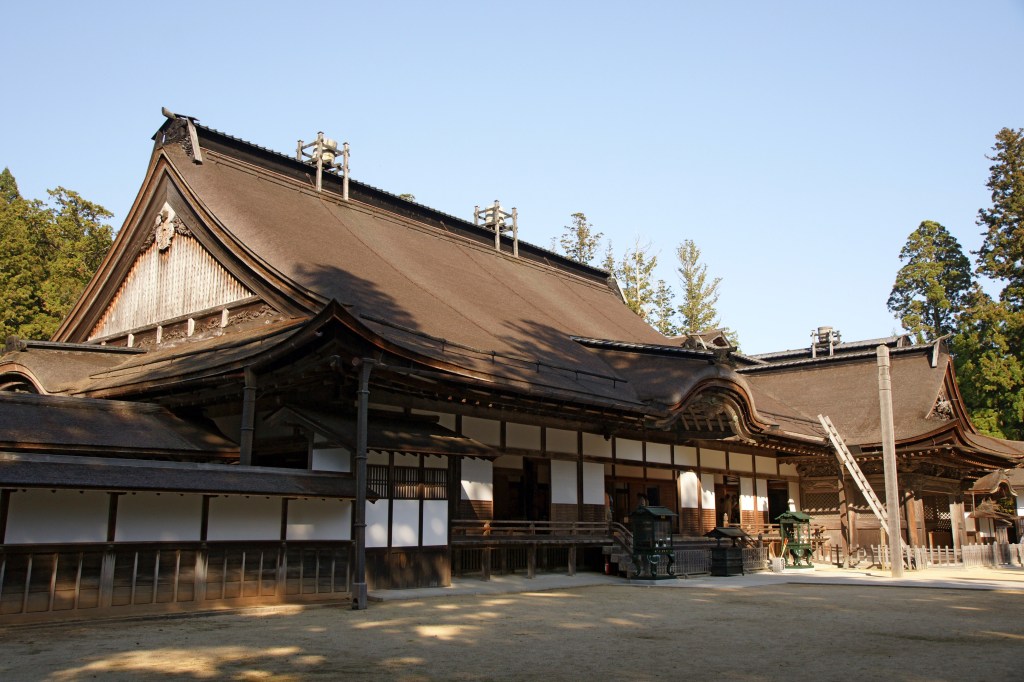
The mountain’s administrative head temple, a short walk away, is Kongōbu-ji (金剛峰寺) — today the headquarters of the Kōyasan Shingon school, famous for its painted sliding screens and for Banryūtei, the largest rock garden in Japan. The name Kongōbu-ji, “Temple of the Diamond Peak,” was once used for the whole mountain monastery before it settled onto this single building.
Okunoin and the saint who never died
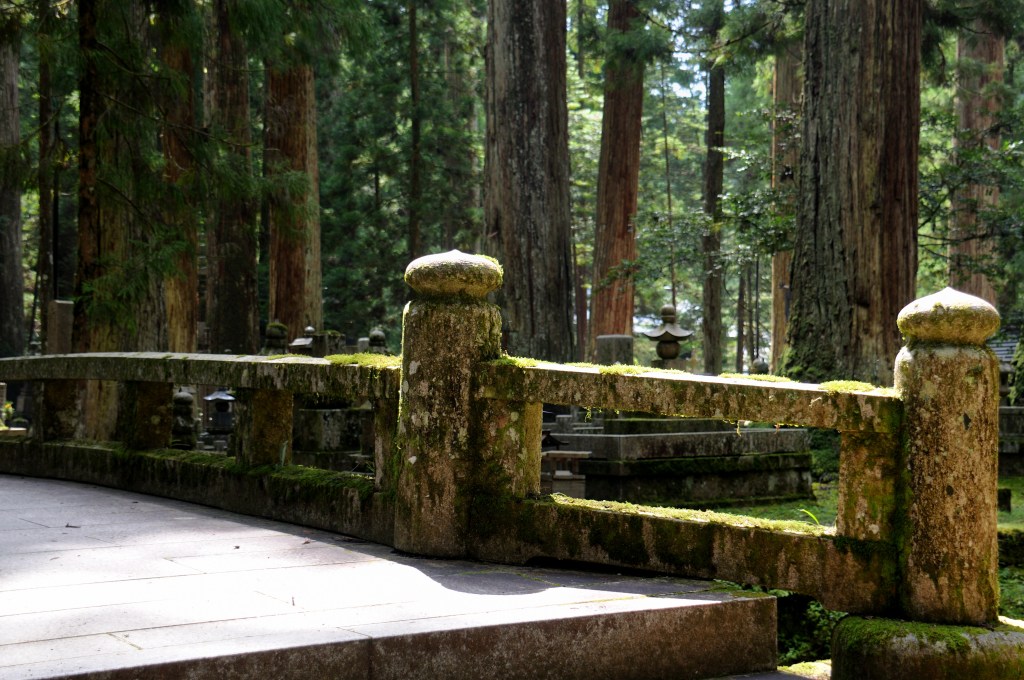
If the Garan is the mountain’s mind, Okunoin (奥之院) is its heart. At the eastern end of the town, a stone-paved approach runs for roughly two kilometres through a forest of towering cedars, and along it stand more than 200,000 graves, memorial pagodas and monuments — one of the largest cemeteries in Japan and, for many visitors, the most atmospheric place in the country. To be buried, or simply memorialised, near Kūkai is to wait beside him for the future; over the centuries emperors, aristocrats, monks and ordinary families all sought a place along this path.
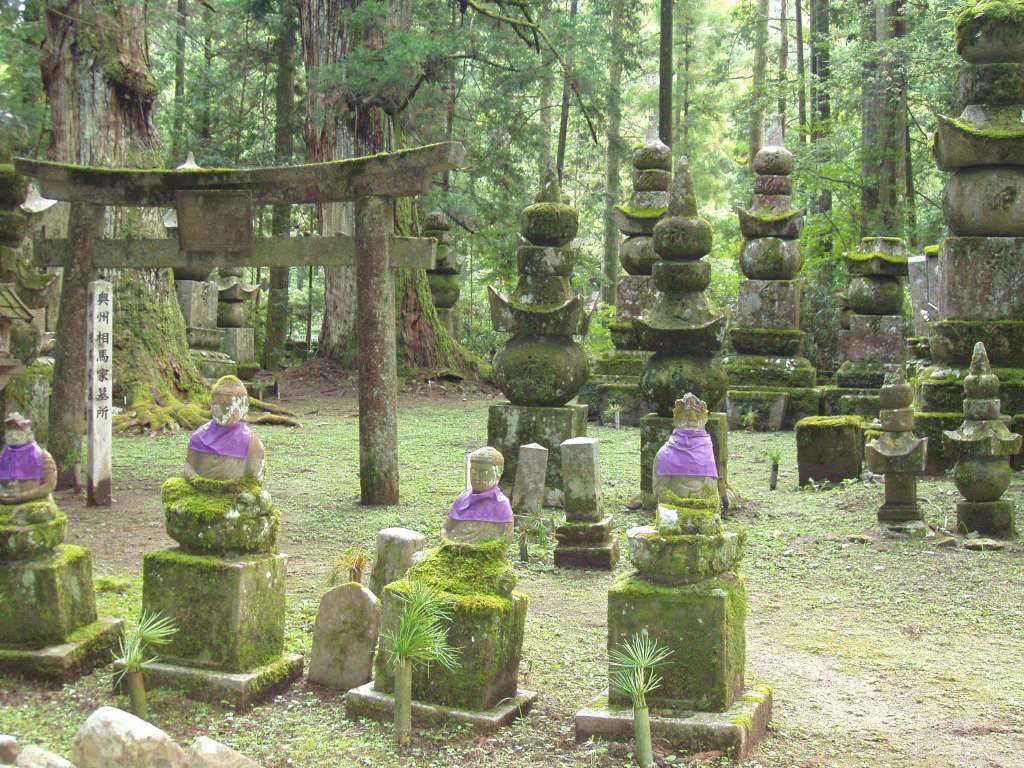
The result is a strange and moving democracy of the dead. Warlords who were mortal enemies in life — Oda Nobunaga, Takeda Shingen, Uesugi Kenshin, Date Masamune — have graves and memorial monuments here within a short walk of one another, near the mausoleum of Toyotomi Hideyoshi, the warlord who unified Japan. Among them, in more recent times, companies have raised memorials to their employees, and there is even a monument said to console the spirits of pest insects exterminated by a chemical firm — the same logic of universal salvation, extended to the smallest lives.
Two bridges mark the passage inward. Crossing Ichinohashi, the “first bridge,” pilgrims bow, because from here they are understood to be entering Kūkai’s presence. At the far end, past the Lantern Hall, the last bridge, Gobyōbashi, marks the threshold of the most sacred ground: beyond it, visitors are asked not to take photographs, eat, or drink. Just across it stands the Tōrōdō (灯籠堂, Lantern Hall), where more than 10,000 lanterns hang, kept perpetually lit; two of them, tradition says, have burned without going out for around nine hundred years.
Behind the Lantern Hall, closed to the public, is the Gobyō (御廟), Kūkai’s mausoleum — and here we reach the belief that defines the mountain. Shingon tradition holds that in 835 Kūkai did not die but entered nyūjō (入定), a state of eternal meditative absorption, sealing himself away to wait for Miroku (Maitreya), the Buddha of the future, who will appear on Earth billions of years from now. Until then, Kūkai is regarded not as a dead founder but as a living presence who continues to help those who call on him.
This is not a metaphor the mountain treats lightly. Every day, at 6:00 in the morning and again at 10:30, robed monks prepare a meal and carry it in solemn procession across Gobyōbashi to the mausoleum, an offering ritual called Shōjin-gu (生身供) that has continued, by tradition, for more than a millennium — food brought to a man his followers insist is not gone. It is one thing to read about a belief in an eternal saint; it is another to watch breakfast being carried to him.
The mountain that once turned women away
For most of its history, Koyasan was closed to half of humanity. Like several major Japanese sacred mountains, it observed nyonin kinsei (女人禁制), a prohibition on women setting foot in the monastic precinct — a rule bound up with medieval ideas about ritual purity and monastic discipline. Women who came on pilgrimage could go no further than a ring of halls at the mountain’s entry points, the Nyonin-dō (女人堂, “women’s halls”), from which they worshipped toward the sacred centre they could not enter. A pilgrim path for women, the Nyonin-michi, ran around the rim between these halls.
The ban was only lifted in 1872, in the sweeping reforms of the early Meiji period. One Nyonin-dō still stands today, a quiet reminder that the openness a modern visitor takes for granted is, on this mountain, less than two centuries old.
Staying the night: shukubo and temple food
Koyasan is one of the few places in Japan where an ordinary traveller can sleep inside a working monastery. More than 50 of the mountain’s temples operate as shukubo (宿坊), temple lodgings that once housed pilgrims and now open their tatami guest rooms to visitors of any faith. A night in one is not a themed hotel experience but a share, however brief, in the rhythm of the temple: guests are served shōjin ryōri (精進料理), the refined Buddhist vegetarian cuisine that uses no meat or fish — Koyasan is especially known for goma-dofu, a rich sesame “tofu” — and are welcome to join the monks’ early-morning service.
That morning ritual is often a goma (護摩) fire ceremony, an unmistakably esoteric rite in which wooden prayer sticks are fed to a roaring fire on the altar while the officiant chants mantras, the flames standing for the burning away of earthly desire. Some temples also offer visitors a taste of Ajikan (阿字観), the Shingon meditation on the Sanskrit letter “A,” the sound associated with Dainichi and the origin of all things. For anyone who wants to understand what the pagoda and the mausoleum are for, an overnight stay is worth far more than a day trip — and because the popular temples fill up, especially in autumn, booking well ahead is wise.
Visiting Koyasan
Despite its remoteness, Koyasan is a comfortable half-day trip from Osaka. The classic route runs on the Nankai railway from Namba to Gokurakubashi at the foot of the mountain, then up a steep cable car to the top, where buses connect the Garan, Kongōbu-ji and Okunoin (the walk into the cemetery is easily done on foot). The energetic can instead climb the historic pilgrimage trail, the Chōishi-michi (町石道), marked by roughly 180 stone posts — one for each chō (about 109 metres) — that have guided walkers up from the plain for centuries.
Okunoin rewards two very different visits: by day, when light filters green through the cedars, and after dark, when the stone lanterns of the approach are lit and the cemetery becomes genuinely otherworldly; several temples run guided night walks. Autumn brings vivid foliage and the largest crowds; winter is cold and often snowbound but profoundly quiet. Whenever you come, treat the innermost precinct as the active place of worship it is — modest dress, low voices, and no cameras beyond Gobyōbashi.
In closing
It is tempting to file Koyasan under scenery — an old cemetery in a cedar forest, a red pagoda, a night in a temple. But every part of it is an argument made physical. The pagoda is a claim that the whole universe has a shape and that you can stand inside it. The cemetery is a claim that enemies and strangers and even insects can wait together for the same salvation. And the meal carried across the bridge each morning is a claim, renewed daily for over a thousand years, that the mountain’s founder never really left. Koyasan is less a place you look at than a belief you walk through.
Trivia
Kūkai’s shadow reaches far beyond Koya. He is the spiritual patron of the famous Shikoku 88-Temple Pilgrimage on his home island, whose white-clad walkers carry a staff said to embody the Daishi himself and travel under the motto dōgyō ninin (同行二人), “two travelling together” — the pilgrim and Kūkai, side by side. By long custom, pilgrims who complete the circuit come to Koyasan afterward to report their journey to the Daishi at Okunoin, closing the loop where his story began.


_-_1960.40_-_Art_Institute_of_Chicago.jpg)


コメントを残す