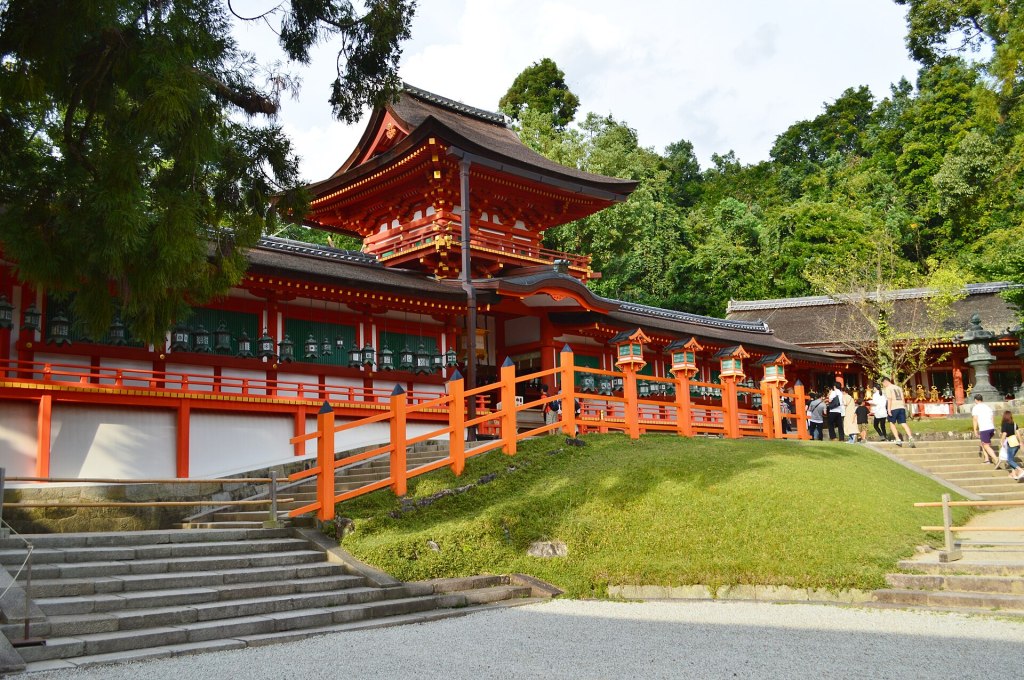
Most visitors meet Kasuga Taisha twice before they even reach it. First come the deer, bowing for crackers along the path; then the lanterns, thousands of them, mossy stone pillars marching up through a dim cedar forest. It is one of the most photographed approaches in Japan. But the deer are not a petting-zoo attraction, and the lanterns are not decoration. Both are theology — the visible edge of a shrine built by the most powerful family in Japanese history to house the gods who guaranteed its power.
This article looks past the postcard. We will see why a clan built a shrine to its own ancestors, why a thunder god arrived in Nara riding a deer, why for most of its history this “shrine” was inseparable from a great Buddhist temple next door, and why the whole complex is torn down and rebuilt on a schedule that has run, almost unbroken, for twelve centuries.
In this article
- A family shrine in a sacred forest
- The clan that built a shrine to itself
- Four gods, four distant shrines
- Why the deer are sacred
- When shrine and temple were one
- Kasuga-zukuri and the shrine rebuilt forever
- Three thousand lanterns and the nights they are lit
- The Wakamiya and Japan’s most faithful festival
- Visiting Kasuga Taisha
- In closing
A family shrine in a sacred forest
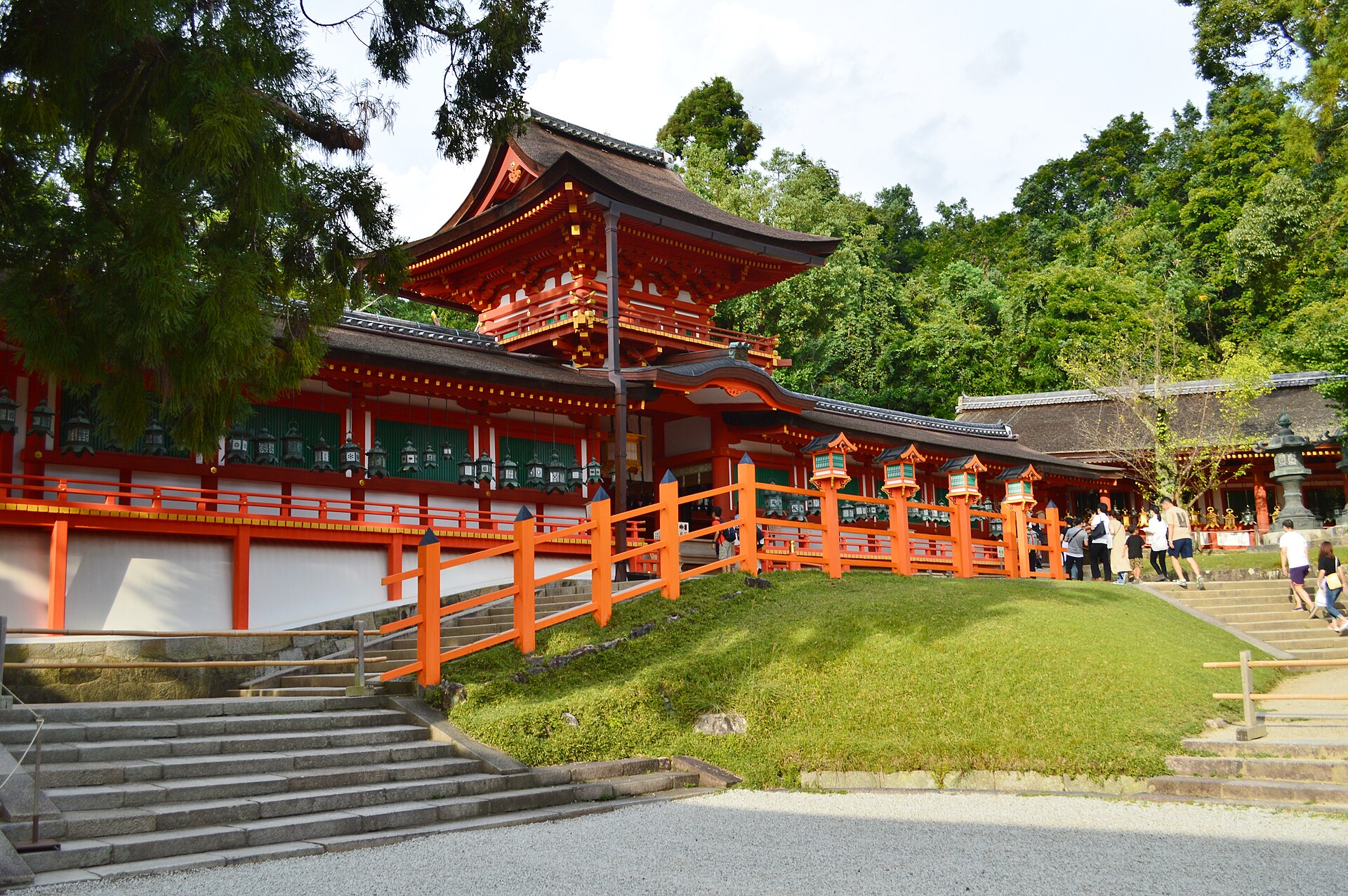
Kasuga Taisha (春日大社) stands at the foot of Mount Mikasa on the eastern edge of Nara, the city that served as Japan’s capital in the 8th century. Its vermilion buildings and white walls sit against a wall of dark green: the Kasugayama Primeval Forest, a hillside where hunting and logging were forbidden for well over a thousand years and where old-growth trees still stand. The shrine and its forest are inscribed together on the UNESCO World Heritage list as part of the “Historic Monuments of Ancient Nara” (1998).
What sets Kasuga apart from a shrine like Ise, dedicated to the imperial ancestor, or a great civic shrine, is that it began as something more private: the ujigami (氏神) shrine of a single clan — a shrine to the guardian deities of the Fujiwara family. To understand Kasuga, you have to understand the family that built it.
The clan that built a shrine to itself
For much of the Nara (710–794) and Heian (794–1185) periods, Japan was governed less by its emperors than by the Fujiwara, a noble house that made itself the permanent power behind the throne. Their method was marriage: generation after generation, Fujiwara fathers married their daughters to emperors, so that the next emperor was a Fujiwara grandson, and a Fujiwara regent ruled in his name. Fujiwara no Fuhito (659–720), the architect of this strategy, married a daughter to the emperor and was grandfather to an empress.
A family this powerful needed its gods close at hand. Tradition holds that in the early 8th century the Fujiwara brought their guardian deity, the thunder god Takemikazuchi, from a distant shrine to the hill of Mikasa overlooking their new capital. The shrine was then formally established in its current four-hall form in 768, when Fujiwara no Nagate, acting on the command of Empress Shotoku, enshrined four deities in a row of matching sanctuaries at the mountain’s foot. From that point, the fortunes of the shrine and the fortunes of the clan rose together. As the Fujiwara spread their influence across the country, they founded branch shrines everywhere; today roughly 3,000 Kasuga shrines nationwide trace back to this one.
Four gods, four distant shrines
The four deities of Kasuga are unusual in that they were, in effect, gathered from across eastern and central Japan and settled together in Nara. Collectively they are worshipped as Kasuga Daimyojin (春日大明神), “the Great Deity of Kasuga,” but each has its own identity and origin:
- Takemikazuchi-no-Mikoto — a god of thunder and of the sword, brought from Kashima Jingu in what is now Ibaraki Prefecture, far to the east. In myth he is one of the warrior gods sent from heaven to pacify the land.
- Futsunushi-no-Kami — a companion sword god, brought from Katori Jingu in present-day Chiba Prefecture.
- Ame-no-Koyane-no-Mikoto — brought from Hiraoka Shrine near Osaka. This god matters most to the family: he is revered as the ancestral deity of the Fujiwara themselves, the divine forefather from whom the clan claimed descent.
- Himegami — a goddess also enshrined from Hiraoka, paired with Ame-no-Koyane.
The choice tells a story. By seating their own ancestor beside two mighty warrior gods, the Fujiwara wrapped their earthly authority in divine protection: the guardians of the realm and the founder of the family, worshipped side by side in a single precinct.
Why the deer are sacred
The famous deer of Nara are not simply wildlife that wandered into a park. They descend, in belief, from a single sacred animal. According to the shrine’s tradition, when the thunder god Takemikazuchi made the journey from Kashima to Mount Mikasa, he arrived riding on the back of a white deer. From that moment the deer of Kasuga became shinshi (神使) — messengers of the kami, sacred servants of the gods rather than ordinary beasts.
This belief had real, lasting consequences. Because harming a messenger of the gods was unthinkable, the deer were protected for centuries, and hunting was banned on the shrine’s mountain. Some 1,200 wild deer still roam Nara Park today, and their status echoes everywhere in the shrine: fortune slips are drawn from little deer figurines, and deer appear on amulets and carvings throughout the grounds. When a Nara deer bows its head for a cracker, it is repeating, by happy accident, a gesture that visitors have read for centuries as the reverence due to a sacred creature.
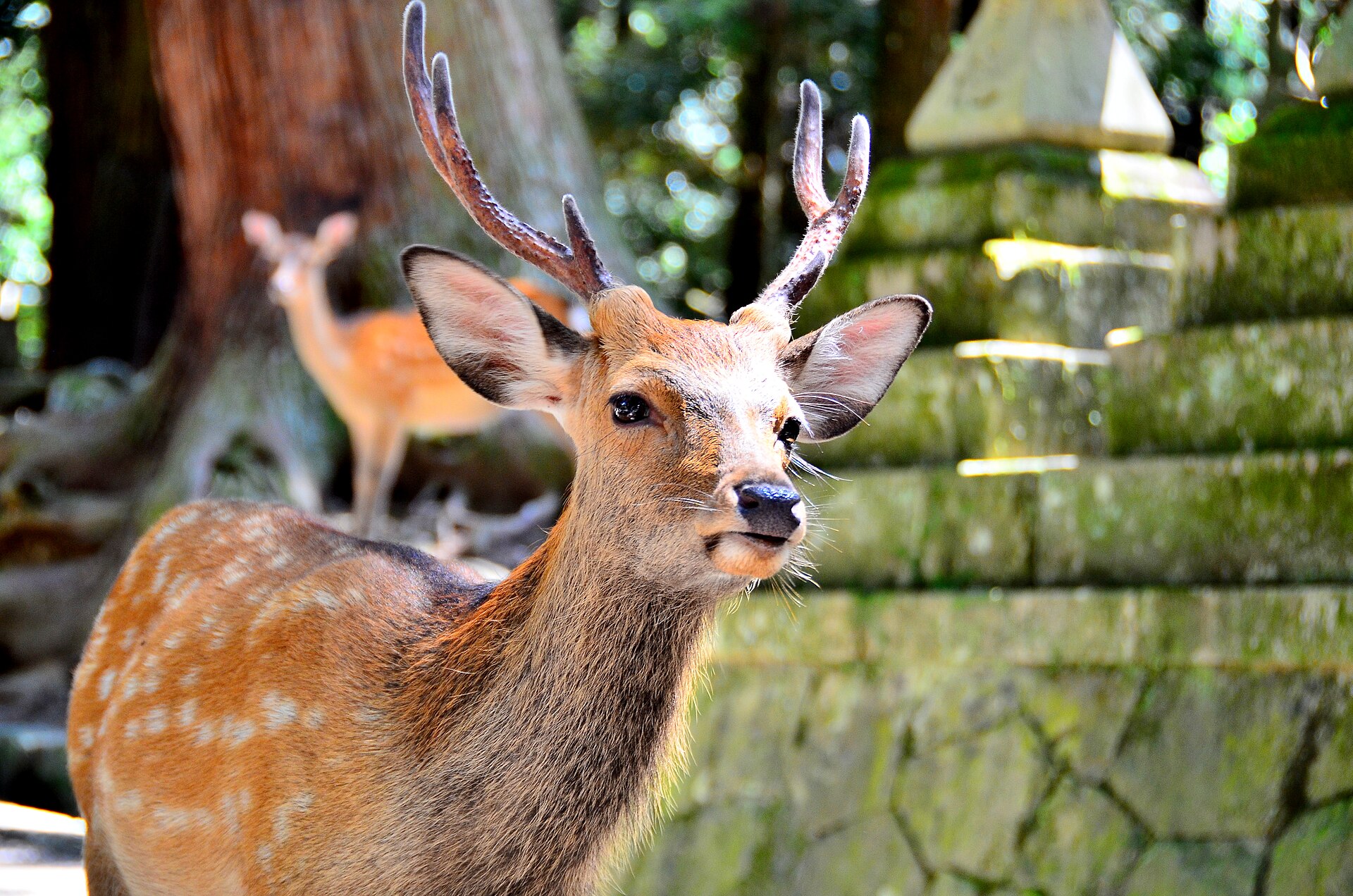
At Kasuga the deer is not a symbol of the god. For most of the shrine’s history it was treated as the god’s own envoy — which is why an entire city learned to live alongside its wild herd.
There is a Buddhist echo here too. To pilgrims steeped in Buddhism, a park full of gentle, protected deer recalled the deer park at Sarnath where the Buddha is said to have preached his first sermon — a resonance that felt natural in a place where, for over a thousand years, the shrine’s gods and the Buddhist faith were not separate at all.
When shrine and temple were one
Kasuga Taisha did not stand alone. Just downhill sat Kofuku-ji, the grand Buddhist temple that served as the Fujiwara clan’s ujidera (氏寺), or family temple, the counterpart to the shrine’s role as family ujigami. For most of the medieval period the two were not rivals but a single religious institution. This fusion of kami and buddhas has a name — shinbutsu-shugo (神仏習合) — and Kasuga is one of its clearest examples. (For the wider story, see our article on the difference between Shinto and Buddhism.)
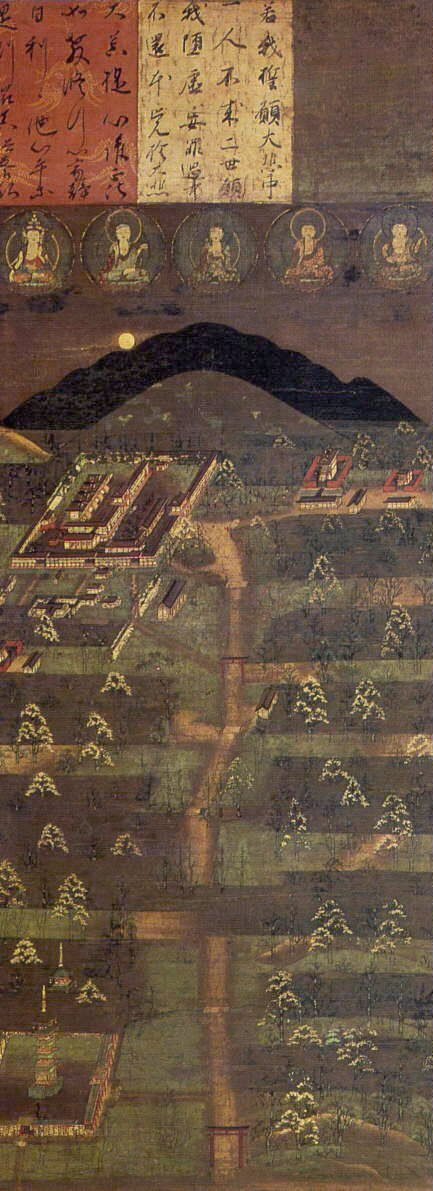
Under the medieval logic of honji suijaku (本地垂迹, “original ground, manifest traces”), each Kasuga kami was understood as the local appearance of a specific buddha or bodhisattva. The thunder god Takemikazuchi, for instance, was paired with Fukukenjaku Kannon, a form of the bodhisattva of compassion enshrined in Kofuku-ji’s Nan’en-do hall. Painters produced the celebrated Kasuga mandala, images that show the shrine, its forest, and Mount Mikasa hovering with the buddhas who were believed to stand behind its gods.
The bond could also be a weapon. When the monks of Kofuku-ji were angry with the court, they staged goso (強訴), forceful appeals in which they carried the Kasuga shrine’s sacred sakaki tree toward the capital. To advance the sacred tree was to bring the anger of the Kasuga gods to the emperor’s gate — a spiritual threat that a devout government could not easily ignore. This intertwined world was pulled apart only in 1868, when the new Meiji government ordered the separation of kami and buddhas (shinbutsu bunri), and Kasuga and Kofuku-ji became the officially distinct shrine and temple visitors see today.
Kasuga-zukuri and the shrine rebuilt forever
At the heart of the shrine stand four small sanctuaries in a row, one for each deity. Their design was so influential that it named an entire architectural style: kasuga-zukuri (春日造), marked by a curved, projecting gable roof of hinoki cypress bark over a compact single-bay hall, painted in the shrine’s signature vermilion. Countless Kasuga branch shrines across Japan copy this form.
More remarkable than the style is what happens to it. Following the practice of shikinen zotai (式年造替), the shrine’s buildings are thoroughly rebuilt or refurbished on a fixed cycle of roughly every twenty years — a discipline that has continued, almost without a break, for about twelve centuries; the 60th renewal took place in 2016. This mirrors the more famous rebuilding of Ise Jingu, and reflects a deep idea in Japanese religion: sacred architecture is kept alive not by freezing the original timber but by renewing it, passing the form — and the craftsmen’s skills — intact to the next generation.
Three thousand lanterns and the nights they are lit
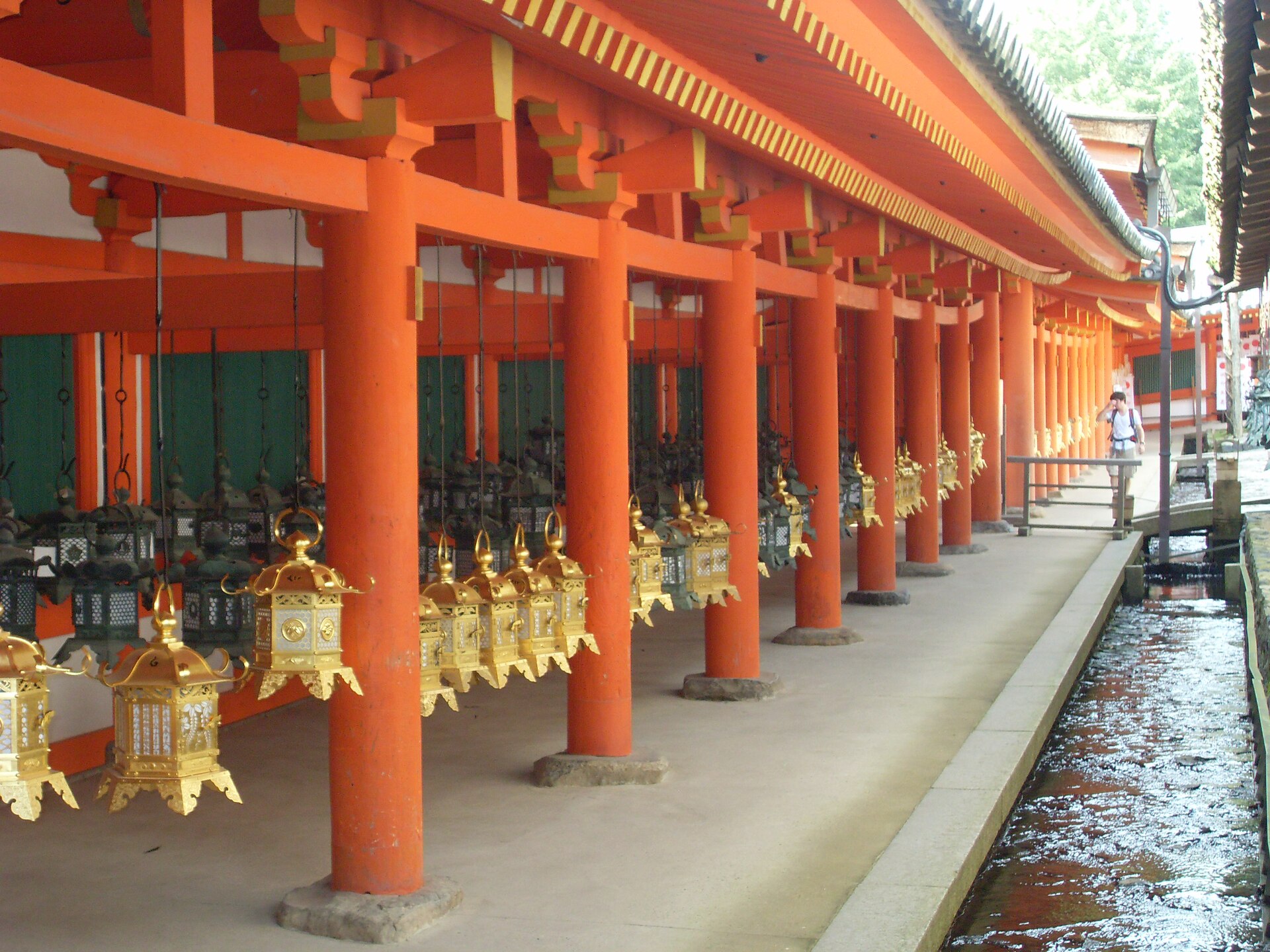
Kasuga is often called the shrine of lanterns, and the number is not an exaggeration: roughly 3,000 in all. About 2,000 are stone lanterns (ishi-doro) lining the wooded approach, many donated by worshippers over the centuries; the other 1,000 or so are bronze hanging lanterns (tsuri-doro) crowded along the shrine’s roofed corridors, presented by the faithful across some 800 years. Ordinarily they stand dark, an army of quiet grey and green stone.
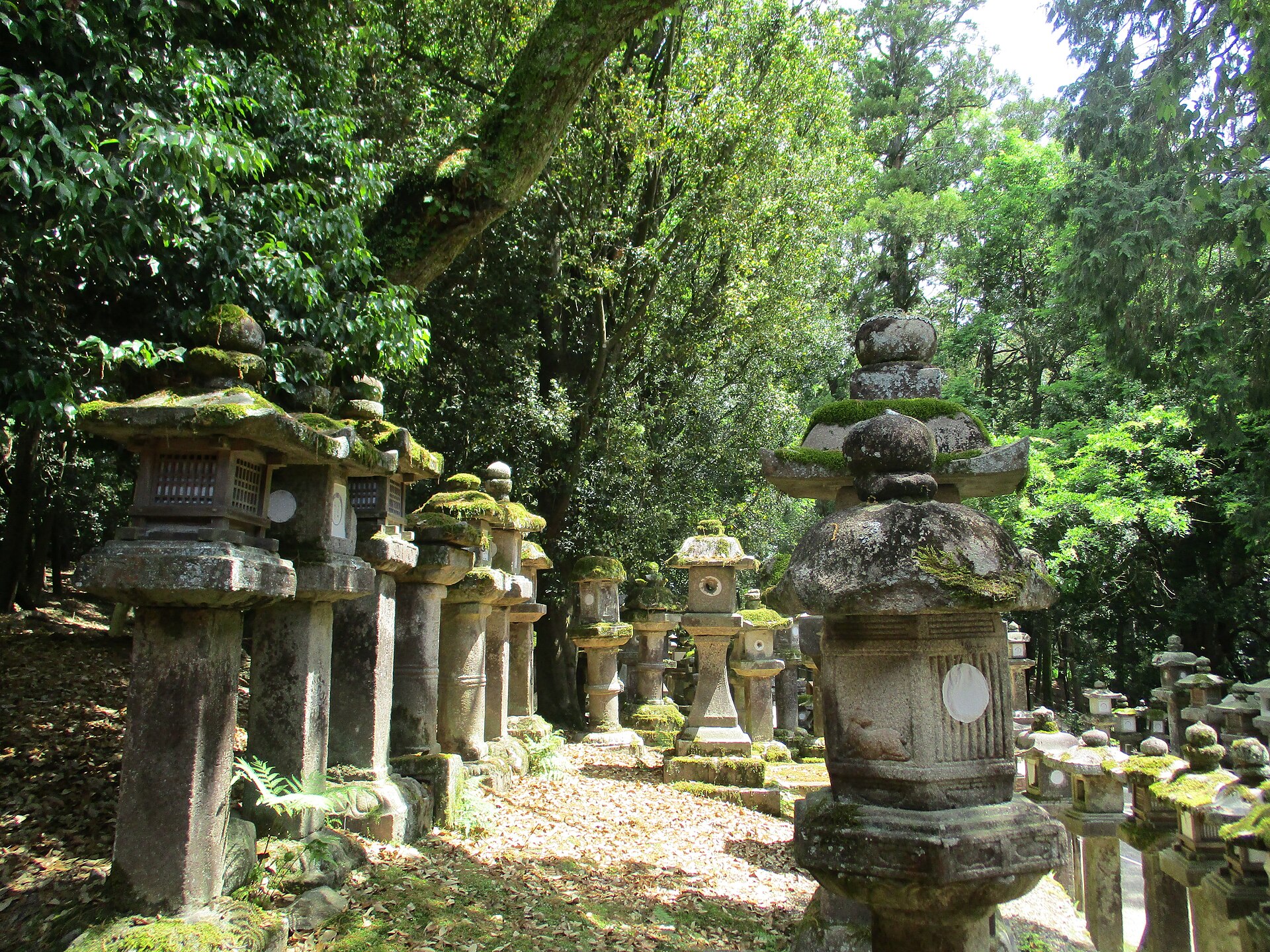
Twice a year they all come alight at once, in a ceremony called Mantoro (万灯籠), “ten thousand lanterns.” It is held on Setsubun in early February (around February 3) and again as Chugen Mantoro in mid-August (August 14–15), during the season when Japanese honor their ancestors. On those nights the corridors and forest paths fill with warm, flickering light, and the shrine becomes what it must have looked like to a medieval pilgrim arriving after dark.
The Wakamiya and Japan’s most faithful festival
A short walk from the main sanctuaries stands the Wakamiya, a subsidiary shrine established in 1135 for a “young prince” deity, the divine child of two of the Kasuga gods. The very next year, in 1136, the regent Fujiwara no Tadamichi held a great festival there to pray for relief from famine and epidemic and for a good harvest. That festival, the Kasuga Wakamiya On-Matsuri, has been held every single year since — nearly nine centuries without interruption — and is designated a National Important Intangible Folk Cultural Property.
Staged each December 15–18, its centerpiece is a grand costume procession, the Owatari-shiki, in which participants parade through Nara dressed in the styles of every era from the Heian to the Edo period, followed by night-long offerings of ancient sacred music and dance. Where many festivals reconstruct a tradition, this one has simply never stopped — a living thread running back to the age of the regents.
Visiting Kasuga Taisha
Kasuga Taisha sits within Nara Park, an easy walk or short bus ride from Kintetsu Nara Station and comfortably combined with Todai-ji and its Great Buddha in a single day. The tree-lined approach and outer grounds are open and free; a paid inner area lets you walk in close among the bronze lanterns and the four sanctuaries. Approaching the shrine to pray, follow the usual Shinto etiquette of bows and claps — if you are unsure of the sequence, see our guide to how to worship at a shrine. And give the deer their due: they will bow to you, but they are, by long tradition, the messengers of the gods you have come to meet.
In closing
It is easy to enjoy Kasuga Taisha as a pretty walk — deer, lanterns, red buildings in a green wood. But every one of those images is a piece of history made visible. The deer carry a thunder god’s arrival; the lanterns carry eight centuries of prayers; the four red halls carry the ambitions of the family that ruled Japan from behind the throne, and the ghost of the great temple they were once joined to. Kasuga is not a backdrop for the deer. It is the reason the deer of Nara have been treated as sacred for more than a thousand years.
Trivia
The name Fujiwara means “wisteria plain,” and the wisteria (fuji) is an emblem of the clan and of its shrine. Kasuga Taisha is famous for its wisteria, including an ancient, long-trailing vine within the grounds — so that the family of the wisteria and the shrine of the wisteria bloom, quite literally, as one each spring.


.jpg)


コメントを残す