Rising to the northeast of Kyoto is a forested mountain that shaped Japanese Buddhism more than any other single place. On its slopes sprawls Enryaku-ji, the head temple of the Tendai school and, for centuries, the most powerful monastery in the country. Almost every great reformer of medieval Japanese religion trained here first; armies of warrior-monks marched down from here to bend the imperial court to their will; and one night in 1571 the whole mountain was put to the torch. To understand Enryaku-ji is to understand how close religion and power once stood in Japan.
This guide traces why the temple was built where it was, why it is called the “mother mountain” of Japanese Buddhism, how a single lamp has supposedly burned for twelve hundred years, and why its monks still run a thousand-day marathon toward enlightenment.
In this article
- The mountain that guards Kyoto
- The mother mountain of Japanese Buddhism
- The inextinguishable light
- Warrior monks and a mountain no one could rule
- The night Mount Hiei burned
- The marathon monks
- Visiting
- Trivia: the word for letting the oil run out
The mountain that guards Kyoto
In 788 a young monk named Saichō (最澄), later honored as Dengyō Daishi, built a small hermitage on Mount Hiei (比叡山), the peak that stands over the northeastern edge of the Kyoto basin. The location was not casual. When the capital moved to Heian-kyō—today’s Kyoto—a few years later, the mountain lay in the kimon (鬼門), the “demon gate” to the northeast, the direction from which, in continental geomancy, evil was thought to enter. A great monastery there would guard the new capital spiritually. The temple took its lasting name, Enryaku-ji, from the Enryaku era of the reigning Emperor Kanmu.
Saichō had studied in China and brought home the teachings of the Tiantai school, which he established in Japan as Tendai (天台) Buddhism, centered on the Lotus Sutra and famous for embracing many practices—doctrinal study, meditation, and esoteric ritual—within a single system. His great contemporary Kūkai founded the rival Shingon school on the remote heights of Mount Kōya in the same era; between them, the two mountains defined the Buddhism of the Heian age. The principal image at Enryaku-ji’s main hall is Yakushi Nyorai, the Buddha of healing.
The mother mountain of Japanese Buddhism
Enryaku-ji’s deepest influence is not architectural but human. For four centuries it was the great university of Japanese Buddhism, and nearly every founder of the movements we now think of as classically Japanese studied on Mount Hiei before breaking away to teach on his own. Hōnen and his disciple Shinran, who between them created the Pure Land traditions; Eisai and Dōgen, who carried Zen from China; and Nichiren, who preached devotion to the Lotus Sutra—all trained here first. Their new schools make up much of the map laid out in our guide to the schools of Japanese Buddhism. For this reason Enryaku-ji is often called the “mother mountain” of Japanese Buddhism: the single source from which an astonishing amount of later religion flowed.
The inextinguishable light
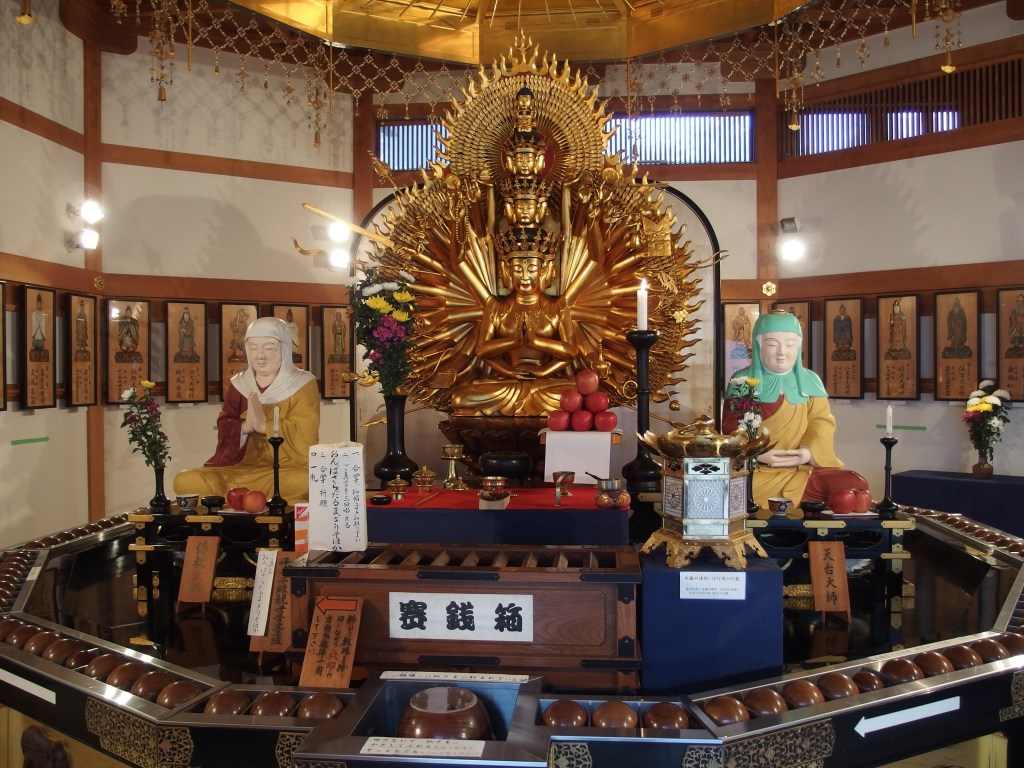
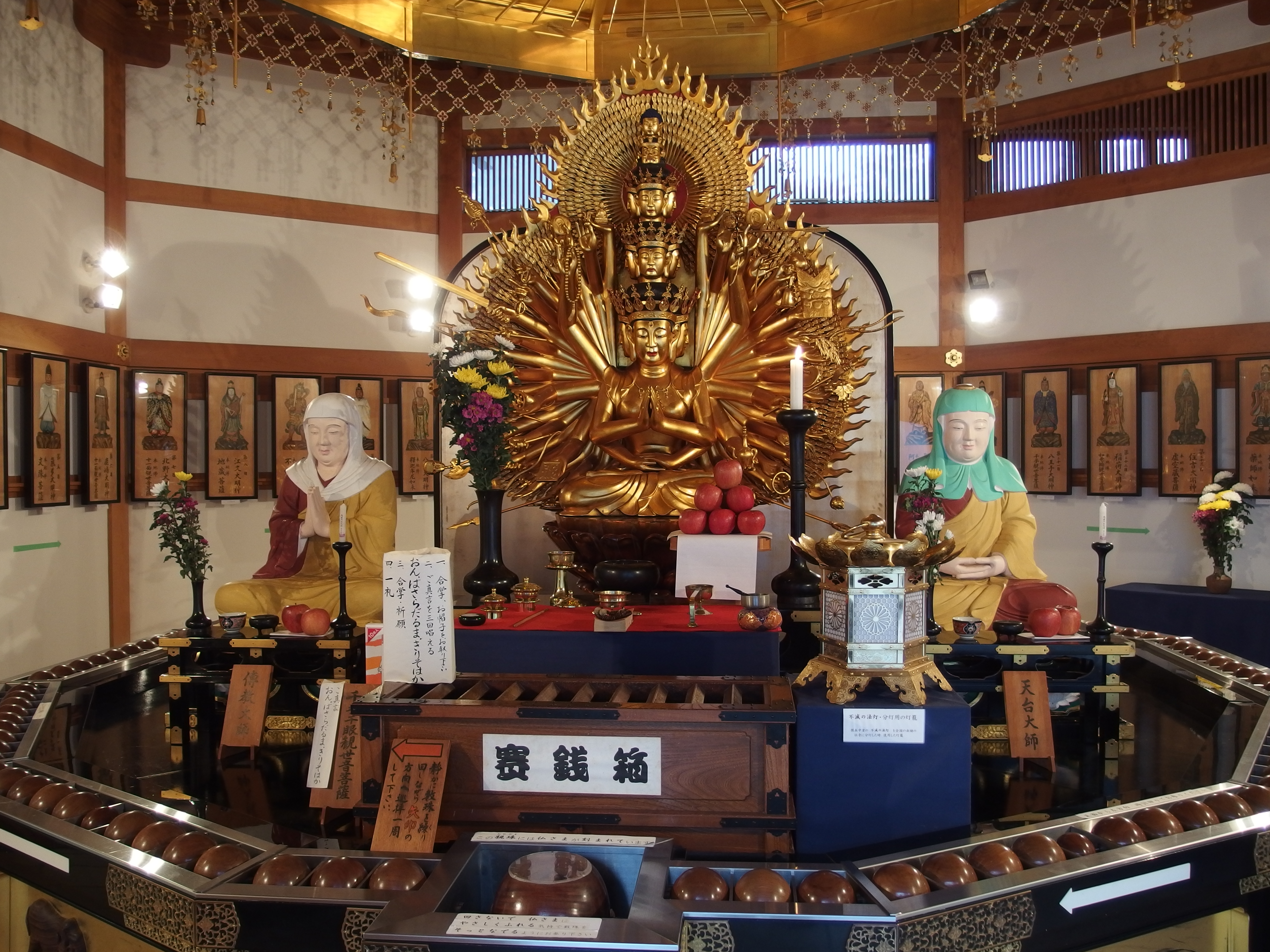
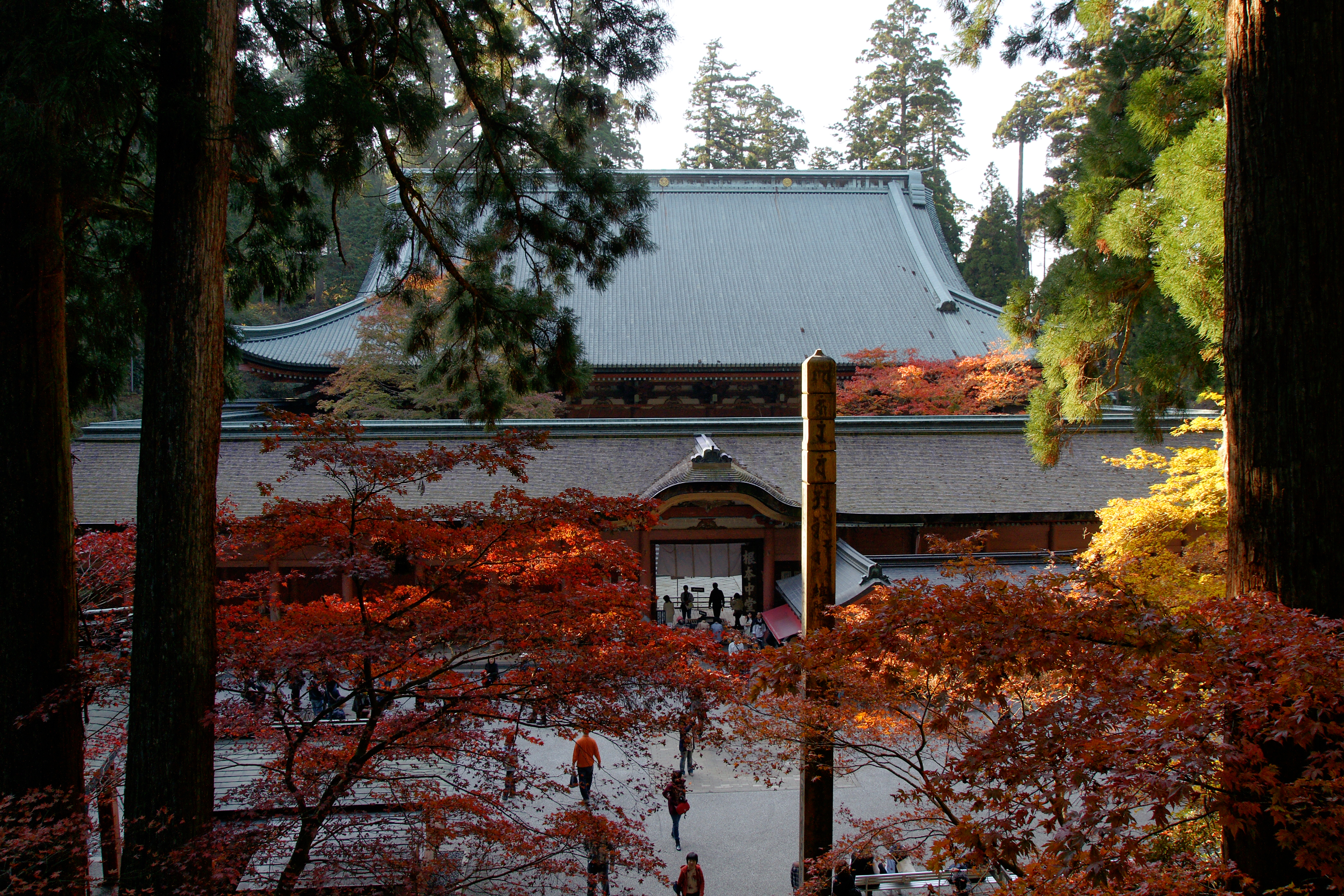
The spiritual heart of the complex is the Konpon Chū-dō (根本中堂), the great main hall, a designated National Treasure whose present building dates from a 1642 reconstruction under the shogun Tokugawa Iemitsu. Inside, before the altar, three oil lamps are said to have burned without interruption since Saichō himself lit them—the fumetsu no hōtō (不滅の法灯), the “inextinguishable Dharma light,” now some twelve hundred years old.
The claim of unbroken continuity comes with an honest asterisk, and the temple does not hide it: when Mount Hiei was burned in 1571 the flame here went out with everything else. It was rekindled from a branch flame that Tendai monks had long before carried to Risshaku-ji, a temple far to the north in Yamagata—so the light that burns today descends directly from Saichō’s, kept alive off the mountain during its darkest years. Tending it is a daily duty: the oil must never be allowed to run dry.
Warrior monks and a mountain no one could rule
Wealth and prestige made Enryaku-ji a political power as much as a religious one. At its height the mountain held thousands of buildings and many thousands of residents, and it fielded its own standing army of sōhei (僧兵), warrior-monks who would descend on the capital—sometimes carrying a sacred palanquin as a spiritual threat—to force the court’s hand in disputes over land, appointments, and rival temples. Their power was proverbial. The retired emperor Shirakawa, the most autocratic ruler of his day, is said to have named three things in the realm that not even he could control: the floodwaters of the Kamo River, the fall of the dice, and the monks of Mount Hiei.
The night Mount Hiei burned
That independence proved fatal. As the warlord Oda Nobunaga fought to unify a fractured Japan, Enryaku-ji sheltered and supported his enemies and refused to stand aside. In 1571 Nobunaga answered with total war: his forces surrounded the mountain and burned it end to end, cutting down monks, and—by the accounts that survive—women and children who had taken refuge there as well. Thousands died, and the ancient complex was annihilated in a day. It was one of the most shocking acts of the age, and it broke the temporal power of the warrior-monks forever. Reconstruction began under Nobunaga’s successors from the 1590s, and the Tokugawa shoguns rebuilt the Konpon Chū-dō in 1642; what visitors see today is that Edo-period restoration of a much older sacred landscape.
The marathon monks
Tendai is also home to one of the most extreme religious austerities in the world, the kaihōgyō (回峰行), or “circling-the-mountain practice.” In its full form, the sennichi kaihōgyō, a monk commits to a thousand days of mountain pilgrimage spread across seven years, walking and running set courses—30 kilometers a day in the early years, rising to 84 kilometers a day in the seventh—while stopping to pray at hundreds of stations along the way.
The ordeal at its center is the dōiri: in the fifth year, the monk sits in the hall for nine days without food, water, or sleep, reciting mantras. And the commitment is literal in the gravest sense—traditionally the practitioner carries a cord and a short blade, a vow that if he fails to finish he will take his own life rather than abandon the path. Only a few dozen monks have completed the full thousand days in modern times. For those who do, the practice is not athletic achievement but a walking meditation carried to the edge of human endurance, in search of awakening.
Visiting
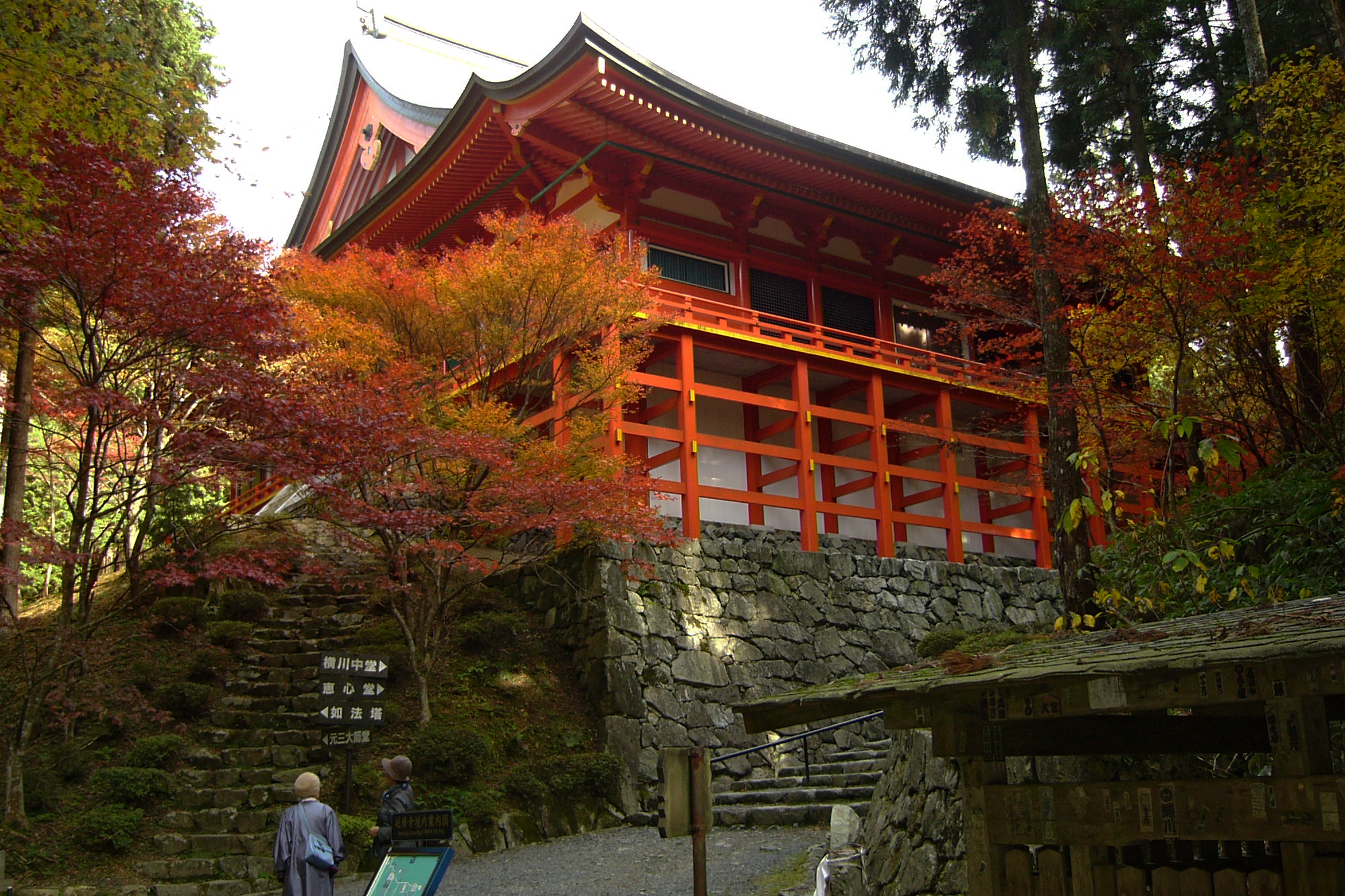
Enryaku-ji is not a single building but a mountain dotted with halls, divided into three precincts: the Tōdō (East Pagoda area), which contains the Konpon Chū-dō and is the historic core; the quieter Saitō (West Pagoda); and the remote Yokawa, further along the ridge. A cable car and ropeway climb the mountain from the Kyoto and Lake Biwa sides, and buses link the three areas for those who do not want to walk the forest paths between them. The temple is inscribed on UNESCO’s World Heritage list as part of the Historic Monuments of Ancient Kyoto. Note that the Konpon Chū-dō has been undergoing a major decade-long restoration, so parts of the main hall may be under cover—worth checking before a visit if it is your main goal.
Trivia: the word for letting the oil run out
Keeping the inextinguishable light alive means never letting its oil run dry—a monk must top it up faithfully, day after day, for a lapse would end a twelve-hundred-year flame. A popular tradition links this duty to a common Japanese word: yudan (油断), meaning carelessness or a dangerous lapse of attention, written with the characters for “oil” and “to cut off.” By this telling, to “let the oil run out” became a metaphor for the negligence that undoes long effort in a single careless moment. Language scholars debate the etymology—but standing before the lamps at Enryaku-ji, watching a monk tend a flame older than almost anything around it, the lesson needs no footnote.
In closing
Enryaku-ji is easy to visit as a scenic mountain temple and easy, therefore, to underestimate. But this is the ground where Japanese Buddhism grew up: the school that seeded a dozen others, the monks who cowed emperors, the fire that ended an age, and the lamp that outlived it all. Walk its cedar-shadowed paths slowly, and you are walking through the center of a thousand years of Japanese religious history.


コメントを残す