An hour by train from Kyoto, on the quiet Ikaruga plain west of Nara, stands a wooden building that has been holding up its own roof since roughly the year 700. The Golden Hall of Hōryū-ji is, by broad scholarly agreement, the oldest wooden structure standing anywhere on Earth. Beside it rises a five-story pagoda of almost the same age. That these timber halls have survived thirteen centuries of fires, earthquakes, wars, and weather in one of the most seismically active countries in the world is close to miraculous.
But Hōryū-ji is far more than a record-holder for old wood. It is a near-complete snapshot of the moment Buddhism took root in Japan — its earliest architecture, its earliest Buddhist sculpture, and the memory of the prince who championed the foreign religion, all preserved on a single wooded compound. This article looks at who built it and why, the fire that nearly erased it, why its columns bulge like a Greek temple’s, and the sealed Buddha that a foreigner talked the monks into unwrapping after two hundred years.
A temple at the dawn of Japanese Buddhism
Hōryū-ji (法隆寺) sits in the town of Ikaruga in Nara Prefecture, a short distance from the old capital of Nara. It is the head temple of the Shōtoku sect (Shōtoku-shū) of Japanese Buddhism — for most of its history it belonged to the Hossō school, but it became independent in 1950, taking the name of its founder. The temple grounds hold more than 180 items designated National Treasures or Important Cultural Properties, an extraordinary concentration for a single site.
In 1993, Hōryū-ji — together with the nearby small temple of Hokki-ji — became the first site in Japan to be inscribed on the UNESCO World Heritage list, as the “Buddhist Monuments in the Hōryū-ji Area.” What earned it that recognition is not only age but completeness: nowhere else does a working temple preserve so much of Japan’s 7th- and 8th-century religious world in its original setting.
Prince Shōtoku and the founding
The temple’s origins are bound to one of the most revered figures in Japanese history, Prince Shōtoku (Shōtoku Taishi, 574–622), also known by his given name Prince Umayado. As regent for his aunt, the Empress Suiko, he is remembered as the great early patron of Buddhism in Japan — the religion had arrived from the Korean kingdom of Baekje only a few decades earlier and was still contested at court. Later tradition credits him with a Seventeen-Article set of moral-political principles and with sending official embassies to Sui-dynasty China.
According to temple tradition and the 8th-century chronicle Nihon Shoki, Hōryū-ji was founded in 607 by Prince Shōtoku and Empress Suiko, to fulfill the wish of the prince’s late father. The prince had built his palace, the Ikaruga Palace, on this same plain, and the first temple — known to scholars as the Wakakusa-garan — rose beside it. That original temple, however, is not the one visitors see today.
The fire of 670 and a century-long debate
The Nihon Shoki contains a stark single line: in 670, it records, Hōryū-ji burned to the ground after being struck by lightning, with not a single building left standing. For centuries this sentence was easy to overlook. But in the modern era it set off one of the most famous controversies in Japanese art history — the reconstruction debate (saiken / hi-saiken ronsō). If the temple truly burned down in 670, then the halls standing today could not be the originals of 607, and Japan’s proudest ancient buildings would be several decades younger than believed. Scholars divided into two camps, and the argument ran for decades.
It was settled in the ground. In 1939, excavations to the southeast of the present Western Precinct uncovered the foundation stones of an older temple laid out on a different plan — the lost Wakakusa-garan, burned in 670. The conclusion was clear: the temple was indeed destroyed and then rebuilt on a new site just beside the ruins, with the present buildings completed by around 711. The halls we admire today are therefore not from 607, but they are still the oldest surviving wooden buildings in the world — a distinction the fire could not take away.
The oldest wooden buildings on Earth
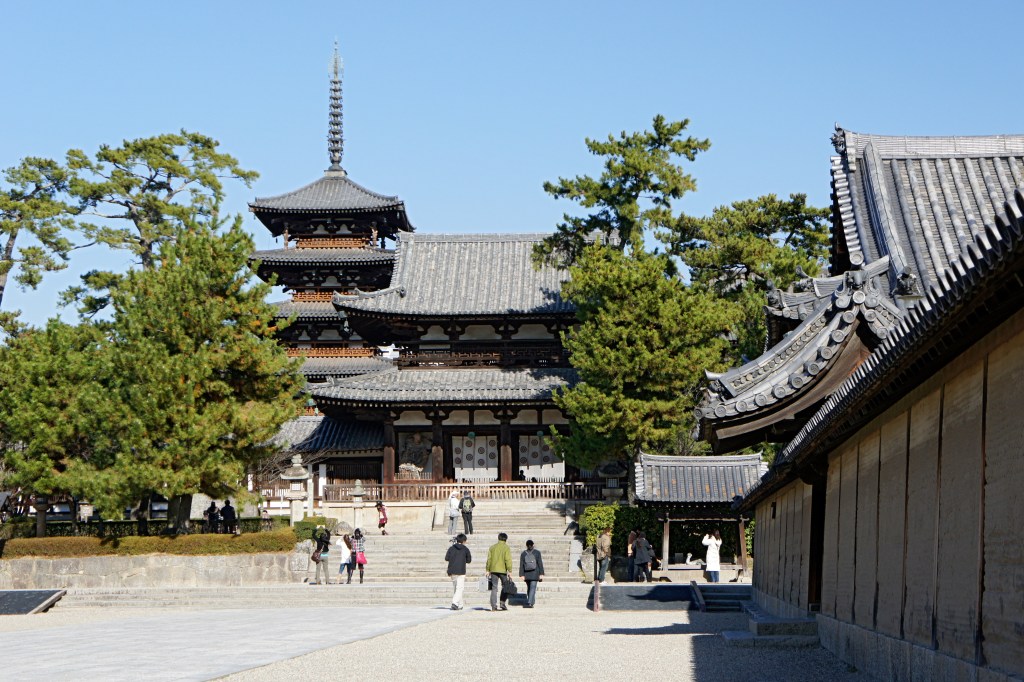
The heart of Hōryū-ji is the Western Precinct (Sai-in), a rectangular cloister enclosing two buildings that break the usual symmetry of Buddhist temples: the pagoda stands on the left, the main hall on the right, rather than one behind the other.
The Kondō (Golden Hall), the main hall of worship, is the building usually called the oldest wooden structure in the world. It is a compact two-storey hall, about 18.5 by 15.2 metres, its lower eaves supported by railings and dragon-carved posts added in later centuries. Beside it, the five-story pagoda rises 32.45 metres — the oldest pagoda in Japan. A pagoda is the descendant of the Indian stupa, a reliquary mound; this one is built around a single great central pillar that runs from a buried foundation stone, said to hold a relic of the Buddha, up through all five roofs.
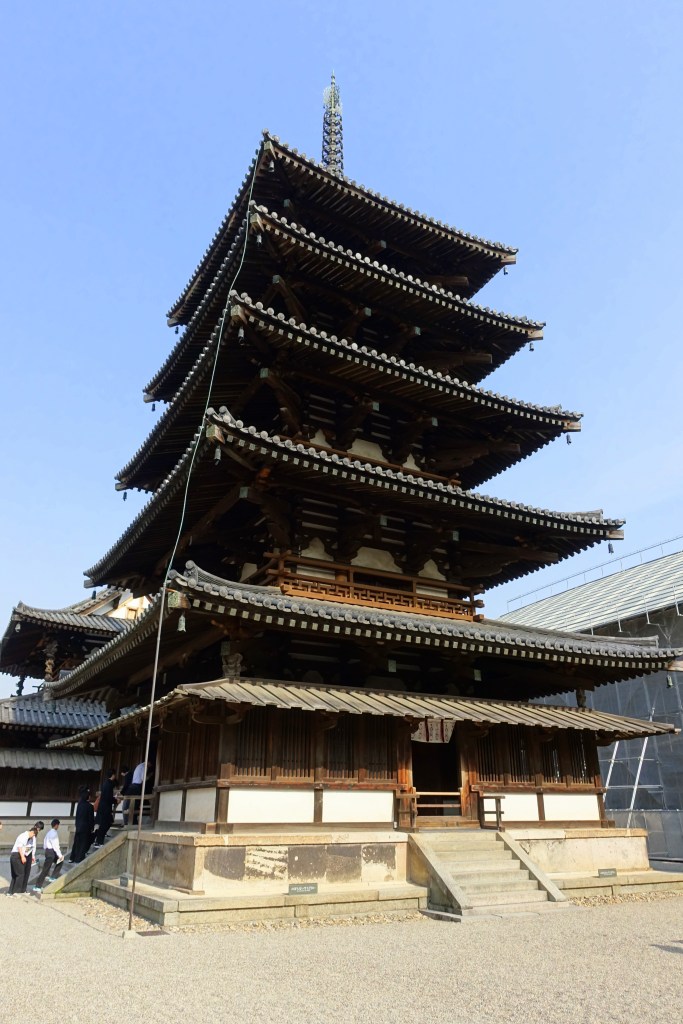
Two features mark these halls as products of the Asuka period, Japan’s first Buddhist century. The bracket arms that carry the eaves are carved in bold cloud shapes (kumo-to), a style seen nowhere later. And the wooden columns swell gently at the middle before tapering toward the top — a subtle bulge known as entasis. The same refinement appears in the columns of ancient Greek temples such as the Parthenon, and it is often said that the idea travelled east along the Silk Road from the Hellenistic world to Japan. It is a romantic connection, and a genuinely open question; most scholars treat the resemblance as unproven rather than as established fact.
The Buddhas inside
Hōryū-ji preserves the earliest surviving Buddhist sculpture in Japan, and to stand before it is to meet the very first generation of Japanese Buddhist art. In the Kondō sits the bronze Shaka Triad — the Historical Buddha flanked by two attendants — cast in 623, the year after Prince Shōtoku’s death, and dedicated to his memory. It is the masterwork of Tori Busshi (Kuratsukuri no Tori), the first named sculptor in Japanese history, and its still, almond-eyed, faintly smiling faces show the direct influence of China’s Northern Wei style. (For how to read the different types of Buddhist figures, see our guide to Buddhist statues.)
Among the temple’s other treasures, two are especially famous. The Kudara Kannon — the “Baekje Kannon” — is a strikingly tall, slender wooden bodhisattva of the early-to-mid 7th century, about 209 centimetres high, whose serene elongation looks almost modern; whether it was made in Japan or imported from Korea is still debated. The Tamamushi Shrine (Tamamushi no Zushi) is a miniature lacquered shrine, over two metres tall, once decorated with the iridescent wings of thousands of jewel beetles; it predates 693 and is among the oldest objects of its kind in East Asia.
The Eastern Precinct and the Hall of Dreams
A short walk east leads to the Eastern Precinct (Tō-in), built directly on the site of Prince Shōtoku’s own Ikaruga Palace after the palace was destroyed. At its centre stands one of the most beautiful buildings in Japan: the octagonal Yumedono, the Hall of Dreams, raised in 739 by the monk Gyōshin to honour the prince. Its name comes from a legend that Shōtoku would retreat to a hall here to meditate, and that a golden being visited him in his dreams to help him interpret difficult scriptures.
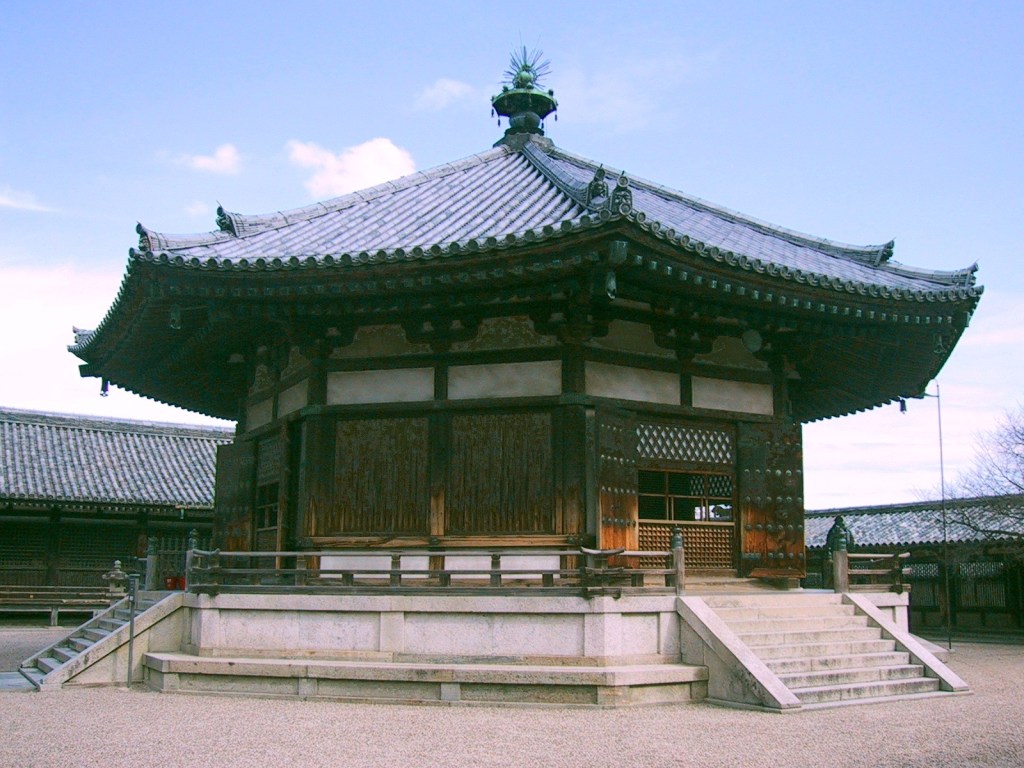
Inside sits the Guze Kannon, a gilded wooden image regarded as a “secret Buddha” (hibutsu) and kept wrapped in cloth, hidden from all eyes for centuries. In 1884, the American scholar Ernest Fenollosa and his Japanese colleague Okakura Tenshin obtained government permission and persuaded the reluctant monks to unwind hundreds of metres of cloth — revealing a nearly perfectly preserved 7th-century masterpiece that had scarcely seen daylight in a thousand years. Even now the statue is shown only for limited periods each spring and autumn.
A prince who became an object of faith
In the centuries after his death, Prince Shōtoku was transformed from a historical statesman into a figure of religious devotion. A cult grew around him (Taishi shinkō), casting him as a saint and even as an incarnation of a bodhisattva, and Hōryū-ji became the centre of that faith. Much of what later ages “knew” about the prince — the miracles, the precocious wisdom — belongs to this devotional tradition rather than to firm history, and modern scholars are careful to separate the two. What is not in doubt is the scale of his legacy: his image appeared on Japanese banknotes for much of the 20th century, and the temple he founded still carries his name as its sect.
Visiting Hōryū-ji
Hōryū-ji lies in Ikaruga, between Nara and Osaka, and is easily reached as a half-day trip; the nearest station is Hōryūji on the JR Yamatoji Line, with a short bus ride or walk to the gate. A single ticket covers the Western Precinct, the Great Treasure Gallery (where many of the sculptures are displayed), and the Eastern Precinct with the Yumedono. Photography is not permitted inside the halls, so the Buddhas must be met in person rather than through a lens. Spring and autumn are the most comfortable seasons, and they coincide with the limited public showings of the temple’s secret images. Allow more time than the compact map suggests — the quiet, low-slung buildings reward slow looking.
In closing
It is easy to walk into Hōryū-ji expecting old buildings and to leave having seen something larger: the first chapter of Japanese Buddhism, still standing where it was written. The cloud-carved brackets, the swelling columns, the smiling bronze Buddha cast in memory of a dead prince — these are not reconstructions or replicas but the actual objects through which a foreign religion became Japanese. Thirteen centuries on, the oldest wood in the world is still doing the job it was cut for: holding up a roof over a place of prayer.
Trivia
When researchers applied dendrochronology — tree-ring dating — to the great central pillar of the five-story pagoda, they found that its timber had been felled around 594, decades before the 670 fire that supposedly destroyed the temple. The finding deepened rather than settled the mystery: the wood may have been stockpiled long before construction, or salvaged and reused from the earlier temple. Even the age of the world’s oldest pagoda, it turns out, still holds a puzzle or two.


_Horyuji.jpg)
コメントを残す