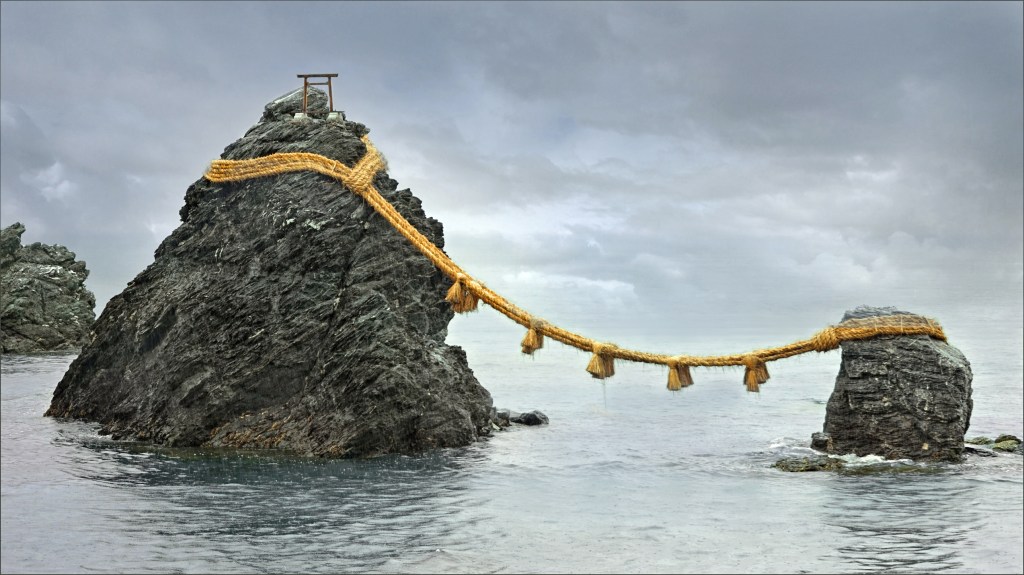
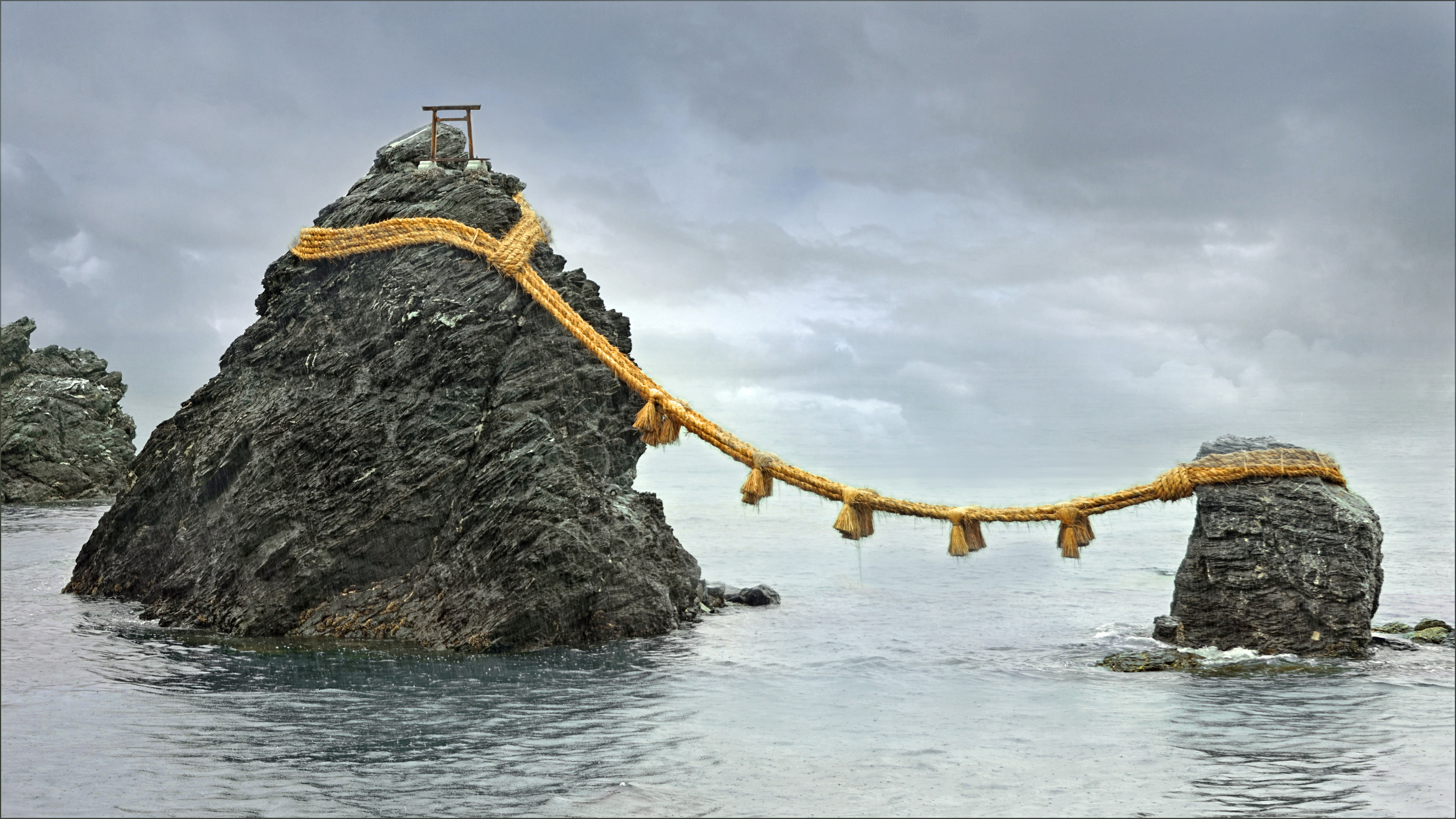
Walk through any Japanese town and you will pass them without noticing: a rope of rice straw tied around an old tree, a small shrine wedged between two office buildings, a roadside stone worn smooth by centuries of hands. Each marks the presence of a kami. English almost always renders the word as “god,” but that translation quietly misleads. A kami is not necessarily a ruler of the universe, not necessarily good, and not necessarily even a “being” in the way we usually mean. This article asks a deceptively simple question that sits underneath every shrine you will ever visit in Japan: what, exactly, is a kami?
In this article
- Not quite “gods”: the trouble with translation
- What the word kami actually means
- The eight million: the many kinds of kami
- Bright and rough: the two faces of a kami
- How a kami is met: shrines, sacred objects, and festivals
- Kami through history: myth, buddhas, and the state
- Kami in Japan today
- Visiting with kami in mind
Not quite “gods”: the trouble with translation
When Western visitors first meet the word kami (神), they usually reach for the nearest word in their own language: God, or gods. It is an honest attempt, and it is not entirely wrong. But it carries assumptions that do not fit.
The God of the monotheistic traditions is singular, all-powerful, morally perfect, and the creator of everything that exists. A kami is none of these things by definition. There are countless kami, not one. A kami may be immensely powerful or quite local and modest. A kami can be benevolent, but it can also be dangerous, jealous, or destructive if neglected. And a kami is usually not a creator standing outside the world — it is a presence within the world, felt in a particular mountain, a particular waterfall, a particular ancestor.
This is why many scholars prefer to leave kami untranslated, or to gloss it loosely as “spirit,” “divinity,” or “sacred power.” The concept belongs to Shinto (神道, “the way of the kami”), Japan’s indigenous tradition of reverence for these presences. To understand a Japanese shrine, you first have to loosen your grip on the word “god.”
What the word kami actually means
The most famous attempt to pin the word down was made more than two centuries ago by Motoori Norinaga (1730–1801), a physician and scholar of the Kokugaku (国学, “National Learning”) movement, who spent roughly thirty-five years writing a monumental commentary on Japan’s oldest surviving book. In that work, the Kojiki-den, he confessed that the meaning of kami was hard to fix — and then gave a definition that is still quoted today.
The word kami refers, first of all, to the deities of heaven and earth spoken of in the ancient records, and to the spirits enshrined in the shrines where they are worshipped. It also includes human beings, birds, beasts, trees, plants, seas, mountains — and anything else whatsoever which possesses extraordinary and awe-inspiring power. Eminence here does not mean nobility or goodness alone: things that are evil or mysterious, if they are extraordinary and dreadful, were also called kami.
Norinaga’s point is radical in its simplicity. What makes something a kami is not that it is good, or that it rules, but that it inspires awe — a response the Japanese language captures in the word kashikomi, a mixture of reverence and fear. A towering cedar, a thunderstorm (the word for thunder, kaminari, literally means “the sounding of the kami”), an emperor, a fox, a plague: anything that overflows the ordinary scale of human life and provokes that shiver of respect can be, and has been, treated as kami.
The eight million: the many kinds of kami
Japanese has a wonderful phrase for the number of kami: yaoyorozu no kami (八百万の神), “the eight million kami.” The figure is not a census. Eight million is an old idiom for “countless,” and the phrase deliberately leaves the door open — new kami continue to be recognized. Rather than a fixed pantheon, Shinto offers an open field of sacred presences, which roughly sort into a few families.
Kami of nature
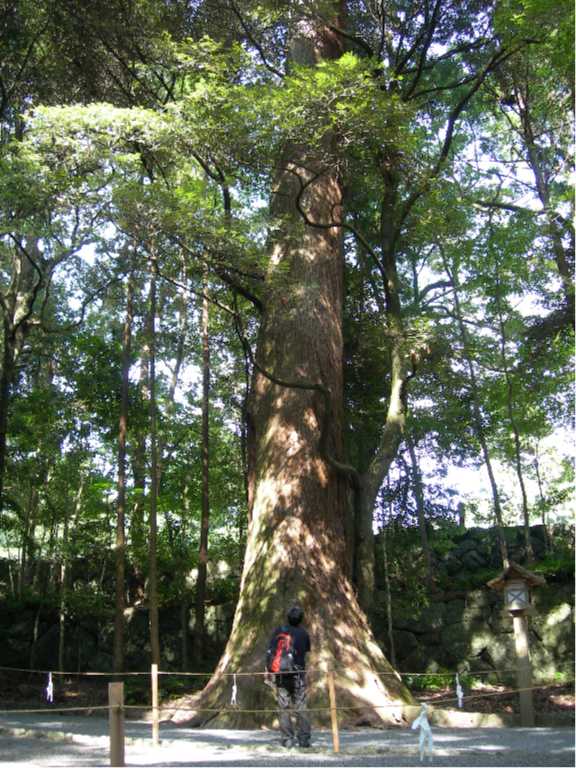
The oldest and most intuitive layer. Mountains, rivers, the sea, the wind, rice, great rocks, and ancient trees are all homes of kami. A sacred mountain such as Mount Miwa in Nara is itself the object of worship — there is no statue inside, because the mountain is the kami. This layer reflects the animistic sensibility woven deep into Japanese culture: the feeling that the natural world is alive with presence.
Kami of myth
Then there are the named deities of Japan’s creation myths, recorded in the Kojiki (712) and the Nihon Shoki (720). Chief among them is Amaterasu Omikami, the sun goddess, from whom the imperial line traditionally claims descent, and who is enshrined at Ise. Her brother Susanoo, the storm god, and Okuninushi, the deity of Izumo who ceded the land to the heavenly kami, belong to the same great cycle of stories. Early tradition even ranked them, distinguishing the amatsukami (heavenly kami) from the kunitsukami (earthly kami), though later practice let the distinction fade.
Kami of people and ancestors
Perhaps the most striking category to a newcomer: human beings can become kami. Ancestors are venerated as protective spirits, and certain historical figures were enshrined as kami in their own right. The courtier Sugawara no Michizane, who died in exile in 903, was deified as Tenjin, the kami of learning, after a string of disasters was read as his angry spirit at work. The warlord who unified Japan, Tokugawa Ieyasu, was enshrined as a kami at Nikko. In the modern era, Emperor Meiji was enshrined at Meiji Jingu in Tokyo. A person, in this world-view, does not have to become divine so much as reveal an extraordinary power that was always kami-like.
Underlying all of these is a further idea. Many local communities are protected by an ujigami (氏神), a tutelary kami of the district — originally a clan ancestor, now more often simply the kami of one’s neighborhood shrine, whose parishioners are the ujiko, the “children” of the kami.
Bright and rough: the two faces of a kami
Because a kami is defined by power rather than by goodness, it has two faces, and Shinto took this seriously enough to name them. The spirit of a kami, its mitama (御魂), was traditionally described as having a gentle aspect, the nigimitama (和魂), which brings harmony and blessing, and a rough aspect, the aramitama (荒魂), which is wild and can bring calamity. The two were sometimes enshrined and worshipped separately, as though a single kami had a calm hand and a raised one.
This double nature explains much of Shinto practice. A kami that is properly honored — given a clean shrine, offerings, and festivals — turns its gentle face toward the community. A kami that is neglected or offended may loose its rough side as tatari (祟り), divine punishment in the form of illness, storm, or misfortune. The cult of Tenjin began exactly this way: to pacify a dangerous spirit by treating it as a kami.
Closely tied to this is the Shinto concern with purity. Kami are drawn to cleanliness and repelled by kegare (穢れ), a kind of spiritual pollution associated above all with death, blood, and decay. This is why worshippers rinse their hands and mouth at the stone basin before approaching, and why priests perform harae (祓, ritual purification). Shinto has relatively little to say about sin in the moral sense; its deeper axis runs between the pure and the polluted, the ordinary and the sacred.
How a kami is met: shrines, sacred objects, and festivals
If a kami is a presence rather than a person, how do people encounter one? The answer shapes the whole architecture of a Japanese shrine, or jinja (神社).
A kami is invisible and does not permanently reside in the shrine. Instead it is invited to descend into a yorishiro (依代), an object that can host it — a tree, a rock, or, inside the shrine’s innermost hall, a shintai (神体, “kami-body”): a sacred object such as a mirror, a sword, or a stone in which the kami’s presence is enshrined. Ordinary worshippers never see it. The mirror at Ise, associated with Amaterasu, is the most famous example. This is a crucial difference from a Buddhist temple, where the central image is a statue of a buddha meant to be seen and contemplated. (We explore that contrast in our guide to the difference between shrines and temples.)
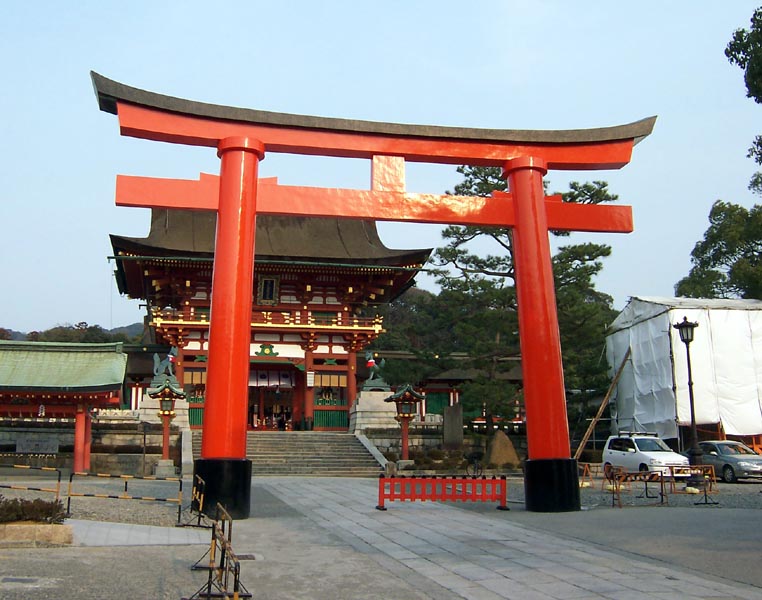
The torii (鳥居) gate that marks a shrine’s entrance is best understood in this light: it is a threshold between ordinary space and the space where a kami may be present. The straw rope called shimenawa (注連縄) does the same work on a smaller scale, cordoning off a tree or rock as sacred ground. And the great communal matsuri (祭, festival) is, at heart, the moment when the kami is welcomed out among the people — often carried through the streets in a portable shrine, the mikoshi — entertained, thanked, and sent back.
Kami through history: myth, buddhas, and the state
The idea of kami is old, but it did not stand still. Three turning points matter most.
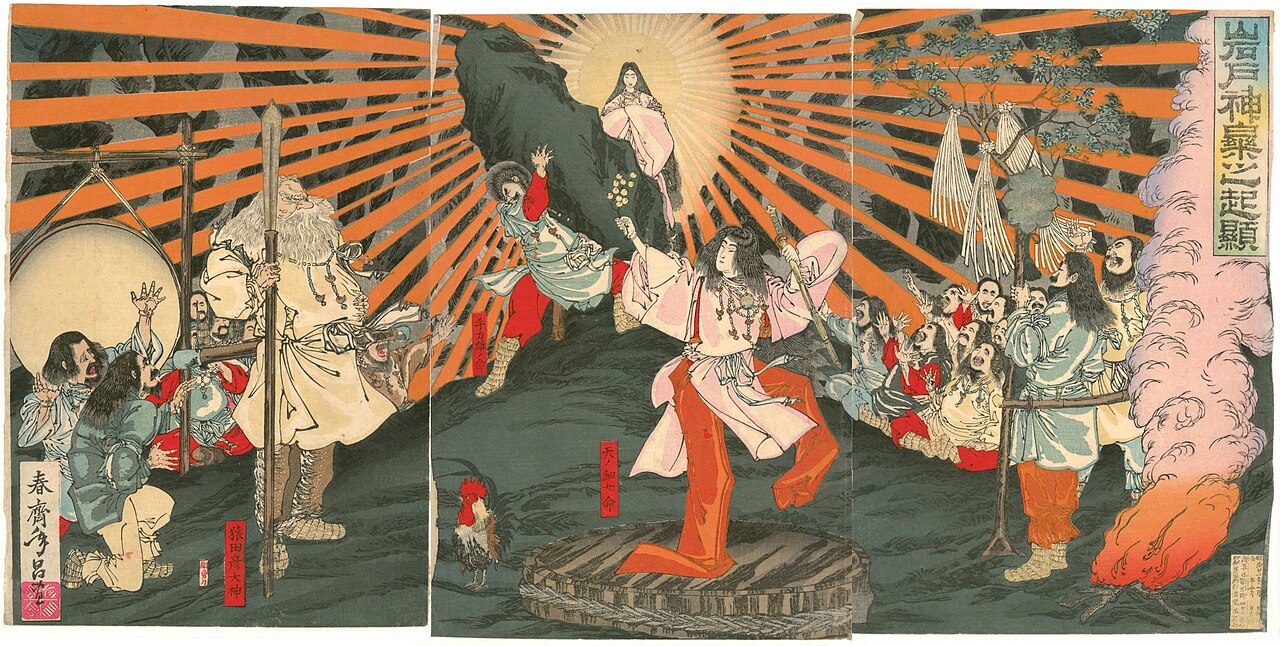
The first was the writing down of the myths. When the Kojiki and Nihon Shoki were compiled in the early eighth century, a loose web of local nature-worship was gathered into a national story centered on Amaterasu and the imperial line. One of its most beloved episodes tells how the sun goddess, offended by her brother, hid in a cave called Ame-no-Iwato and plunged the world into darkness, until the other kami lured her out with music, laughter, and a mirror — a myth still echoed in shrine dance today.
The second was the arrival of Buddhism in the sixth century. Rather than displacing the kami, Buddhism fused with them over the following thousand years in a synthesis called shinbutsu-shugo (神仏習合), “the fusion of kami and buddhas.” Under the theory of honji suijaku, kami came to be understood as local manifestations of buddhas and bodhisattvas. For most of Japanese history, in other words, kami and buddhas shared the same sacred spaces. (This remarkable blending has its own article: Shinbutsu-Shugo, when Japan’s gods and buddhas were one.)
The third turning point was the most disruptive. In 1868 the new Meiji government forcibly separated the two traditions in a policy called shinbutsu bunri, and promoted a state-managed Shinto that placed the emperor, as a descendant of Amaterasu, at the center of national life. This State Shinto was dismantled after 1945, and the kami returned to their older, quieter role: presences of place, harvest, and community rather than instruments of the state.
Kami in Japan today
Ask many Japanese people today whether they “believe in” kami and you may get a shrug. Formal belief is not really the point. Kami are woven into the rhythm of ordinary life more as practice and sensibility than as doctrine. Some 80,000 shrines are scattered across the country, and at New Year tens of millions of people make hatsumode (初詣), the first shrine visit of the year, to ask the kami for good fortune.
People buy omamori (お守り), protective amulets, for safe travel or success in exams; they bring newborns to the local shrine, and hold weddings before the kami. A new building may be blessed with a ground-breaking rite, a jichinsai, to placate the kami of the land. Even outside religion, the intuition survives in everyday phrases — thanking one’s food, treating tools and old objects with care, sensing something worthy of respect in a very old tree. That quiet animism, the feeling that the world is populated by presences deserving of courtesy, may be the most enduring form the kami take.
Visiting with kami in mind
Understanding kami changes how a shrine visit feels. A few small gestures show respect for the presence you are visiting. Pause and give a slight bow when you pass through the torii; the center of the path is traditionally left for the kami, so walk a little to one side. At the water basin, the temizuya, rinse your hands and mouth to set aside everyday impurity before you approach. At the main hall the customary sequence is two bows, two claps, a silent wish, and a final bow — the claps are a way of announcing yourself to the kami. None of this requires belief. It is simply the etiquette of entering a space where, for a thousand years, people have felt themselves to be in the company of something greater.
Trivia: the kami who failed exams
Sugawara no Michizane, deified as Tenjin, was in life one of the finest scholars of his age — which is why he became the kami of learning. Today his shrines, such as Dazaifu Tenmangu in Kyushu and Kitano Tenmangu in Kyoto, fill each winter with students who hang wooden ema plaques begging for success in their entrance examinations. It is a striking illustration of how a kami works: an angry ghost, feared and pacified eleven centuries ago, has become the patron of anxious teenagers cramming for their tests. The awe that Norinaga described has simply changed its clothes.


_(41314901970).jpg)
_01.JPG)

コメントを残す