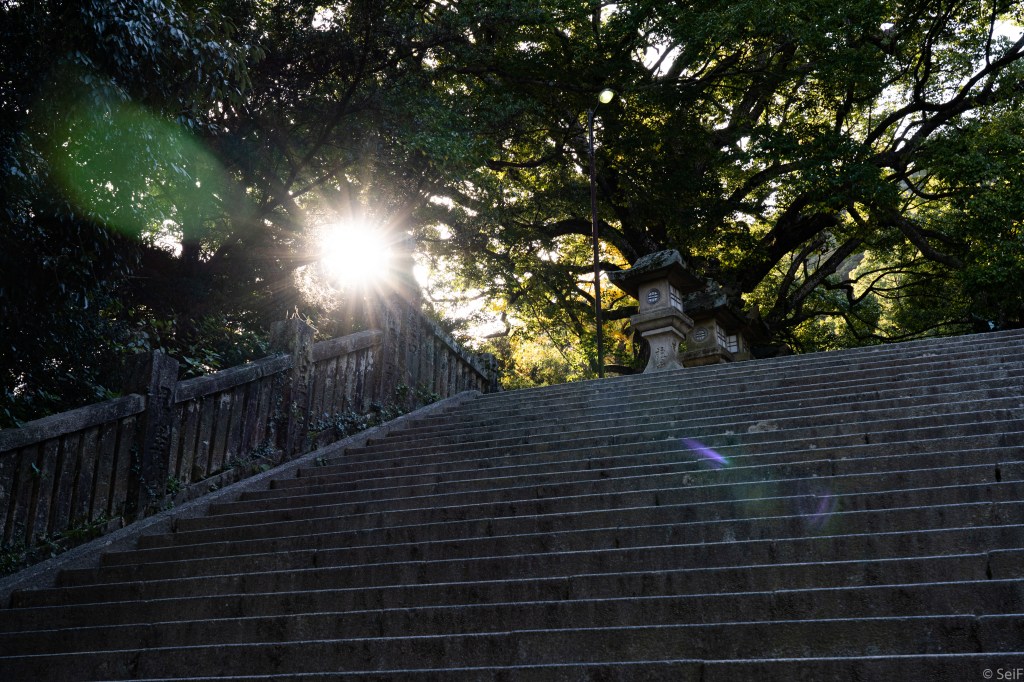
On the wooded slope of a mountain in Kagawa Prefecture, on the island of Shikoku, a stone stairway climbs past souvenir shops, a great gate, carved halls and rows of lanterns. Count the steps and you will reach 785 before you stand in front of the main hall of Kotohira-gu, the shrine that most Japanese simply call Konpira-san. Keep going, and the count rises to 1,368 at the inner shrine near the top.
For centuries, people have made this climb to pray above all for safety at sea. In the Edo period (1603–1867), when ordinary people needed a religious reason to travel, a trip to Konpira was a once-in-a-lifetime dream. Those who could not go sometimes sent a dog in their place, or set a barrel adrift on the sea. This guide explains who is worshipped here, how a crocodile god of India’s Ganges River came to watch over Japanese sailors, what changed in 1868, and how to plan your climb. Where sources disagree, we say so.
In this article
- Kotohira-gu at a glance
- Omononushi and Emperor Sutoku: who is worshipped here
- Why sailors pray to Konpira
- Konpira Daigongen: a crocodile god from the Ganges
- 1868: from Konpira Daigongen to Kotohira-gu
- Konpira mairi: dogs, barrels and the Edo pilgrimage boom
- Climbing the 785 steps
- The Shoin and the paintings of Maruyama Okyo
- Kanamaru-za: Japan’s oldest surviving kabuki theater
- Practical info: visiting Kotohira-gu
- Trivia: the five candy sellers inside the gate
- In closing
Kotohira-gu at a glance
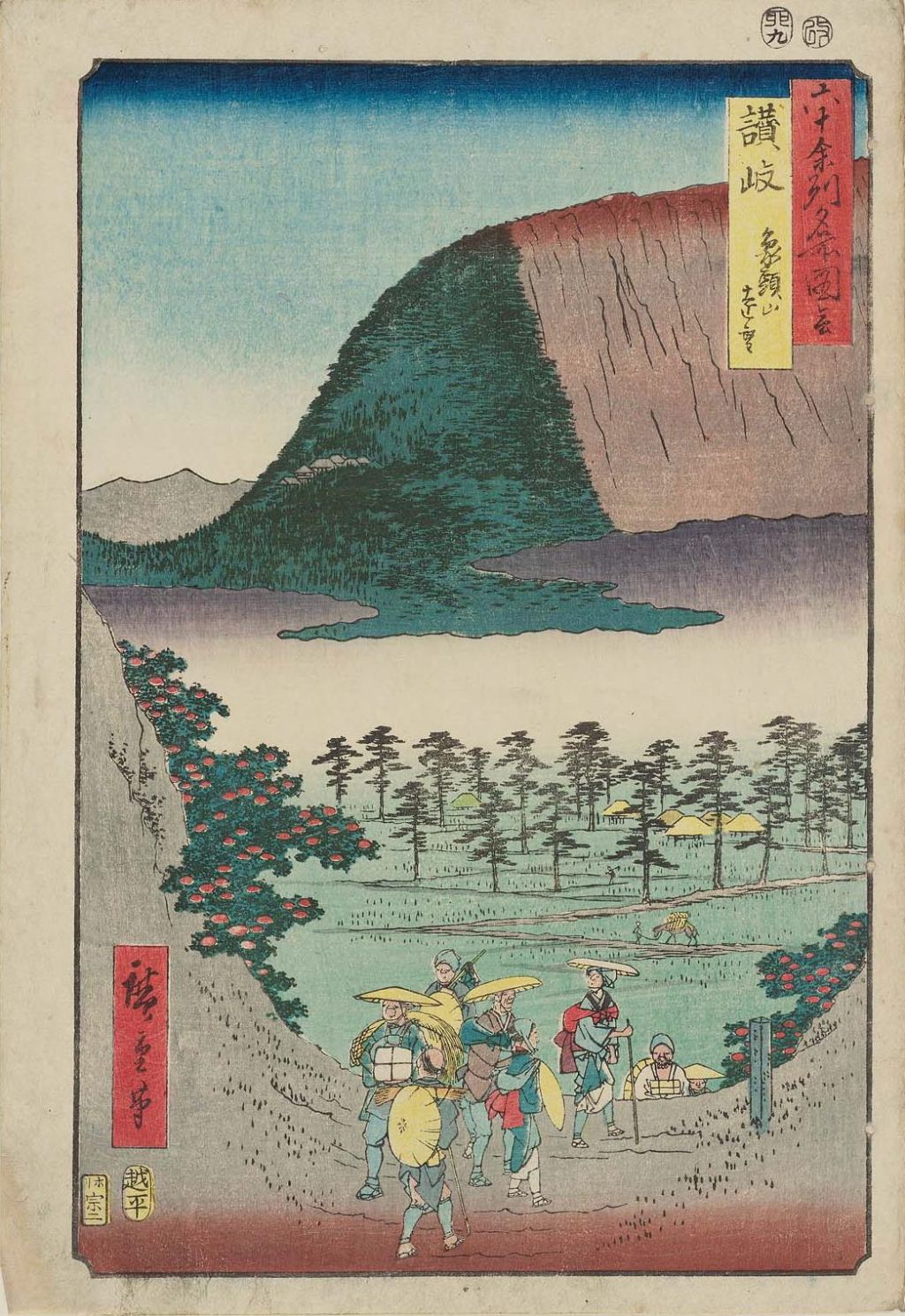
Kotohira-gu stands on the eastern slope of Mount Zozu (Zozusan, “elephant’s head mountain”), above the small town of Kotohira in western Kagawa. The mountain’s outline is said to resemble an elephant’s head. The shrine is the head shrine of the many Kotohira and Konpira shrines across Japan. Its kami are asked for help with farming, medicine and much else, but above all Konpira is the guardian of people who work at sea.
The precinct climbs the mountain in stages. The main hall, the Gohongu, stands at step 785, about 251 meters above sea level. The inner shrine, Izutama-jinja, lies 583 steps higher, at about 421 meters. Kotohira-gu is also unusually independent: in 2020 it withdrew from the Association of Shinto Shrines, the national body that oversees most of Japan’s shrines.
Omononushi and Emperor Sutoku: who is worshipped here
The main hall enshrines two kami (the gods and spirits of Shinto): Omononushi and Emperor Sutoku.
Omononushi, the god who came over the sea
Japan’s oldest chronicles tie Omononushi closely to Okuninushi, the great land-building god worshipped at Izumo Taisha. In the Kojiki (712), after Okuninushi’s helper god leaves him, a god appears, “lighting up the sea,” and offers to help if Okuninushi will worship him. That god is enshrined on Mount Miwa in Yamato (today’s Nara Prefecture). The Nihon Shoki (720) goes further. There the god explains that he is Okuninushi’s own “lucky spirit and wondrous spirit,” and the text lists Omononushi among Okuninushi’s many names.
Kotohira-gu’s own history follows this tradition, describing Omononushi as the gentle, peaceful aspect of Okuninushi. Shrine legend adds a local story: in ancient times Mount Zozu was an island in the Seto Inland Sea, and Omononushi built a temporary palace here as a base from which to govern the land.
Sutoku, the exiled emperor
The second kami is Emperor Sutoku (1119–1164), the 75th emperor. After losing the Hogen Rebellion of 1156, a short and bloody struggle over the throne in Kyoto, he was exiled to Sanuki Province (today’s Kagawa) and never returned. According to the shrine, he venerated the kami of this mountain during his exile and spent time here in retreat. He died in Sanuki in 1164 and was enshrined alongside Omononushi in 1165.
Later generations feared Sutoku as an onryo (vengeful spirit), and medieval tales describe him dying full of rage against the court that banished him. Japan has a long tradition of calming such spirits by worshipping them as kami; our post on Dazaifu Tenmangu tells a similar story about Sugawara no Michizane.
Why sailors pray to Konpira
Why would a land-building god become a god of the sea? Part of the answer lies in the myth itself: Omononushi first appears as a light moving across the water. Part lies in geography. Mount Zozu rises out of the flat Sanuki plain, and sailors on the Seto Inland Sea used its outline as a landmark. Off the coast lie the Shiwaku Islands, where tidal currents meet and churn, waters long feared by sailors. Kagawa’s regional newspaper, the Shikoku Shimbun, traces the roots of the Konpira faith to these waters and the seafarers who crossed them.
Konpira was never only a sea god. According to Kokugakuin University’s Encyclopedia of Shinto, it was also worshipped as a kami of thunder, water and farming. The encyclopedia notes one theory about the name Kotohira: it may come from kotohiki, a magical practice of countering the sound of thunder with the sound of the koto (a long zither).
The decisive factor was trade. In the Edo period, coastal shipping boomed, and the crews of merchant ships such as the kitamaebune, which linked Osaka with northern Japan by way of the Seto Inland Sea and the Sea of Japan coast, became some of Konpira’s most devoted followers. The Encyclopedia of Shinto says the cult spread “along with the development of shipping.”
Konpira Daigongen: a crocodile god from the Ganges
For most of its history, Kotohira-gu was not a shrine in the modern sense. Like many sacred sites in Japan, it belonged to the world of shinbutsu-shugo, the fusion of kami worship and Buddhism. Its deity was worshipped as Konpira Daigongen. A gongen is a “provisional manifestation”: a buddha or bodhisattva who appears in Japan in the form of a kami.
The name Konpira comes from Kumbhira, a Sanskrit name. According to the Japanese encyclopedia Nipponica, Kumbhira was originally a water deity, a deified crocodile of the Ganges River. In Buddhist scriptures he became a guardian of the Buddha’s teaching, and in East Asia he is listed first among the Twelve Heavenly Generals who protect Yakushi, the buddha of healing. The Encyclopedia of Shinto describes him as “a dragon king sea deity.”
How exactly this Indian guardian became attached to a mountain in Shikoku is unclear. One theory holds that a statue of the general Kubira (Kumbhira) at the mountain’s Buddhist temple, Matsuo-ji, gave the local kami its name. Others see the Indian link as a later Buddhist layer added to an older kami of the mountain. According to the Encyclopedia of Shinto, Kumbhira and Konpira were fully merged only in the Edo period.
Yusei, the monk who became a tengu
Buddhist monks ran the mountain for centuries. The earliest reliable record of a Konpira hall is a munafuda (a wooden plaque recording a building’s construction) dated 1573. The key figure of this era was Yusei (died 1613), head of the temple Konko-in, which managed the mountain. According to the shrine, he trained at Koyasan and worked to restore Konpira after it was ruined in the wars of the late 16th century. Shrine tradition says that in 1613 he vowed to guard the mountain forever, turned into a tengu, a long-nosed mountain spirit of Japanese folklore, and vanished.
Through Yusei and the mountain ascetics (yamabushi) who followed him, Konpira became closely linked with tengu. Today Yusei is worshipped at the inner shrine as Izutamahiko no Mikoto, honored as the founder of the Konpira faith. Carvings of a tengu and a crow-tengu look down from the cliff above it.
1868: from Konpira Daigongen to Kotohira-gu
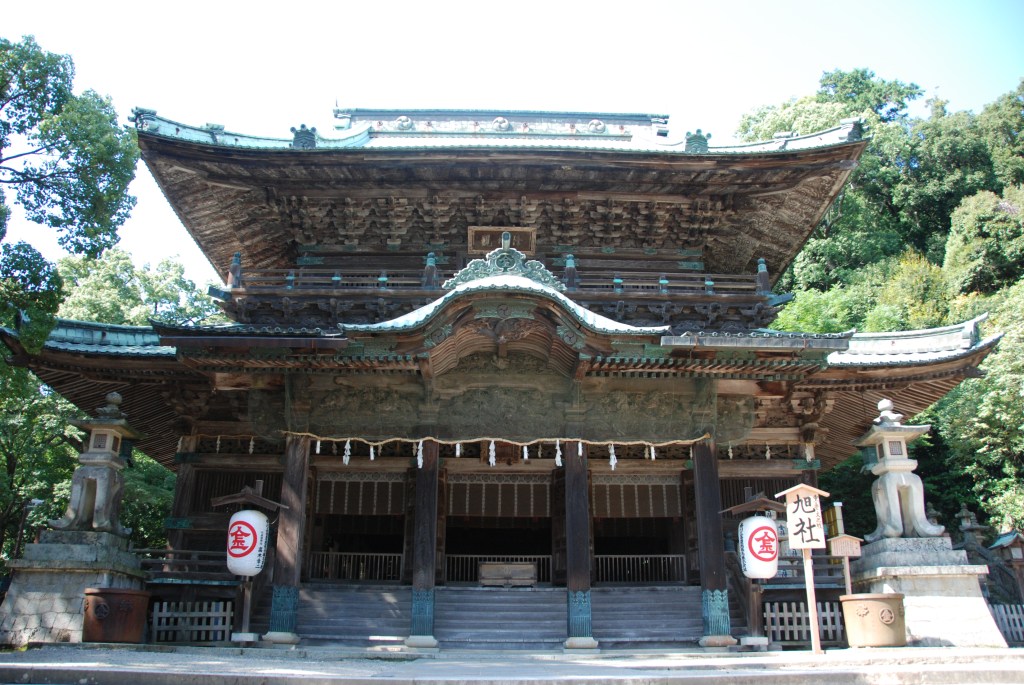
In 1868 the new Meiji government ordered the separation of kami and buddhas (shinbutsu bunri). Konpira Daigongen became a Shinto shrine. According to the shrine, it returned to its original name, Kotohira, and in the seventh month of 1868 it was granted the title -gu, used for shrines of special standing, becoming Kotohira-gu. Some other accounts give 1889 for the final adoption of this name. The head of Konko-in returned to lay life, and the temple handed over its buildings and holdings. Buddhist statues and ritual objects were removed, and according to Japanese accounts many were burned in 1872. The magnificent hall that had been built as the Kondo (“golden hall,” a Buddhist term) was renamed Asahi-sha.
Traces of the Buddhist past survive: the treasure museum holds an Eleven-Headed Kannon statue from the Heian period (794–1185). Our guide How to Read a Japanese Shrine will help you read the buildings as you climb.
Konpira mairi: dogs, barrels and the Edo pilgrimage boom
Konpira’s golden age came in the Edo period. The shogunate tightly controlled travel, but pilgrimage was an accepted reason for ordinary people to leave home. Konpira mairi, the pilgrimage to Konpira, became one of the most popular journeys in Japan. Groups called Konpira-ko (Konpira associations) pooled money so that members could take turns making the trip. In Edo (today’s Tokyo), the Kyogoku family, lords of the Marugame domain in Sanuki, opened the Konpira shrine in their city residence to the public. Kabuki and puppet plays spread the belief that prayers to Konpira would always be answered.
Many pilgrims came by sea. From the mid-18th century, boats known as Konpira-bune carried travelers from Osaka to the port of Marugame, from where they walked inland. The voyage gave its name to a folk song, Konpira fune fune (“Konpira boats, boats”), whose refrain describes a sail catching a following wind. It seems to have begun as a lively song sung with pilgrims at banquets, and today it is best known as a party game played with geisha. In the town of Kotohira, the Takadoro, a wooden lantern tower about 27 meters tall completed in 1860, is said to be the tallest wooden lantern in Japan; it served as a beacon for ships at sea.
Konpira-inu: dogs on pilgrimage
If you could not make the journey yourself, you could send your dog. According to the shrine and Kagawa’s official tourism site, owners tied a bag around the dog’s neck. It held a wooden tag with the owner’s name, money for the offering and money for the dog’s food. Travelers on the road passed the dog from hand to hand, fed it and pointed it toward Konpira, where the offering was made on the owner’s behalf. These proxy pilgrims became known as konpira-inu (“Konpira dogs”). How often this really happened is hard to measure, and some stories have surely grown in the retelling. Today a bronze konpira-inu by the illustrator Yumura Teruhiko stands in front of the Takahashi Yuichi Hall, and since January 2025 the shrine has offered a dog amulet set: a collar, a lead and a wooden name tag.
Nagashi-daru: barrels set adrift
Sailors who passed by without landing had another way to pray. They prepared a barrel of sake (miki, rice wine offered to the kami) or an offering, marked it for Konpira, and set it adrift. Fishermen who found such a nagashi-daru (“floating barrel”) carried it to the shrine on the senders’ behalf. Both the senders and the finders were believed to receive the kami’s blessing. The custom is still alive: in 2017, for example, the training sailing ship Nippon Maru held a nagashi-daru ceremony before a voyage to Hawaii, with the help of local fishermen.
Climbing the 785 steps
The climb begins in town, on a lane lined with udon shops and souvenir stalls. At step 365 you pass through the Omon, the great gate; beyond it lies the sacred precinct. Just inside, five vendors sit under large white parasols (see Trivia). Next comes Sakura-no-baba, a stone-paved avenue about 150 meters long, lined with stone lanterns and cherry trees. A cherry blossom festival is held here on April 10.
Beyond the treasure museum and the Shoin (see below) stands the Asahi-sha. Completed in 1845 after about 40 years of construction, it is, according to the shrine, the largest wooden shrine or temple building in Shikoku, and its surfaces are covered with carvings. It is designated an Important Cultural Property. In 2024 the shrine began a restoration expected to take about 18 years, so depending on when you visit, you may find work under way, scaffolding or a protective building around the hall.
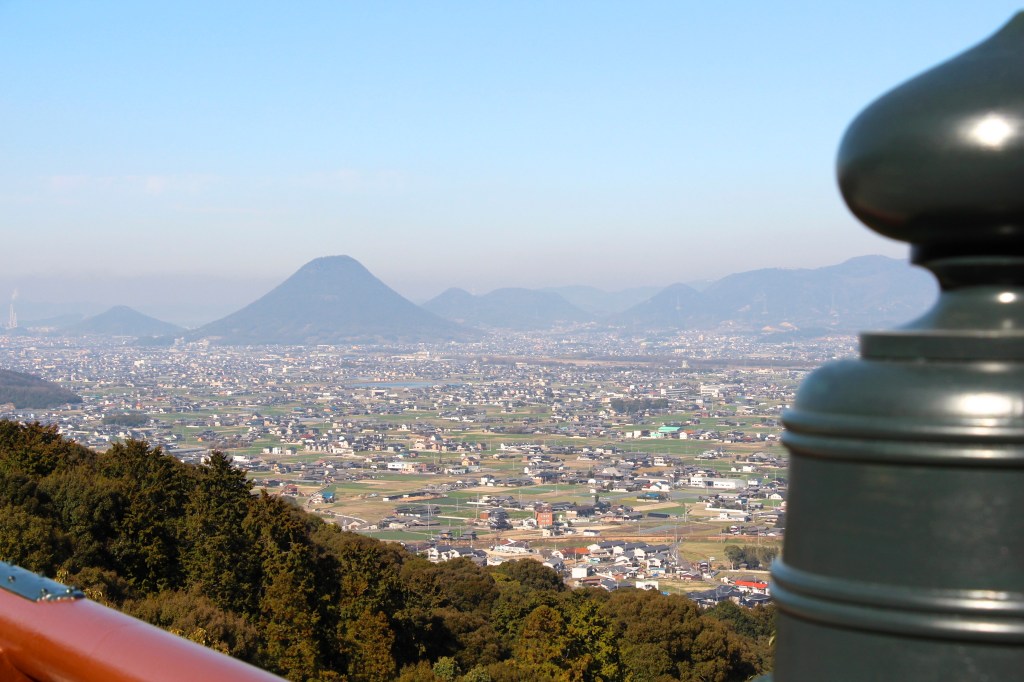
The final stretch to the main hall is the steepest. The Gohongu was last rebuilt in 1878, according to the shrine. Its roof is covered in layered cypress bark, renewed about every 33 years, and its ceiling panels are lacquered and painted by craftsmen of Wajima, a lacquer town on the Noto Peninsula. Beside the hall, an observation terrace looks out over the Sanuki plain, scattered with farm ponds and small cone-shaped hills. According to the shrine, you can see Sanuki Fuji (Mount Iino) and, on clear days, the Seto Ohashi Bridge over the Seto Inland Sea.
On to the inner shrine
From beside the main hall, a path leads on to Izutama-jinja, the inner shrine. It is about 1.2 kilometers and 583 more steps through quiet forest, far from the crowds. The shrine faces back toward the main hall as if guarding it, and the tengu carvings watch from the rock face of Itokuiwa, the cliff above the shrine. Allow about two and a half hours for the round trip from town to the inner shrine, and about one and a half hours to the main hall and back.
An easier start: the shuttle to the Omon
Until January 2020, a kago (palanquin) could carry you up to the Omon gate at step 365; the service ended because its bearers were growing old. Today a local bus company, Kotobus, runs a climbing shuttle by car from town to the Omon (1,000 yen one way, 7:00–19:00, no service January 1–3). From there you still walk the last 420 steps to the main hall. Shops at the foot of the steps lend bamboo walking sticks for a small fee.
The Shoin and the paintings of Maruyama Okyo
Many climbers walk straight past the Omote-shoin (“front reception hall”), said to date from about 1660 and used to receive important guests. Both the building and its wall paintings are Important Cultural Properties.
Those paintings are by Maruyama Okyo (1733–1795), the Kyoto artist who founded the Maruyama school. Okyo was famous for painting from close observation of nature. He decorated five rooms here: the Crane Room, with cranes at play; the Tiger Room, with tigers at play; a room showing the Seven Sages of the Bamboo Grove, a group of Chinese scholars who withdrew from public life; a landscape room; and the upper room, with a waterfall. Dated works from 1787 and 1794 come from his late, mature years. According to the shrine, they were painted in Kyoto with support from the wealthy Mitsui merchant family.
Look closely at the tigers. Tigers did not live in Japan, and Okyo never saw a live one. According to the Shikoku Shimbun, he painted them from tiger skins and his imagination; some viewers find them almost cat-like. Deeper in the complex, the Oku-shoin (“inner reception hall”) holds flower paintings by Ito Jakuchu, another great Kyoto painter of the time. It opens only on special occasions. The Omote-shoin is open 9:00–17:00 (last entry 16:30) and closed on Tuesdays (or the next weekday if Tuesday is a holiday); admission is 800 yen for adults.
Kanamaru-za: Japan’s oldest surviving kabuki theater
Where pilgrims gathered, entertainment followed. In 1835 a permanent playhouse opened in Kotohira, known as the Konpira Oshibai (“Konpira grand theater”). Renamed Kanamaru-za around 1900, it is the oldest surviving kabuki theater in Japan. It was designated an Important Cultural Property in 1970, taken apart and rebuilt on its present site between 1972 and 1976, and renovated again, with earthquake reinforcement, from 2003.
The theater keeps its old stage machinery: a revolving stage, trapdoors, the hanamichi walkway through the audience, and the kakesuji, a track that lets actors “fly” above the seats. All of it is still worked by hand by local volunteers. Since 1985, leading kabuki actors have come here in most years for a spring season, the Shikoku Konpira Kabuki Oshibai; the 39th season ran from April 10 to 26, 2026. At other times you can tour the building, including the space under the stage (9:00–17:00, adults 500 yen; closed during performances). It is a short walk from the start of the shrine’s approach.

Practical info: visiting Kotohira-gu
- Getting there from Takamatsu: JR trains run to JR Kotohira Station in about an hour (980 yen one way, covered by the Japan Rail Pass). Alternatively, the Kotoden Kotohira Line runs from Takamatsu-Chikko Station, a short walk from JR Takamatsu Station, to Kotoden-Kotohira Station in about an hour (780 yen from October 2026, about every 30 minutes; not covered by the Japan Rail Pass). From Okayama, a JR limited express takes about an hour. The foot of the steps is about a 10-minute walk from either station.
- Time and hours: Allow half a day, or most of a day with the inner shrine and Kanamaru-za. According to the shrine, the Omon gate is open 6:00–18:00 and the main hall’s doors 7:00–17:00. The path to the inner shrine is open 9:00–16:30 (from 7:00 between July 12 and September 30). Worship is free.
- Best time: In summer, climb early. Spring brings cherry blossoms (festival on April 10) and autumn brings maples (maple-viewing festival on November 10). The grand annual festival, the Reitaisai, takes place on October 9–11, with processions. New Year (hatsumode) brings very large crowds.
- Etiquette: This is an active place of worship. Bow at the torii, keep to the side of the steps and pray at the main hall in the usual way (see How to Visit a Japanese Shrine). Follow photography signs, wear good shoes and carry water.
- Amulets: The shrine’s best-known amulet is a bright yellow “happiness” charm, sold at the main hall; the inner shrine has its own amulets. Our guide to omamori and ema explains how to buy and keep them.
- Sanuki udon: Kagawa (the old province of Sanuki) is Japan’s udon heartland. Sanuki udon, thick wheat noodles known for their firm, chewy texture, is a cheap and filling reward after the climb, and several shops line the approach.
Trivia: the five candy sellers inside the gate
Just inside the Omon gate, five stalls sit under large white parasols. They belong to the Gonin Byakusho (“five farmer families”), the only merchants allowed to trade inside the sacred precinct. According to one of the families, the privilege was granted in return for their ancestors’ service in the shrine’s rituals over many generations. One of the shops says its family is now in its 28th generation.
What they sell is kamiyo-ame, a flat, fan-shaped golden candy said to share the kami’s blessing with pilgrims. It is so hard that it comes with a small hammer for breaking it into pieces.
In closing
Konpira-san is more than a fitness challenge of 785 steps. The climb tells a longer story: a god who came shining over the sea, an exiled emperor, a crocodile from the Ganges, a monk who became a tengu, and a temple-shrine cut in two in 1868. For centuries, ordinary people spent their savings, and sometimes sent their dogs, to pray here for those at sea.
So climb slowly. Stop at the Omon gate, the Shoin and the Asahi-sha. When you reach the terrace beside the main hall and look out toward the Seto Inland Sea, you will see the waters that made this mountain sacred.


コメントをどうぞ