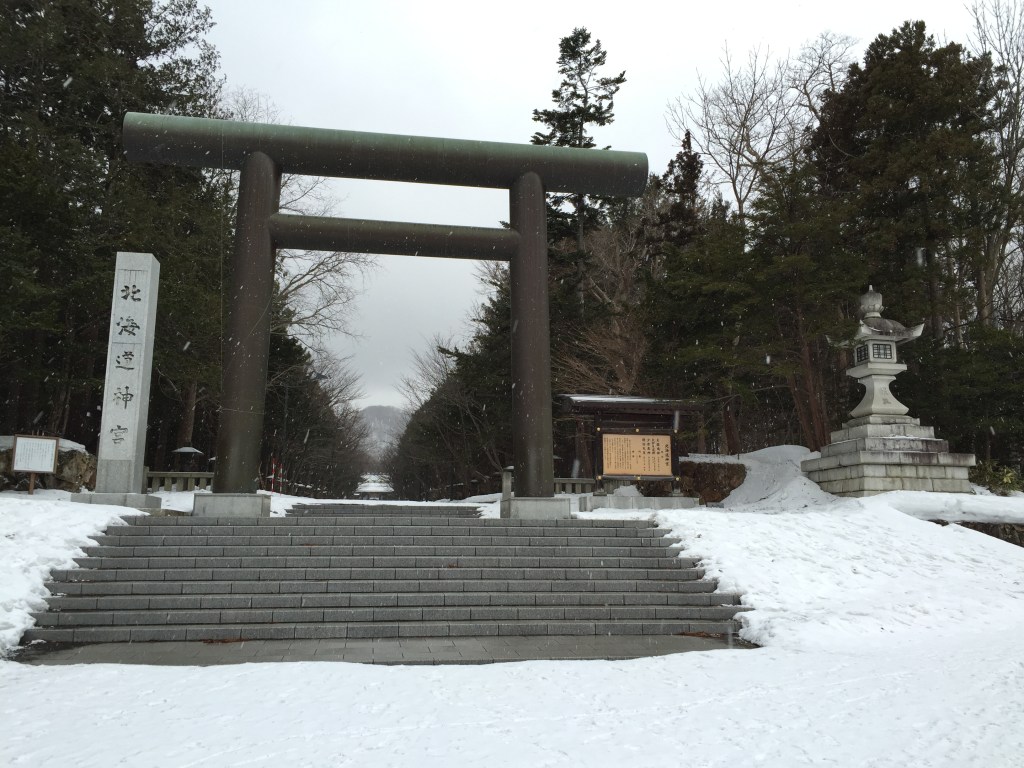
At the western edge of Sapporo, where the city’s grid of streets meets a forested hill, a broad gravel path leads through tall trees to Hokkaido Jingu. Squirrels dart across the approach, and in winter the path is packed hard with snow. It feels ancient. In fact, the shrine is only a little over 150 years old.
That youth is exactly what makes it interesting. Hokkaido Jingu was created by the new Meiji government in 1869–1871, at the very moment the state renamed the northern island “Hokkaido” and set out to colonize it. Its kami were chosen to bless that project. This guide explains those kami, the official who carried them north, the shrine’s place in State Shinto, and what it all meant for the Ainu, the Indigenous people of Hokkaido, along with the blossoms, the festival and practical tips. Where sources disagree, we say so.
In this article
- Hokkaido Jingu at a glance
- The three pioneer kami and Emperor Meiji
- 1869–1871: a shrine founded by the state
- Shima Yoshitake, the official who carried the kami
- Does the shrine face Russia?
- From Sapporo Jinja to Hokkaido Jingu: rank, empire and renaming
- The Ainu perspective
- Kaitaku Jinja: the shrine of the pioneers
- Blossoms, snow and Maruyama Park
- The Sapporo Festival (June 14–16)
- Practical info: visiting Hokkaido Jingu
- Trivia: a sweet named after a judge
- In closing
Hokkaido Jingu at a glance
Hokkaido Jingu stands in the Maruyama district of Chuo Ward, Sapporo, at the foot of Mount Maruyama and next to Maruyama Park. Its wooded precinct covers about 18 hectares. It is the island’s most important shrine and is often called Hokkaido’s ichinomiya (“first shrine” of a region), a modern, informal title, since Hokkaido lay outside Japan’s ancient province system.
Four kami are worshipped here: three “pioneer kami” enshrined in 1869, and Emperor Meiji, added in 1964. Until that year the shrine was called Sapporo Jinja (Sapporo Shrine). The main buildings you see today are not original. In November 1974 an arsonist set fire to the shrine, and the main hall and several other buildings burned down. According to the shrine, they were rebuilt in 1978.
The three pioneer kami and Emperor Meiji
The shrine’s original kami (the gods and spirits of Shinto) are known together as the kaitaku sanjin, “the three kami of pioneering.” Kaitaku means opening up or developing new land, the word the Meiji government used for its colonization of Hokkaido.
- Okunitama no Kami, “great spirit of the land.” Kokugakuin University’s Encyclopedia of Shinto explains kunitama as the spirit of a land or territory, a sacred power tied to a particular place. The shrine describes Okunitama as the kami of the land of Hokkaido itself.
- Onamuchi no Kami, another name for Okuninushi, the great land-building kami of the ancient myths (the shrine calls him the kami of making and developing the land), best known as the kami of Izumo Taisha.
- Sukunahikona no Kami, a tiny kami who, in the myths, arrives over the sea in a boat made from a seed pod. According to the Encyclopedia of Shinto, he worked with Onamuchi to develop the land and to create medicines, and then departed for Tokoyo, a distant otherworld. The shrine honors him above all as a kami of healing.
The choice was deliberate. In Japan’s oldest chronicles, Onamuchi and Sukunahikona are the partners who “complete the land,” making a raw world fit for people to live and farm in. For a government sending settlers into what it saw as a frontier, they were the obvious patrons.
In 1964 a fourth kami joined them: Emperor Meiji (reigned 1867–1912), the emperor in whose name Hokkaido was colonized. According to Sapporo’s official tourism site, Emperor Showa granted permission for the addition. He is also the kami of Tokyo’s Meiji Jingu.
1869–1871: a shrine founded by the state
Before 1869 most of the island was known to the Japanese as Ezochi, the land of the Ezo, a term for the Ainu. Japanese settlement was largely limited to the lands of the Matsumae domain in the far south, and Japanese merchants ran trading posts along the coasts; most of the island remained Ainu land. In 1869, a year after the Meiji Restoration, the new government renamed the island Hokkaido and created the Kaitakushi, usually translated as the Hokkaido Development Commission, to govern and settle it.
The religious side of the project began at the same time. According to the shrine’s own history, in the ninth month of 1869, by order of Emperor Meiji, the three pioneer kami were ritually enshrined at the Jingikan, the government’s office of Shinto rites, in Tokyo, and their sacred objects were sent north by way of Hakodate. In 1870 a temporary shrine was built near the Sosei River, the canal that still divides Sapporo’s street addresses into east and west. In the fifth month of 1871 the shrine was named Sapporo Jinja, and in the ninth month a new shrine was completed on the present site at Maruyama and the kami were moved into it. (These months follow the old lunar calendar, used in Japan until 1872.)
The timing matters. The same government was then forcing the separation of Shinto and Buddhism at old sacred sites across Japan, a policy described in our post on shinbutsu-shugo. Sapporo Jinja had no Buddhist past to remove: it was a shrine of the new state from its first day, in a city that did not yet exist.
Shima Yoshitake, the official who carried the kami
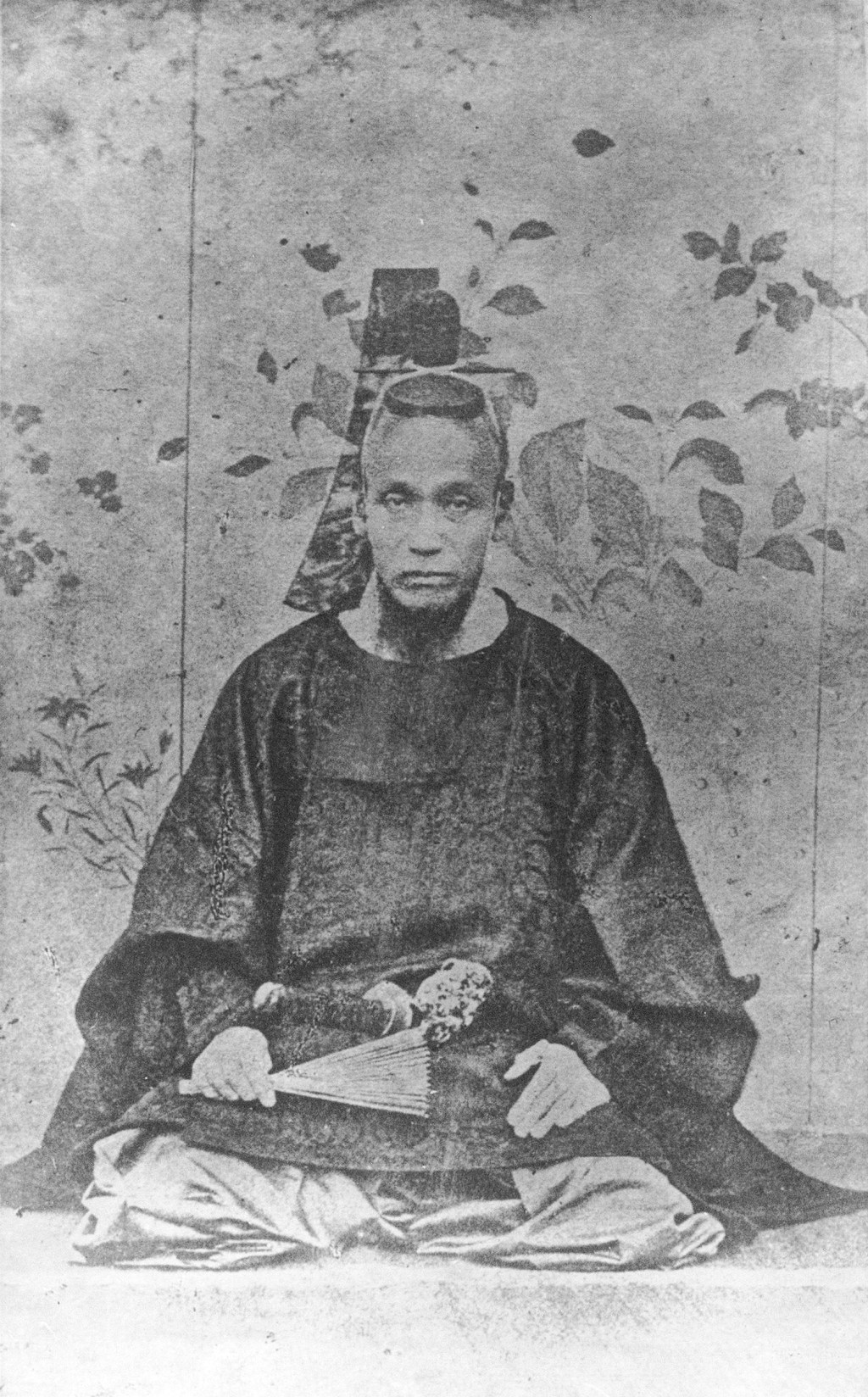
The man who brought the kami to Sapporo was Shima Yoshitake (1822–1874), a samurai of the Saga domain in Kyushu. He already knew the north: in the 1850s his lord sent him to travel through and survey the Ezo territories. In 1869 he was appointed a hangan, a senior official (literally “judge”) of the Kaitakushi, and ordered to build the commission’s headquarters at Sapporo, then a nearly empty plain.
The story Sapporo tells about him is vivid. Shima is said to have carried the sacred objects of the three kami on his own back from Hakodate, over rough and snowy roads, reaching Zenibako, on the coast between Otaru and Sapporo, in the tenth month of 1869. According to the shrine, the kami rested there, at the commission’s temporary office, until the twelfth month. He then laid out the new city on a grid modeled on Kyoto, the ancient capital. He also chose Maruyama as the site for the shrine; according to Sapporo’s tourism board, he valued a place with mountains on three sides and a plain opening out on the fourth. A line attributed to him predicts that Sapporo will one day be the foremost city of the “five continents” (the whole world).
His time in Hokkaido was short. He was dismissed in early 1870, only months after arriving. Accounts differ on why. Sapporo’s tourism board points to slow, costly winter construction and disagreements with his superior; other historians stress friction with the powerful merchants who ran the fishery contracts. He later served briefly as governor of Akita, then returned to Saga, where in 1874 he joined Eto Shinpei in the Saga Rebellion against the government. The rebellion failed, and Shima was executed on April 13, 1874.
So the “father of Sapporo” died as a rebel. In his native Saga, historian Michael Roellinghoff notes, his memory has been ambiguous. In Sapporo he is a founding hero. A bronze statue about four meters tall was erected at Hokkaido Jingu in 1974, the centenary of his death, and another stands at Sapporo City Hall.
Does the shrine face Russia?
Many guides to Hokkaido Jingu repeat one story: the shrine faces northeast, toward Russia, so that its kami could guard Japan’s new frontier. In the 1860s and 1870s the Russian Empire was indeed active in Sakhalin and the Kuril Islands, and fear of Russian expansion was one of the reasons the Meiji government moved so quickly to settle Hokkaido.
The details, however, are less clear than the story. Japanese sources variously say that the great torii faces northeast, or that the main hall and torii do. We could not find this explanation in the shrine’s own history or its English pages. Northeast is also the traditional “demon gate” (kimon), the unlucky direction in Chinese-derived geomancy, and some writers offer that as an alternative reading. Treat “facing Russia” as a popular theory, not an established fact.
From Sapporo Jinja to Hokkaido Jingu: rank, empire and renaming
In 1871 the Meiji government created a national ranking system for shrines. According to the Encyclopedia of Shinto, it divided them into kansha (official, state-supported shrines) and shosha (all others), with grades within each. Sapporo Jinja climbed this ladder quickly. It entered the system in 1871 and rose step by step until, in 1899, it became a kanpei taisha, a “major imperial shrine,” the highest grade.
This was part of what historians call State Shinto: the network of laws, ranks and rituals that tied shrines to the state and to the emperor between the Meiji era and 1945. The term itself is debated, but the Hokkaido case shows the pattern clearly. A shrine was built where the state was expanding, its kami were chosen to sanctify that expansion, and the state ranked and supported it.
The pattern traveled. When Japan built a great shrine in Taipei after taking Taiwan, the Taiwan Shrine (1901) enshrined the same three pioneer kami alongside Prince Kitashirakawa Yoshihisa, who had died during the invasion of the island. Karafuto Shrine (1911), in the Japanese-ruled south of Sakhalin, enshrined the same three. The historian Nakajima Michio has described how such “overseas shrines” became instruments of colonial rule. These shrines disappeared with Japan’s empire in 1945. After the war the state’s support for shrines ended and the ranking system was abolished. Sapporo Jinja continued as an ordinary religious body.
Why “Jingu”?
In 1964 Emperor Meiji was added to the kami, and Sapporo Jinja was renamed Hokkaido Jingu. The title jingu is generally reserved for shrines that enshrine an emperor or an imperial ancestor, such as Ise Jingu, dedicated to the sun goddess Amaterasu, and Meiji Jingu. Enshrining Emperor Meiji made the new title possible. The new name also tied the shrine to the whole island rather than one city.
The Ainu perspective
The official story of Hokkaido Jingu is a story of pioneers. But the land they “opened up” was not empty. The Ainu are the Indigenous people of Hokkaido, and also historically of southern Sakhalin and the Kuril Islands. Even the name Sapporo is generally traced to Ainu words; the leading theory reads it as “dry” and “wide,” describing the land or its river, though other explanations exist.
What colonization meant
For the Ainu, the arrival of the Kaitakushi brought rapid and lasting harm. Legal scholars Ochiai Ken’ichi and Tsunemoto Teruki, writing in the Hokkaido Law Review, summarize the main measures. Under land regulations of 1872, all land in Hokkaido, including areas the Ainu had long used, was to be registered to owners, yet few Ainu obtained ownership. Deer hunting and salmon fishing, the basis of Ainu life, were soon prohibited across Hokkaido. Customs such as earrings for men and tattoos for women were banned. Settlers from Honshu arrived in large numbers, and the Ainu became a small minority in their own homeland.
In 1899 the Hokkaido Former Aborigines Protection Act offered Ainu families plots of farmland, but it is widely described as a tool of assimilation, and the land granted was often poorer than the settlers’ land. According to Upopoy, the Ainu language declined swiftly under the modernization policies that began in the Meiji era; in 2009 UNESCO listed it as an endangered language.
Recognition, slowly
The 1899 law was repealed only in 1997, when a new law to promote Ainu culture replaced it. In 2008 both houses of Japan’s parliament unanimously adopted a resolution recognizing the Ainu as an Indigenous people. In 2019 the Ainu Policy Promotion Act became the first Japanese law to state this recognition. It also led to Upopoy, the National Ainu Museum and Park in Shiraoi, southern Hokkaido, which opened on July 12, 2020, about three months late because of the pandemic. The act has its critics. Hokkaido University professor Jeffry Gayman, for example, argues that it focuses narrowly on culture and lacks a rights-based approach to the lands and resources taken from the Ainu.
Kamuy
Ainu spirituality has its own sacred beings, the kamuy. In Ainu belief, kamuy are spiritual beings found in animals, plants, fire, water, everyday tools and natural forces, and people keep up a relationship of respect with them through prayer and ritual (sources: Upopoy; the Hokkaido Museum; the University of Oregon’s Ainu collections). The word is sometimes compared to the Japanese kami, but the two belong to different religious traditions, and a similar sound should not be read as the same idea.
None of this makes a visit to Hokkaido Jingu wrong; today it is above all a place where Sapporo families pray at New Year and picnic under the blossoms. But a shrine to the “pioneer kami” makes the most sense when you know whose land was being pioneered. If you have time, a day at Upopoy tells the other half of the story.
Kaitaku Jinja: the shrine of the pioneers
Of the smaller shrines in the precinct, the most interesting is Kaitaku Jinja, the “Pioneers’ Shrine.” According to the shrine, it was founded in 1938, to mark 70 years of Hokkaido’s development, at the initiative of Ishiguro Hidehiko, then head of the Hokkaido government. It began with 36 people honored for their part in the opening of Hokkaido; a 37th, the settler Yoda Benzo, was added in 1954. Here, then, the kami are not myths but historical humans, an old Japanese practice of honoring people as kami after death.
Among them are Shima Yoshitake himself; the explorer Mamiya Rinzo, who mapped Sakhalin in the early 19th century; the Edo-period shipping merchant Takadaya Kahei; and the explorer Matsuura Takeshiro (1818–1888). Matsuura traveled through the Ezo lands repeatedly in the 1840s and 1850s. According to Japan’s National Diet Library, he coined the name “Hokkaido” in 1869 while serving in the Kaitakushi, then resigned in 1870, unhappy with the direction the commission was taking.
The shrine offers prayer tablets here for wishes such as passing exams, success in business and good health. It is also a quiet place to ask who counts as a pioneer, and who was already there.
Blossoms, snow and Maruyama Park
Spring: cherry and plum together
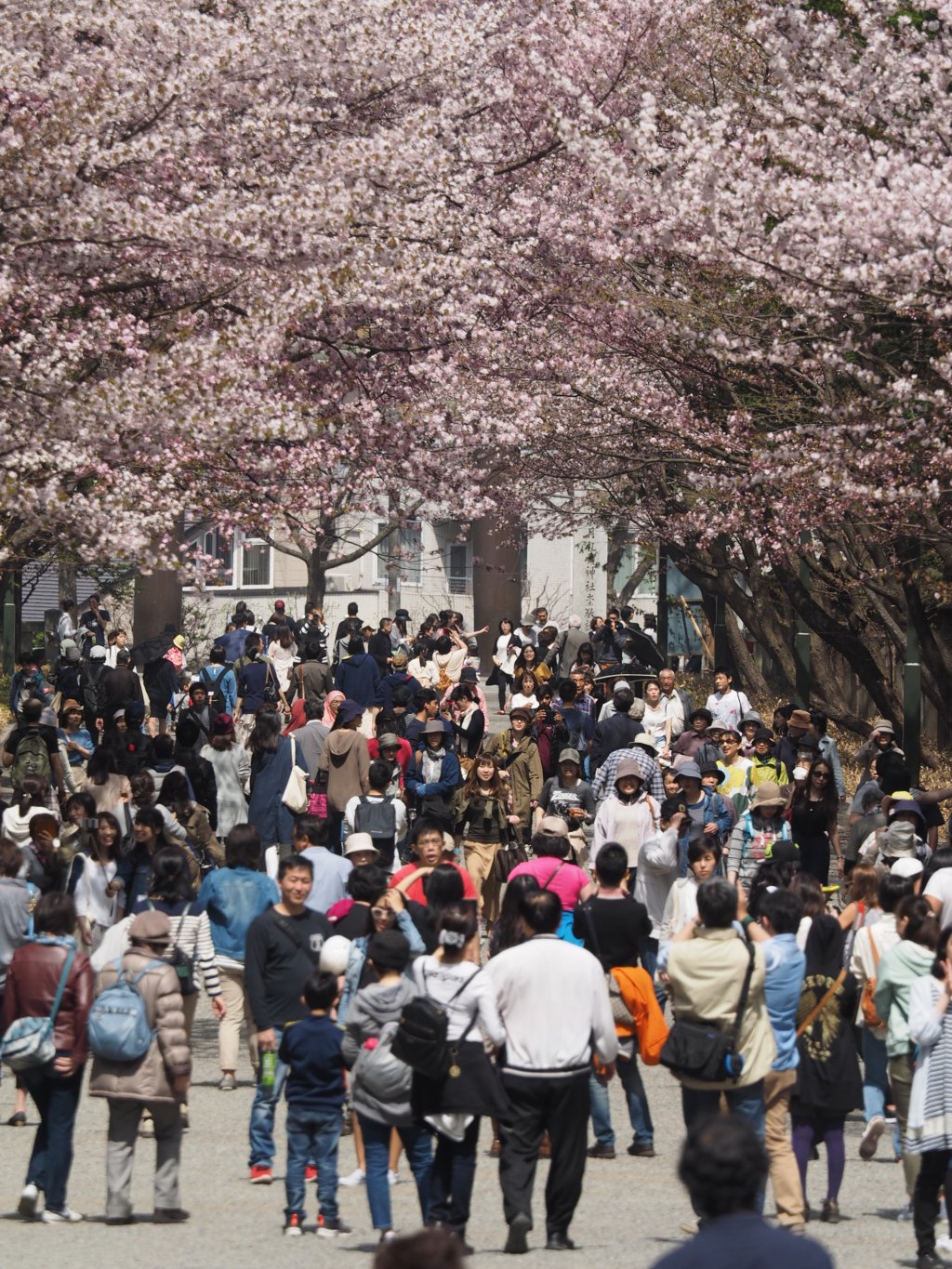
Spring comes late to Sapporo. The cherry trees usually bloom from late April to early May, around Japan’s Golden Week holidays, about a month after Tokyo. In Honshu, plum blossoms come weeks before the cherries, but here the plums bloom at almost the same time. The shrine’s grounds hold more than a thousand cherry trees and a plum grove; the exact counts vary by source, from about 1,000 to 1,400 cherry trees and 120 to 250 plum trees. During the season the crowds are large, and food stalls set up nearby.
Next door, Maruyama Park is one of Sapporo’s favorite cherry-viewing spots. It has a local custom you will not find in Kyoto: friends gather under the trees to grill lamb on portable barbecues, a Hokkaido dish called jingisukan. Barbecuing is allowed only in set areas and during set hours in the blossom season, and the rules change from year to year, so check the city’s notices before you bring a grill.
Winter: hatsumode in the snow
Hatsumode, the first shrine visit of the New Year, is Hokkaido Jingu’s busiest time. The gates open at midnight on January 1. Estimates vary, but recent reports suggest roughly 400,000 to 450,000 visitors over the first three days. Expect long queues below freezing and stalls selling hot food along the snowy approach. At other times in winter the shrine is quiet, and the snow-laden trees and torii are at their most beautiful.
The Sapporo Festival (June 14–16)
The shrine’s grand annual festival, the Reitaisai, is better known in the city as the Sapporo Matsuri (Sapporo Festival). It runs from June 14 to 16 every year, with the main rites on June 15. According to Sapporo’s tourism board, it dates back to 1872.
The highlight is the mikoshi togyo on June 16, the procession in which the kami travel through the city in portable shrines (mikoshi). More than a thousand people in Heian-period (794–1185) costume escort four mikoshi and eight floats from Maruyama into central Sapporo. Meanwhile Nakajima Park, south of the city center, fills with festival stalls and old-fashioned attractions.
Practical info: visiting Hokkaido Jingu
- Getting there: Take the Sapporo subway Tozai Line to Maruyama-Koen Station. From there it is about a 15-minute walk through Maruyama Park to the shrine. Buses also stop at Jingu-mae, a minute’s walk from the shrine. The address is 474 Miyagaoka, Chuo-ku, Sapporo.
- Hours and cost: Worship is free. The precinct opens early and closes in the late afternoon, with hours that change by season. According to official tourism sites, it is open 6:00–17:00 from April to October, 7:00–17:00 in March, and 7:00–16:00 from November to February. New Year hours are longer (on January 1 the gates open at midnight). Hours can change, so check before you go.
- Time needed: About an hour; more with Maruyama Park and the teahouse.
- Etiquette: Bow at the torii and walk to the side of the approach; the center is traditionally the path of the kami. Purify your hands at the water basin and pray in the usual way, as explained in How to Visit a Japanese Shrine. Our guide How to Read a Japanese Shrine will help you read the torii and other features. Please do not feed the squirrels or other wildlife.
- Winter visits: From December to March, paths are often packed snow or ice. Wear boots with a good grip or slip-on ice cleats, which are easy to find in shops around Sapporo. Give yourself extra time from the station; daylight ends early in midwinter.
- Best times: Late April to early May for blossoms; June 14–16 for the Sapporo Festival; a snowy weekday morning in January or February for quiet beauty. Avoid January 1–3 unless you want the crowds.
Trivia: a sweet named after a judge
Inside the precinct, near the west parking lot entrance, the Hokkaido confectioner Rokkatei runs a small teahouse, the Jingu Chaya. Its specialty is sold only here: Hangan-sama, a soft rice cake made with buckwheat flour, filled with sweet red bean paste and grilled to order on a hot plate. The name means “the honorable hangan” and refers to Shima Yoshitake, the Kaitakushi hangan (senior official) who brought the kami to Sapporo. It is best eaten hot, and visitors are offered a cup of tea with it.
So the man who planned Sapporo and died as a rebel is remembered in bronze, in a city grid and in a warm sweet you can hold in gloved hands.
In closing
Hokkaido Jingu is a young shrine with a big story. It was founded by a modern state to bless a modern project: the colonization of an island and the building of a city from nothing. Its kami came from the old myths of making a land fit to live in; its rank rose with the empire, and its pattern was copied in Taiwan and Sakhalin.
Walk the quiet approach, watch the squirrels and eat a hot Hangan-sama in the snow. But stop for a moment at Kaitaku Jinja, too. Behind the word “pioneer” lies a longer history, in which the Ainu and their kamuy were already at home on this land.


コメントをどうぞ