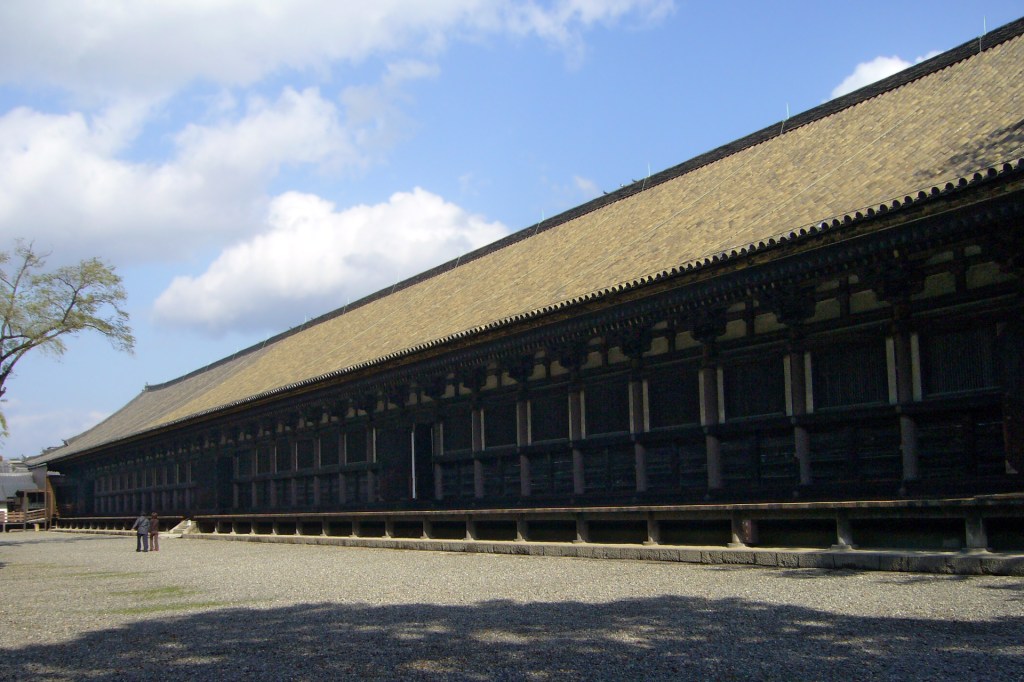
Step through the doors of Sanjūsangen-dō in eastern Kyoto and the effect is almost physical: rank upon rank of golden figures, more than a thousand of them, rising in tiers and receding into the dim length of the longest wooden hall in Japan. Each is a statue of Kannon, the bodhisattva of compassion; each has a thousand arms; and no two faces are quite the same. It is one of the most overwhelming interiors in the country—and, once you know what you are looking at, one of the most carefully thought-out.
This guide explains what the hall is, why an emperor and a warlord built it, how a thousand-and-one Kannon came to stand here, and how to read the arms, faces, and fierce guardians that fill it.
In this article
- A hall named for a number
- An emperor, a warlord, and a fire
- One thousand and one Kannon
- Reading the thousand arms
- The guardians: twenty-eight deities and the gods of wind and thunder
- The archers of the long veranda
- Visiting
- Trivia: the thunder god who came first
A hall named for a number
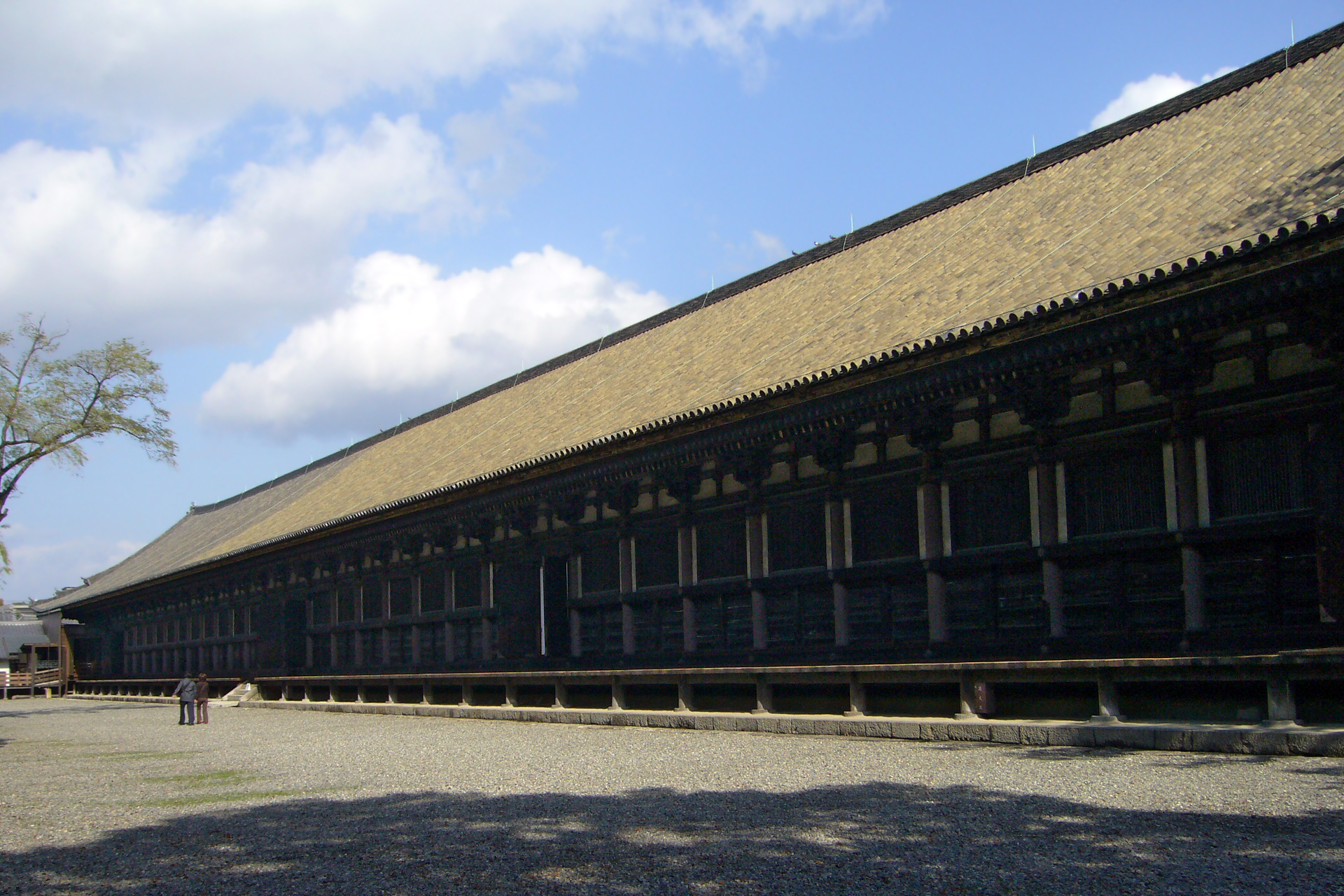
The temple’s formal name is Rengeō-in (蓮華王院), the “Hall of the Lotus King,” an epithet of Kannon. But everyone calls it Sanjūsangen-dō (三十三間堂), which means simply “the hall of thirty-three ken“—a ken being the bay, or space between two pillars, used to measure traditional Japanese buildings. The main hall runs thirty-three bays along its inner sanctuary, and the number is not an accident of carpentry. Thirty-three is sacred to Kannon, who is said to take thirty-three different forms to reach every kind of suffering being. The building is, in effect, a doctrine rendered as architecture.
Stretched to fit its contents, the hall measures roughly 120 meters from end to end, making it the longest wooden structure in Japan. It belongs to the Tendai school of Buddhism—one of the major schools of Japanese Buddhism—and is administered by the nearby Myōhō-in temple.
An emperor, a warlord, and a fire
Sanjūsangen-dō was built in 1164 within the sprawling palace complex of the retired emperor Go-Shirakawa, one of the most formidable political survivors of his age. He did not pay for it himself. The hall was funded by Taira no Kiyomori, the warrior-aristocrat whose clan then dominated the imperial court—an act of devotion that was also a calculated gift to a powerful patron. The result fused imperial piety and samurai wealth into a single vast reliquary of compassion.
The original hall did not survive. In 1249 a fire swept through the complex, and the building burned. Priests and townspeople managed to carry only 124 of the original one thousand standing Kannon out of the flames. Under the retired emperor Go-Saga, reconstruction began, and the hall you see today was completed in 1266—a Kamakura-period rebuilding that has now itself stood for more than seven and a half centuries.
One thousand and one Kannon
The hall holds 1,001 statues of the Thousand-Armed Kannon (Senju Kannon). At the center sits a single large seated figure, about 3.3 meters tall, carved in gilded wood by the master sculptor Tankei—son of the great Unkei—and completed in 1254, when the artist was in his eighties. It is a designated National Treasure. Ranged to its left and right stand one thousand life-sized Kannon, each roughly 1.7 meters tall, arranged in ten long tiers and fifty columns so that the whole army of figures can be seen at once.
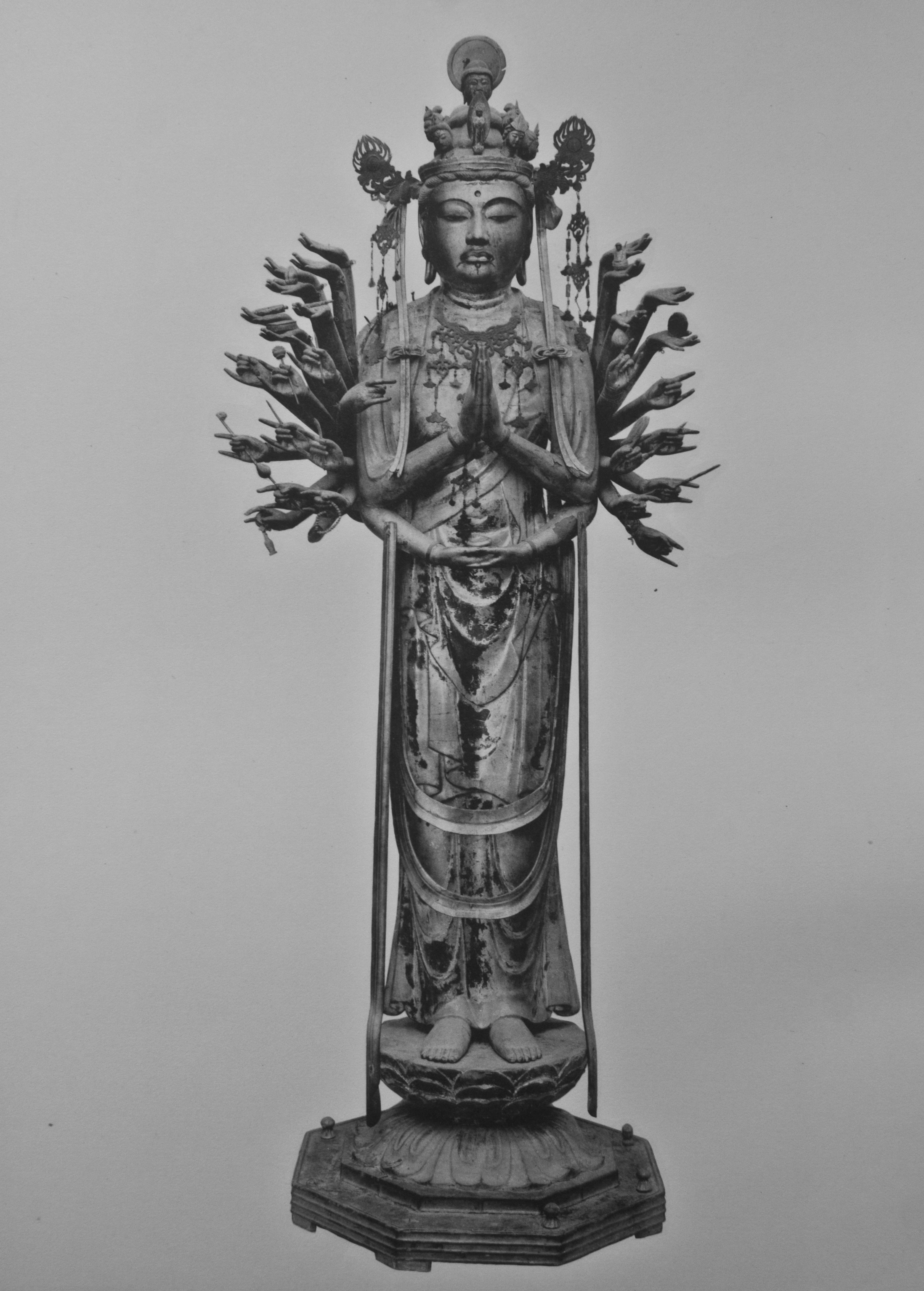
Of the thousand standing statues, 124 are the Heian-period originals rescued from the 1249 fire; the remaining 876 were carved during the thirteenth-century reconstruction by a small army of sculptors from the Kei school and other workshops. The entire assembly—the central Kannon, the thousand standing Kannon, and the guardians described below—is designated a National Treasure.
Reading the thousand arms
No statue in the hall actually has a thousand arms—that would be impossible to carve and unnecessary to the meaning. Each figure has eleven faces and forty-two arms: two joined in prayer at the chest, and forty more fanning out around the body, each grasping a different implement of salvation. The arithmetic is the point. In Buddhist cosmology there are twenty-five planes of existence, and each of the forty arms is said to save beings across all twenty-five—forty times twenty-five making a symbolic one thousand. The extra faces work the same way, letting Kannon look in every direction at once. (For how Kannon and the other ranks of Buddhist figures are told apart, see our guide to identifying Buddhist statues.)
Look closely and you notice that the faces differ, one statue to the next—a tilt of the head, a fuller cheek, an older or younger cast. This individuality has given rise to one of the tenderest sayings in Japanese Buddhism: that among the thousand faces you will always find the face of someone you long to see again. Whether or not you go looking, the effect of a thousand slightly different compassions is hard to forget.
The guardians: twenty-eight deities and the gods of wind and thunder
Standing in front of the Kannon ranks is a second, fiercer population: the Nijūhachi Bushū (二十八部衆), the twenty-eight guardian deities who serve and protect Senju Kannon and those who venerate the bodhisattva. Drawn largely from the older gods of India absorbed into Buddhism, they are rendered with startling realism—taut muscles, glass eyes, faces caught mid-snarl or mid-prayer—among the finest achievements of Kamakura-period sculpture.
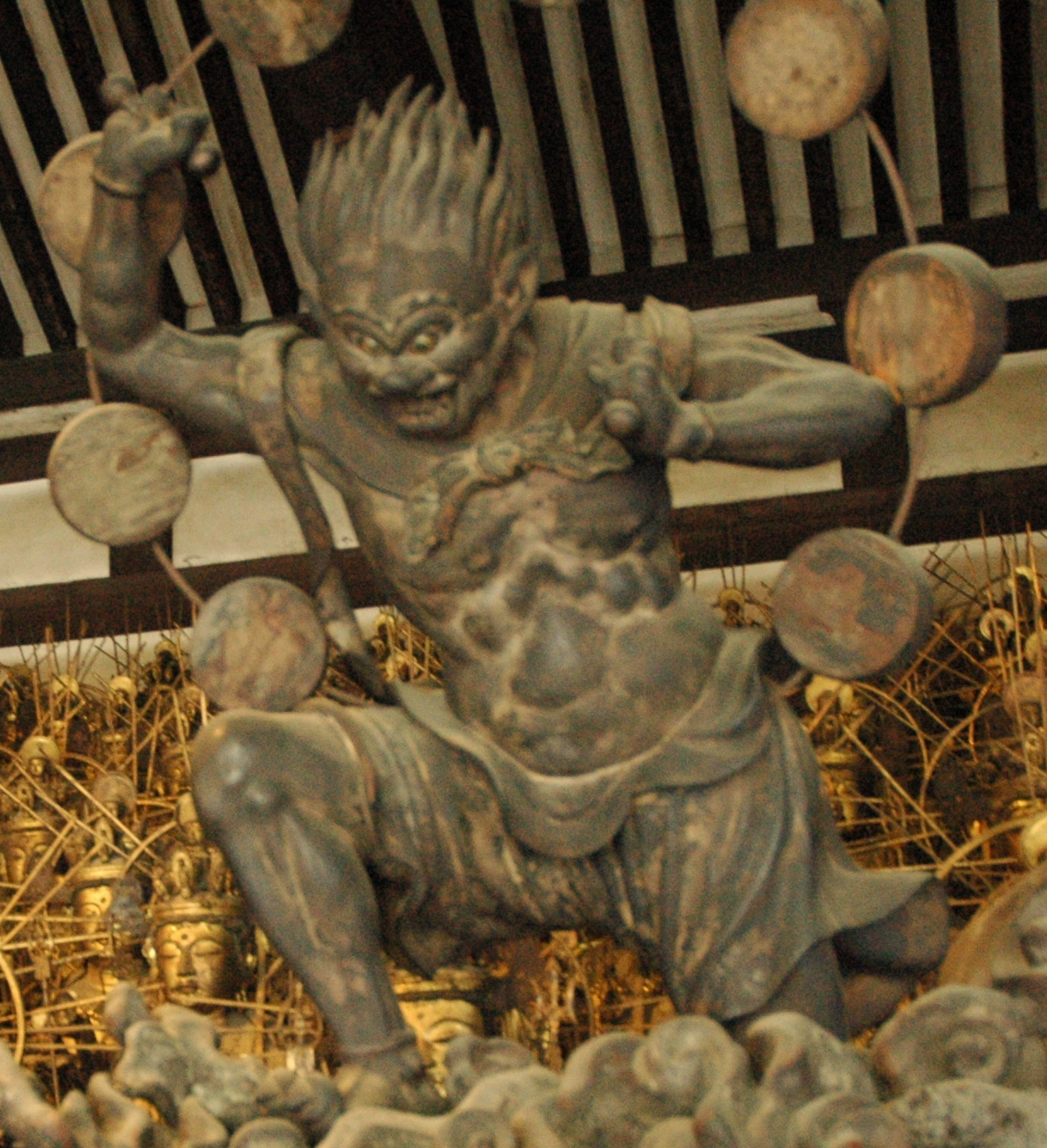
At the two ends of the row stand the most famous of them: Raijin, the god of thunder, gripping his ring of drums, and Fūjin, the god of wind, hauling his great bag of gales across his shoulders. Both descend from ancient Indian deities—the wind god Vāyu and a thunder deity of the Vedic hymns—and the Sanjūsangen-dō pair are among the oldest and most influential such figures in Japan, prototypes for the wind and thunder gods that later Japanese artists would paint again and again.
The archers of the long veranda
The hall’s extraordinary length gave it a second life that had nothing to do with worship. From the early seventeenth century, archers competed in the Tōshiya (通し矢), shooting arrows the entire length of the west veranda—around 120 meters—and counting how many they could send from one end to the other in a fixed time, sometimes over a full day and night. The records are staggering: the greatest marksmen loosed tens of thousands of arrows, of which many thousands flew the full distance. The contest ran for some 255 years in the Edo period. Its descendant survives today as a celebrated New Year archery event, when kimono-clad young archers, many marking their coming of age, draw their bows beside the hall each January.
Visiting
Sanjūsangen-dō sits in eastern Kyoto, a short walk or ride from the Kyoto National Museum and within reach of the Higashiyama temple district that includes Kiyomizu-dera. Shoes come off at the entrance, and the visit is a slow walk down the length of the hall and back. One important point of etiquette: photography is not permitted inside, in order to protect the statues and the atmosphere of worship—so the images stay in your memory rather than your phone. The January archery event and the associated “willow rite” for headache healing are the busiest days of the year.
Trivia: the thunder god who came first
Most visitors meet Fūjin and Raijin, the gods of wind and thunder, through a famous seventeenth-century painted screen by Tawaraya Sōtatsu—green wind god and white thunder god tumbling across gold. But the sculpted pair at Sanjūsangen-dō are far older, carved in the thirteenth century, and art historians regard them as a wellspring of the whole later tradition. In other words, the image countless people know from paintings, textiles, and even modern character design traces back, in part, to two wooden guardians standing quietly at the ends of a Kyoto hall—proof of how a single set of statues can shape an entire visual culture.
In closing
Sanjūsangen-dō can be experienced in two ways at once. As spectacle, it is a thousand golden figures massed in a hall the length of a football pitch. As idea, it is a single act of compassion multiplied past the point of counting—thirty-three forms, a thousand arms, a thousand faces—built by an emperor and a warlord, burned and raised again, guarded by the gods of wind and thunder. Walk it slowly, and the numbers stop being statistics and start being the point.


コメントを残す