On the coast of Shimane Prefecture, facing the Sea of Japan, stands a shrine that Japanese people travel across the country to visit — not to admire a famous view, but to ask for something invisible: a good connection. Izumo Taisha (officially Izumo Ōyashiro) is the great shrine of Ōkuninushi, the god who, in the oldest Japanese myths, built the land and then handed it over — keeping for himself the rule of the “unseen world” of bonds and fate. That single idea explains almost everything strange about this place: why it is the country’s most famous shrine for enmusubi (the tying of relationships), why once a year every god in Japan is said to leave home and gather here, and why visitors clap four times instead of two. This guide looks past the postcard and into the myth that makes Izumo Taisha unlike any other shrine in Japan.
In this article
- Overview: the shrine of the unseen world
- Ōkuninushi and the real meaning of “enmusubi”
- The Transfer of the Land: why Izumo exists
- Kamiarizuki: the month all the gods come to Izumo
- Taisha-zukuri and the legend of Japan’s tallest shrine
- The giant rope — and the hall it actually hangs in
- How to pray at Izumo: two bows, four claps, one bow
- Practical visitor information
- In closing
Overview: the shrine of the unseen world
Izumo Taisha is one of the oldest and most revered shrines in Japan, and along with Ise Jingu it stands as one of the two great poles of the Shinto world. Where Ise enshrines Amaterasu, the sun goddess and ancestor of the imperial line, Izumo enshrines Ōkuninushi no Ōkami (also affectionately called Daikoku-sama), the earthly god who is said to have shaped the land itself. The two shrines represent two different families of gods and two different ideas of what a god governs — a contrast we will return to below.
What sets Izumo apart in the mind of the ordinary Japanese visitor is its association with en (縁) — a word that means the invisible ties between people: love, marriage, friendship, and even good working relationships. People come here to pray for enmusubi, the “tying of connections.” To understand why this one shrine holds that reputation, and why it does things no other shrine does, you have to start with its god.
Ōkuninushi and the real meaning of “enmusubi”
Ōkuninushi is one of the central figures of Japanese mythology as recorded in the Kojiki (the “Record of Ancient Matters,” compiled in 712) and the Nihon Shoki (720). In these accounts he is a god of the earth — a builder and a healer — who, together with the deity Sukunabikona, is credited with kunizukuri, the “making of the land”: establishing agriculture, medicine, and the arts of living. He is, in a sense, the god who made the country habitable before it was ever ruled.
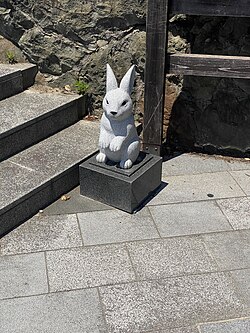
His link to enmusubi begins with one of the best-loved tales in the Kojiki, the Hare of Inaba. As a young god, Ōkuninushi travels behind his many elder brothers, carrying their heavy baggage. On the way they come upon a hare that has been stripped of its fur and left in agony after being tricked. The cruel brothers tell the hare to bathe in salt water and dry in the wind, which only makes the pain worse. Ōkuninushi, arriving last, tells the hare instead to wash in fresh water and roll in the pollen of cattail reeds — and the hare is healed. In gratitude, the hare foretells that it will be Ōkuninushi, not his arrogant brothers, who wins the hand of the beautiful Princess Yakami (Yagami-hime). The prophecy comes true. This first act of kindness, rewarded with the first “match,” is why the hare appears in statues all across the shrine grounds today and why Ōkuninushi is remembered as a god who joins people together.
It is worth clearing up a common misunderstanding. Foreign visitors often hear “Izumo Taisha” translated as a shrine for lovers, and pray there for romance. Romance is included, but the Japanese idea is broader. Musubi means “to tie” or “to bring forth,” and the en that Ōkuninushi presides over is every kind of human bond — the connection between friends, between a person and a job, between a student and a teacher. When Japanese visitors pray at Izumo, many are asking not for a partner but for good relationships of all kinds to come into their lives. This wider meaning is not a marketing slogan; as we are about to see, it is written into the very myth of how the shrine came to be built.
The Transfer of the Land: why Izumo exists
The founding myth of Izumo Taisha is the Kuniyuzuri — the “Transfer of the Land,” one of the pivotal episodes in the Kojiki. Having built up the land, Ōkuninushi ruled the Central Land of Reed Plains (the mythic name for Japan). But Amaterasu, the sun goddess in the High Plain of Heaven, decided that the land should be governed by her own descendants. She sent envoys down to demand that Ōkuninushi give it up.
After negotiation, Ōkuninushi agreed to cede the visible, political world to Amaterasu’s heavenly line — on one condition. In exchange, a magnificent shrine was to be built for him, and he would withdraw to preside over the “hidden” or unseen realm: the world of the spirit, of fate, and of the bonds between people. Izumo Taisha is, by tradition, that promised shrine. This is the key to the whole place. Ōkuninushi did not simply lose a power struggle; he traded rule over the visible world for rule over the invisible one. And the invisible world of unseen connections is exactly the realm of en — which is why the god who gave up a country became the god of relationships.
This myth also explains the deep relationship — and rivalry — between Izumo and Ise. In Shinto the gods are often divided into two families: the Amatsukami, the “heavenly deities” descended from Amaterasu, and the Kunitsukami, the “earthly deities” native to the land, of whom Ōkuninushi is the greatest. Ise, shrine of Amaterasu, represents the heavenly line and the visible order of the state; Izumo, shrine of Ōkuninushi, represents the earthly gods and the hidden order of fate. To visit both is to see the two halves of the Japanese religious imagination — the sun and the land, the seen and the unseen.
Kamiarizuki: the month all the gods come to Izumo
Here is one of the most charming facts in all of Japanese religion. The tenth month of the traditional lunar calendar is called, throughout most of Japan, Kannazuki (神無月) — the “month without gods.” The traditional explanation is that during this month the myriad deities of the land all leave their home shrines and travel to one place. That place is Izumo. And so in Izumo alone, the same month is called by the opposite name: Kamiarizuki (神在月), the “month with gods.”
According to tradition, the assembled gods hold a great conference at Izumo — a divine council in which they discuss and decide the en of the coming year: which people should be brought together, which matches made. In other words, the gods of the whole country gather at the shrine of the god of connections precisely to arrange the bonds between human beings. Special rites called the Kamiari-sai mark the period, and the visiting gods are said to lodge in two long, narrow buildings on the grounds called the Jūkusha. In the modern calendar these rites fall in November; in 2026 the welcoming rite (Kamimukae-sai) is held on the evening of November 18. For a visitor, arriving during Kamiarizuki means seeing the shrine at the one time of year when, by belief, it is at its most crowded — with gods.
Taisha-zukuri and the legend of Japan’s tallest shrine
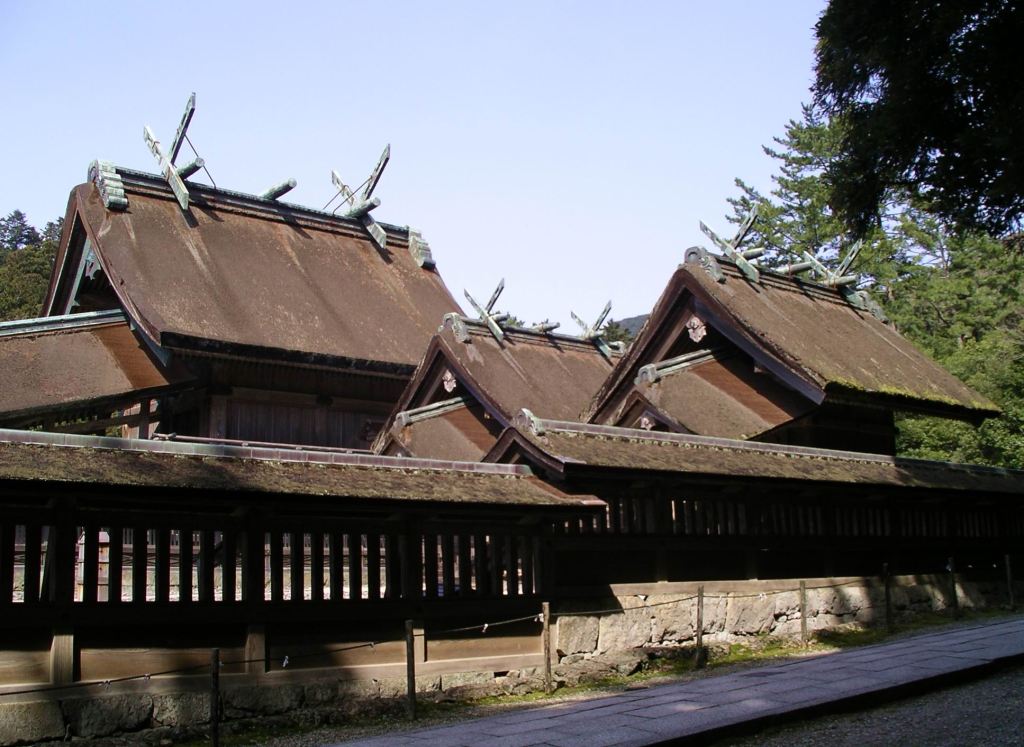
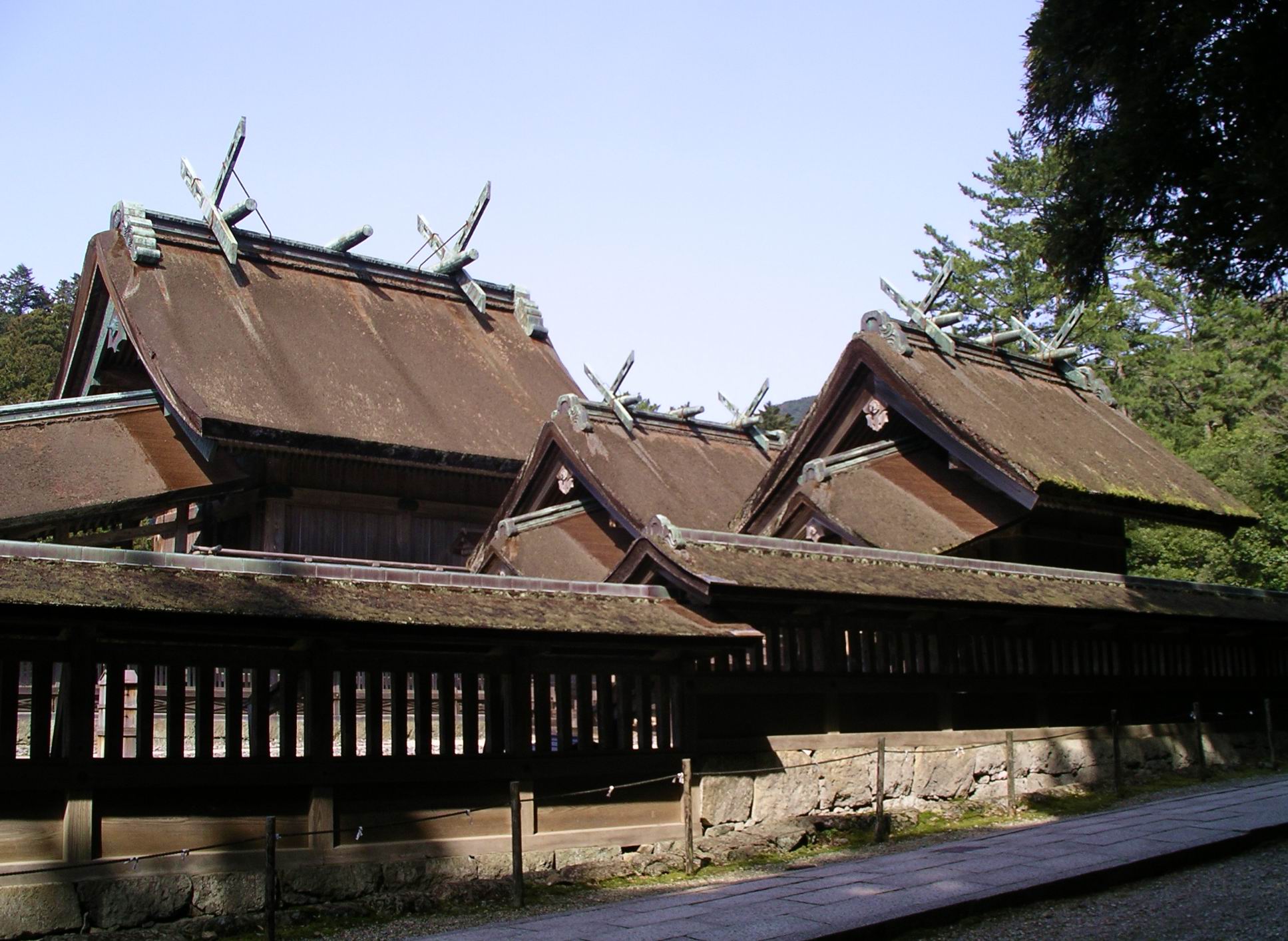
The main hall of Izumo Taisha, the Honden, is built in a style called taisha-zukuri — regarded as the oldest form of Shinto shrine architecture. Unlike the long, low, rectangular halls of Ise’s shinmei-zukuri, a taisha-zukuri hall has a nearly square floor plan, is entered from the gabled end (tsumairi), and is raised high on stout pillars with a great sweeping roof. The present Honden was rebuilt in 1744 and stands about 24 meters (eight jō) tall — one of the tallest shrine main halls in the country. It was designated a National Treasure in 1952. Historically the hall was rebuilt periodically in a cycle of renewal, most recently in the “Great Sengū of the Heisei era,” a major restoration during which the god was moved to a temporary hall and then returned to the refurbished Honden on May 10, 2013.
But the most astonishing story about this hall is about a version that no longer stands. Ancient and medieval records insist that the Honden was once far taller than today — reaching 16 jō, roughly 48 meters, nearly twice its current height, approached by a staircase said to run about 109 meters up to the entrance. A Heian-period text known as the Kuchizusami (970) even ranked the three tallest structures in Japan in a memorable phrase: “Un-ta, Wa-ni, Kyō-san” — Izumo (Un) first, the Great Buddha Hall of Tōdai-ji in Yamato (Wa) second, and the great audience hall of the capital in Kyoto (Kyō) third. For centuries, many historians dismissed a 48-meter wooden shrine as a legend.
Then, in 2000, excavations in the precinct uncovered the proof. Archaeologists found the buried bases of enormous pillars — each made of three great cedar logs bundled together with iron rings into a single column about three meters across. This matched, almost exactly, an old architectural diagram of the shrine (the Kanawa no Gozōei Sashizu) that had been preserved for generations by the shrine’s hereditary priestly family. Radiocarbon dating placed the timber in the mid-thirteenth century. The discovery transformed the “legend” into serious history: a soaring, high-rise shrine, reached by a long ramp of stairs, really does appear to have stood here in the medieval period. When you look at the tall Honden today and try to imagine it doubled in height, you are picturing something that the ground itself has now confirmed.
The giant rope — and the hall it actually hangs in
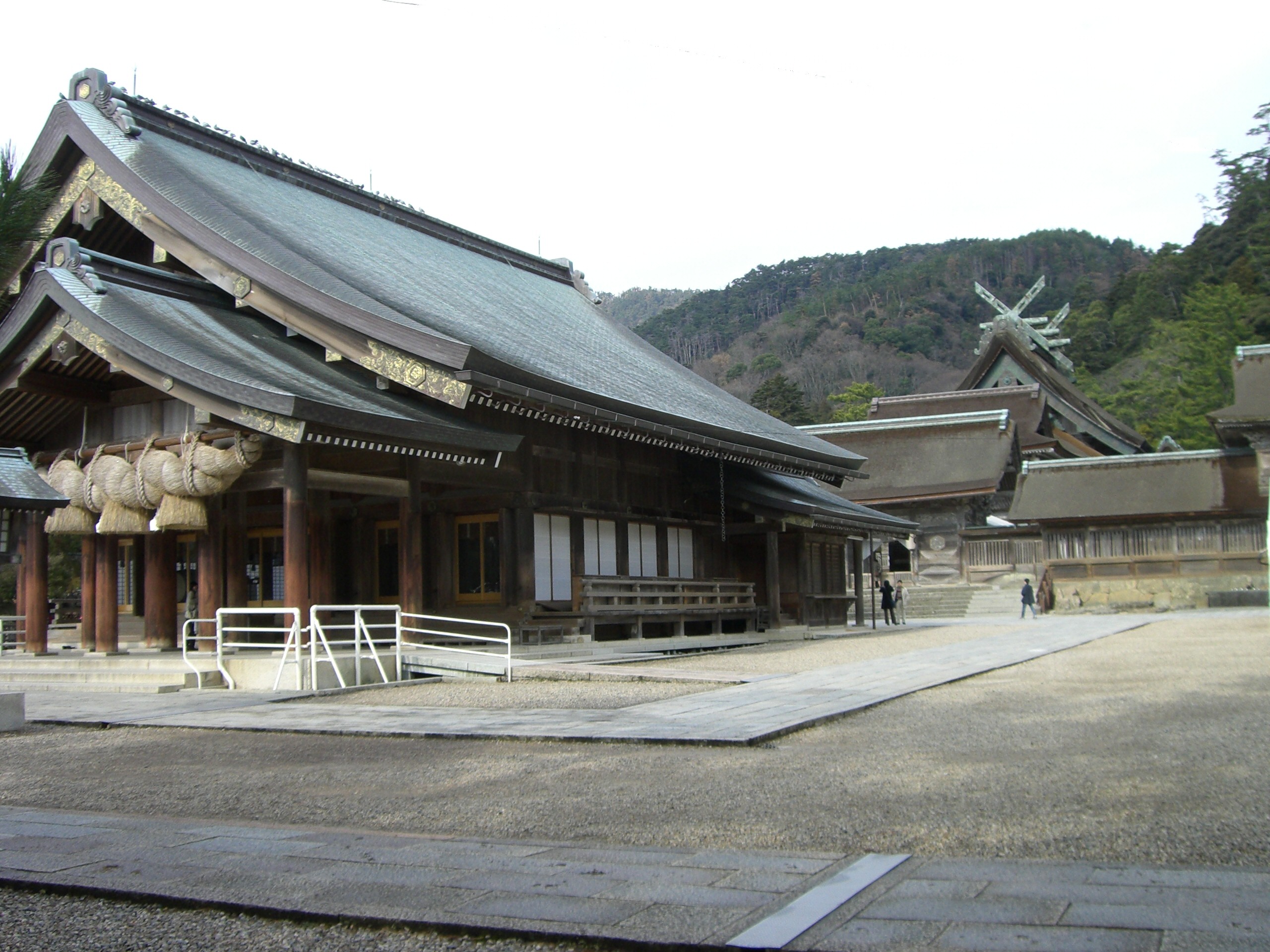
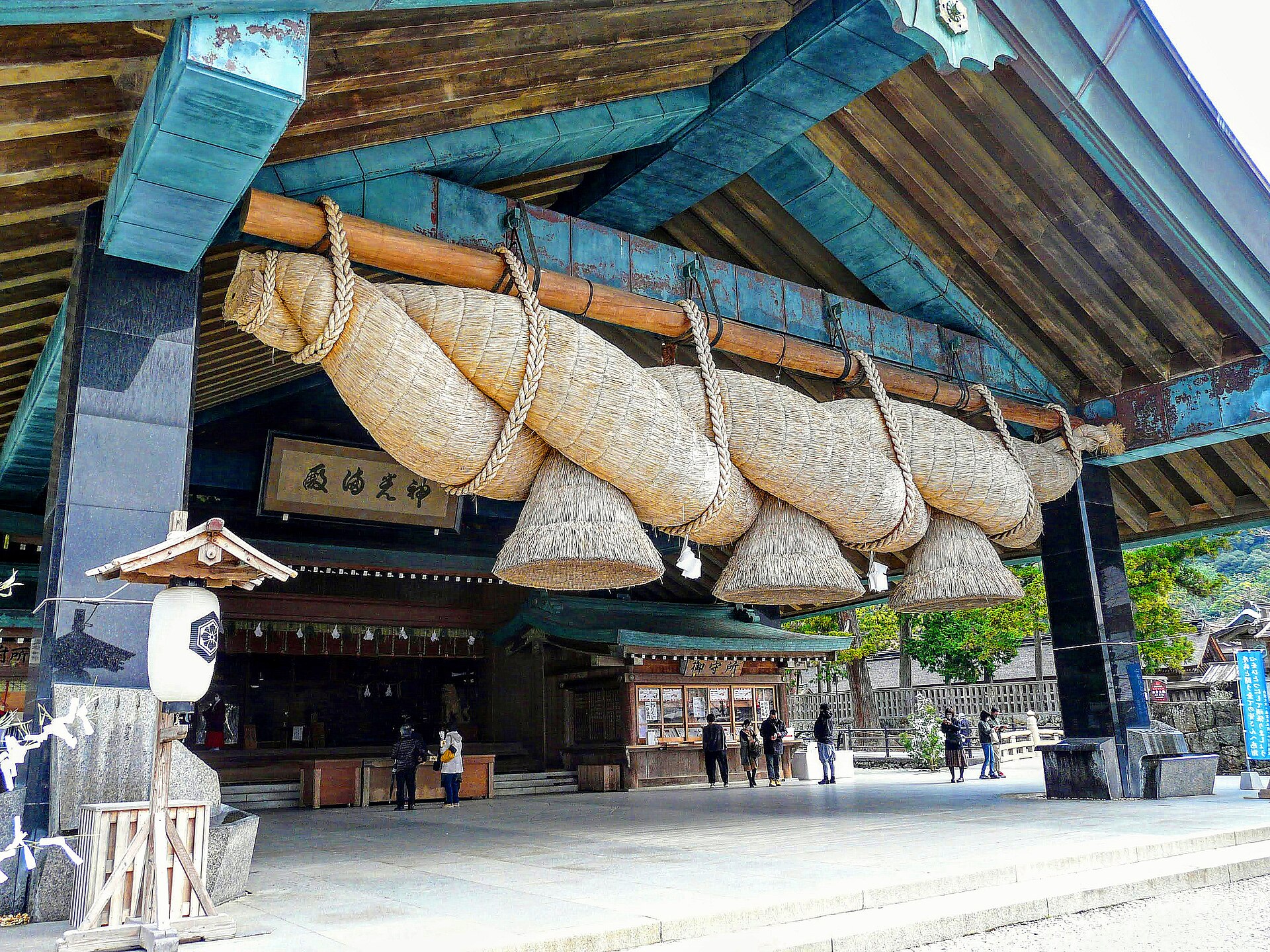
The single most photographed object at Izumo is its colossal shimenawa — a sacred rope of twisted rice straw that marks a sacred boundary. Izumo’s is one of the largest in Japan: roughly 13 meters long and weighing over five tons. It is so massive that first-time visitors often assume it hangs across the main Honden. It does not — and this is worth knowing before you go. The famous giant rope hangs over the front of the Kagura-den, a separate hall used for ceremonies and prayers, built to one side of the main precinct. The Honden, the true home of the god, is a more restrained and solemn structure set behind its fences.
The rope is not permanent. Every several years it is taken down and replaced with a freshly made one, crafted by the straw-rope artisans of the town of Iinan in Shimane — an enormous community undertaking that keeps a living craft alive. Standing beneath it, watching the thick coils of straw sag overhead, you get a physical sense of scale that no photograph quite conveys.
How to pray at Izumo: two bows, four claps, one bow
At almost every shrine in Japan, the standard way to pray is two bows, two claps, one bow — the etiquette we describe in our guide to visiting a shrine. Izumo Taisha is the great exception. Here the correct form is two bows, four claps, one bow (nirei, yonhakushu, ichirei). Visitors who clap the usual two times are, gently, doing it “wrong” for this shrine.
Why four? The shrine’s own explanation reaches back to its greatest festival, the Reisai on May 14, at which eight claps are offered. In the old counting, “eight” symbolized not a literal number but the infinite — boundless, limitless — and so eight claps express boundless reverence for the god. For everyday worship, that number is halved to four. (A gentler, popular interpretation you may hear from guides is that you clap twice for yourself and twice for the one you hope to be connected with — a fitting idea at the shrine of enmusubi, even if the official reason is the older one.) Either way, remember the rule when you stand before the hall: at Izumo, clap four times.
Practical visitor information
Izumo Taisha is in the city of Izumo, Shimane Prefecture, in western Japan on the Sea of Japan coast. It is most easily reached via Izumoshi Station, with a bus or a short taxi ride to the shrine; the region is also served by Izumo Enmusubi Airport. Unusually, the main approach path slopes gently downhill toward the shrine rather than climbing — one of the few “descending” approaches in Japan. Near the entrance stands the small Harae-no-yashiro, a purification shrine where many visitors stop to pray first before continuing to the main hall. The grounds are open and free to enter; there is no admission gate to the precinct, though a treasure hall and the nearby Shimane Museum of Ancient Izumo (which displays the excavated giant pillars) charge separate fees. As always, check official sources for current festival dates and opening hours before you travel, especially if you are timing a visit for Kamiarizuki in November.
Trivia — the god who faces sideways. One quiet mystery of the Honden is its orientation. Worshippers approach and pray from the south front, but the sacred seat of the god inside is traditionally said to face west, not toward the visitors at the front. Because of this, some knowledgeable visitors walk around to the west side of the Honden’s enclosure to offer a second prayer — the spot where, by tradition, they are looking the god in the face rather than at his shoulder. It is a small thing, easy to miss, and very Izumo: at this shrine, even the direction you are praying is part of the story.
In closing
Izumo Taisha rewards a visitor who knows its myth. Without it, you see a big shrine with a very big rope. With it, you see the home of the god who built the land and then gave it up — trading the visible world for the invisible one, and becoming, in that bargain, the keeper of every human connection. It is why the whole country’s gods are said to travel here each autumn to arrange the year’s bonds, why the main hall may once have been the tallest building in Japan, and why you clap four times instead of two. Stand on the downhill path with the Sea of Japan at your back, and Izumo feels less like a monument than like a promise kept — a shrine built, as the old story says, in exchange for a world.


コメントを残す