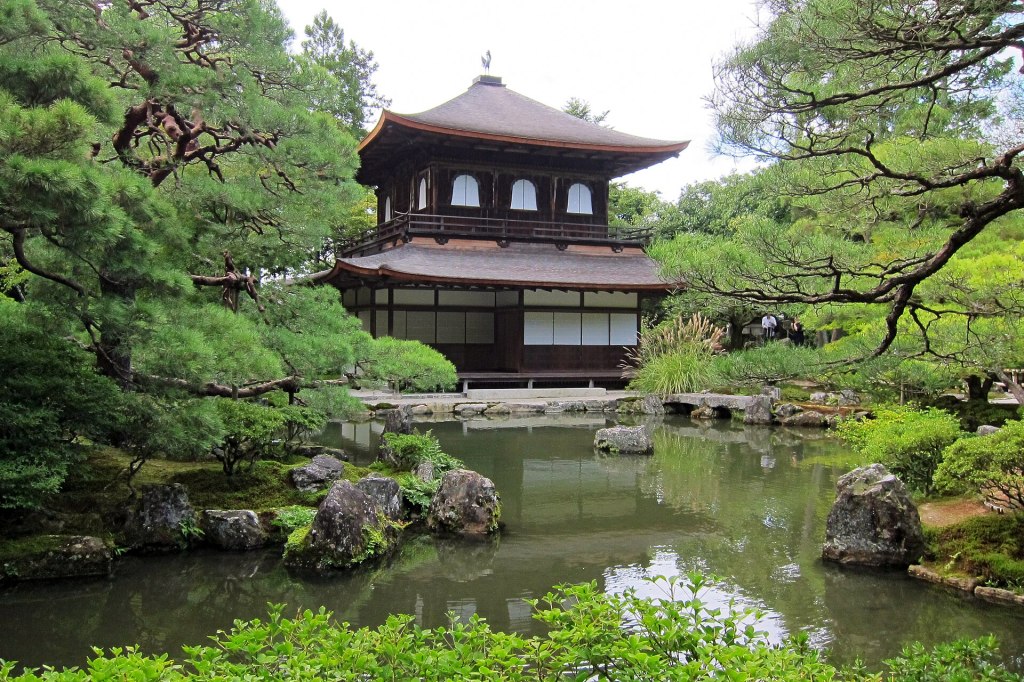
On the eastern edge of Kyoto stands a dark, wooden two-story pavilion beside a pond, with a strange cone of white sand rising in the garden before it. It is called the Silver Pavilion — yet there is no silver on it anywhere. This is Ginkaku-ji, officially Jisho-ji, the quieter twin of Kyoto’s famous Golden Pavilion. But its plainness is the whole point: this is the temple where a shogun who had failed at governing withdrew to pursue beauty instead, and in doing so helped invent much of what the world now thinks of as “Japanese taste” — the tatami tea room, the raked sand garden, and the quiet aesthetic of wabi-sabi. This guide looks past the missing silver to the ideas that make Ginkaku-ji one of the most important buildings in Japan.
In this article
- Overview: Kyoto’s quieter pavilion
- Highlights and must-see points
- Why is it called “silver” with no silver?
- History: the shogun who lost a war and chose beauty
- Higashiyama culture: where “Japanese taste” was born
- Gold and silver: two pavilions, two worlds
- Visiting: the Philosopher’s Path and the seasons
- Practical visitor information
- In closing
Overview: Kyoto’s quieter pavilion
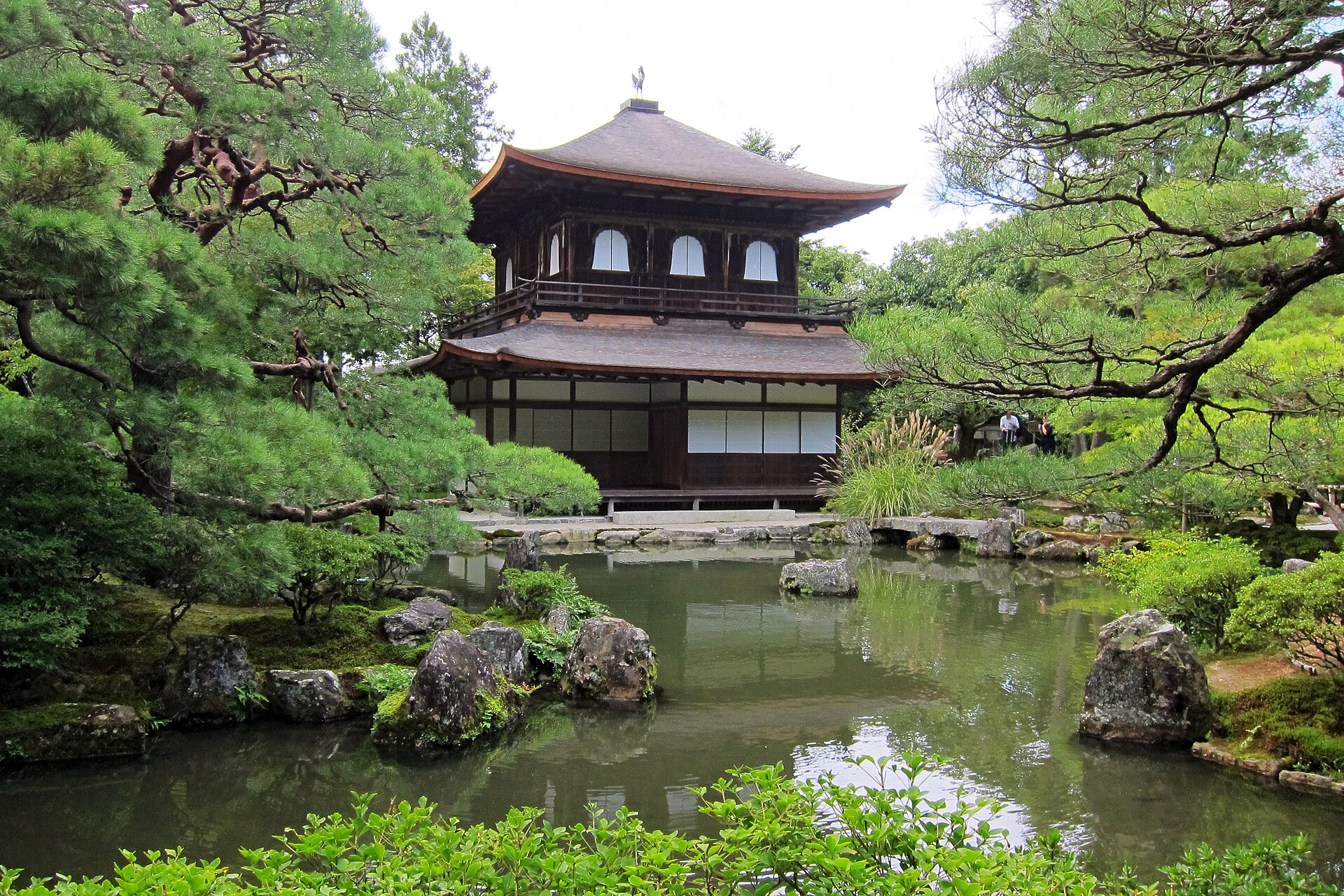
Ginkaku-ji sits at the foot of Kyoto’s eastern hills (Higashiyama), and its official name is Jisho-ji — a Rinzai Zen temple belonging to the Shokoku-ji branch. Like the Golden Pavilion across the city, it was registered as a UNESCO World Heritage Site (Historic Monuments of Ancient Kyoto) in 1994. Its centerpiece is the Ginkaku (Silver Pavilion), a modest two-story hall of dark wood facing a pond, set within a garden of moss, water, and raked white sand. Where the Golden Pavilion overwhelms you with brightness, Ginkaku-ji works the opposite way: it asks you to slow down and notice restraint, shadow, and texture. That restraint is not an accident of budget alone — it is a deliberate aesthetic, and understanding it is the key to the whole site.
Highlights and must-see points
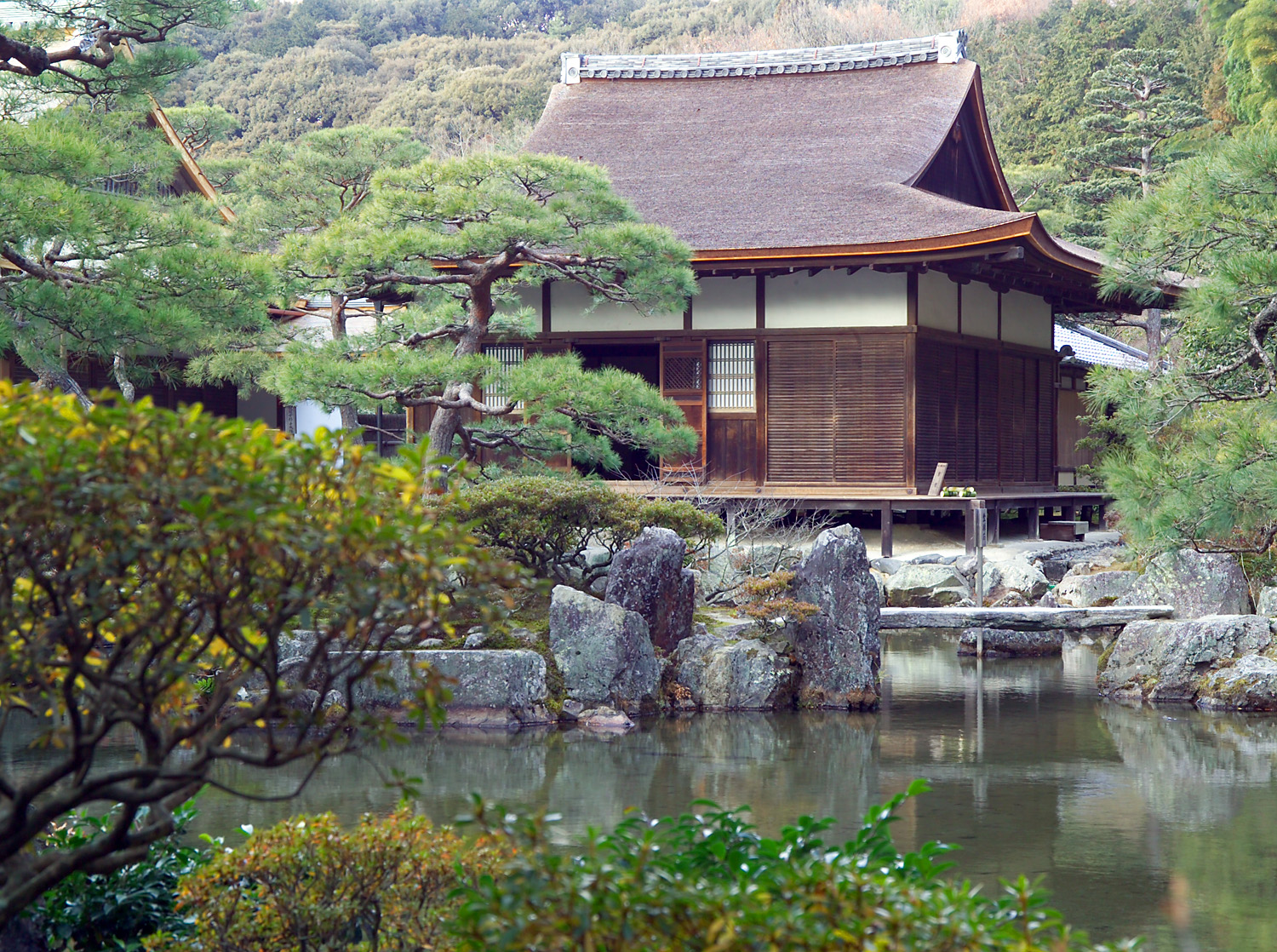
The Silver Pavilion (Kannon-den) itself is the main sight. It has two floors in two different styles: the lower floor, the Shinku-den, is built in a residential, aristocratic manner, while the upper floor, the Cho-on-kaku (“Tower of the Sound of the Tides”), is a Zen-style Buddhist hall that enshrines a statue of Kannon (the bodhisattva of compassion). Its lines are plain and its color is the brown-black of aged wood — a building meant to sit quietly in nature rather than dominate it.
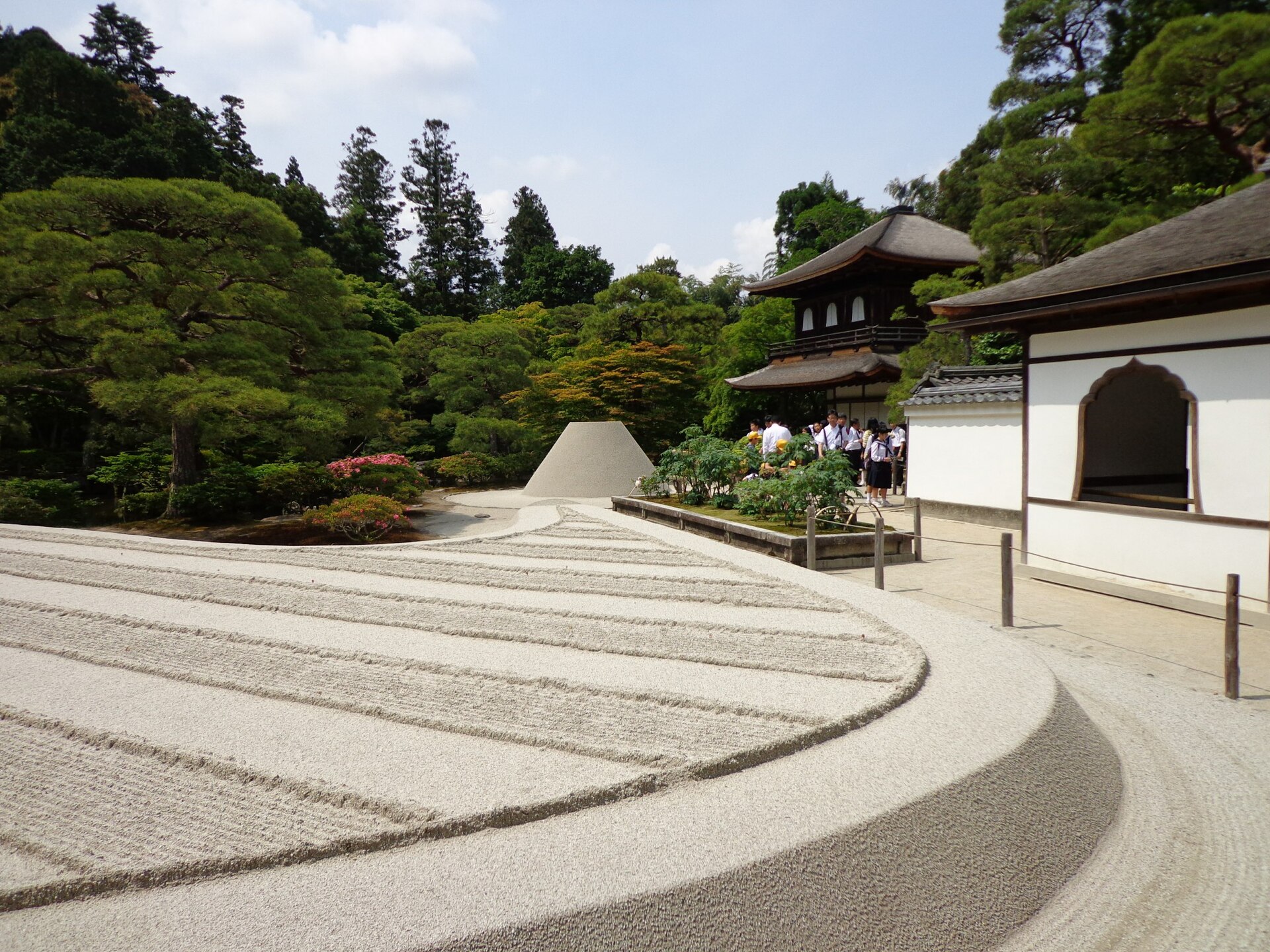
Just as striking is the sand garden. A wide, flat expanse of carefully raked silver-white sand — the Ginshadan (Sea of Silver Sand) — spreads before the hall, and beside it rises a smooth, flat-topped cone nearly two meters high, the Kogetsudai (Moon-Viewing Platform). By day the sand is abstract and sculptural; by moonlight it is said to catch and spread a soft glow. Beyond the sand, a strolling garden of moss, ponds, and a small hillside climb rewards you with a view over the pavilion and the rooftops of Kyoto.
Do not miss the Togudo, a smaller hall on the grounds that is easy to walk past but historically may be the most important building of all — more on it below.
Why is it called “silver” with no silver?
The obvious question every visitor asks: where is the silver? The honest answer is that there never was any. The nickname “Silver Pavilion” (Ginkaku) is thought to date only from the Edo period (1600–1868), long after the building was made, most likely as a natural pairing with the older Golden Pavilion (Kinkaku).
Several explanations circulate. One popular story holds that the pavilion was meant to be covered in silver foil but that the plan was abandoned as wars and money troubles drained the shogunate’s finances. Others suggest the “silver” was always poetic — the way the dark lacquered wood and the white sand garden were said to shimmer under moonlight. Modern surveys have found no evidence that silver leaf was ever applied. Whichever story you prefer, the result is the same: a building whose beauty depends not on precious metal but on proportion, materials, and its setting. In a sense, the “missing” silver is the point.
History: the shogun who lost a war and chose beauty
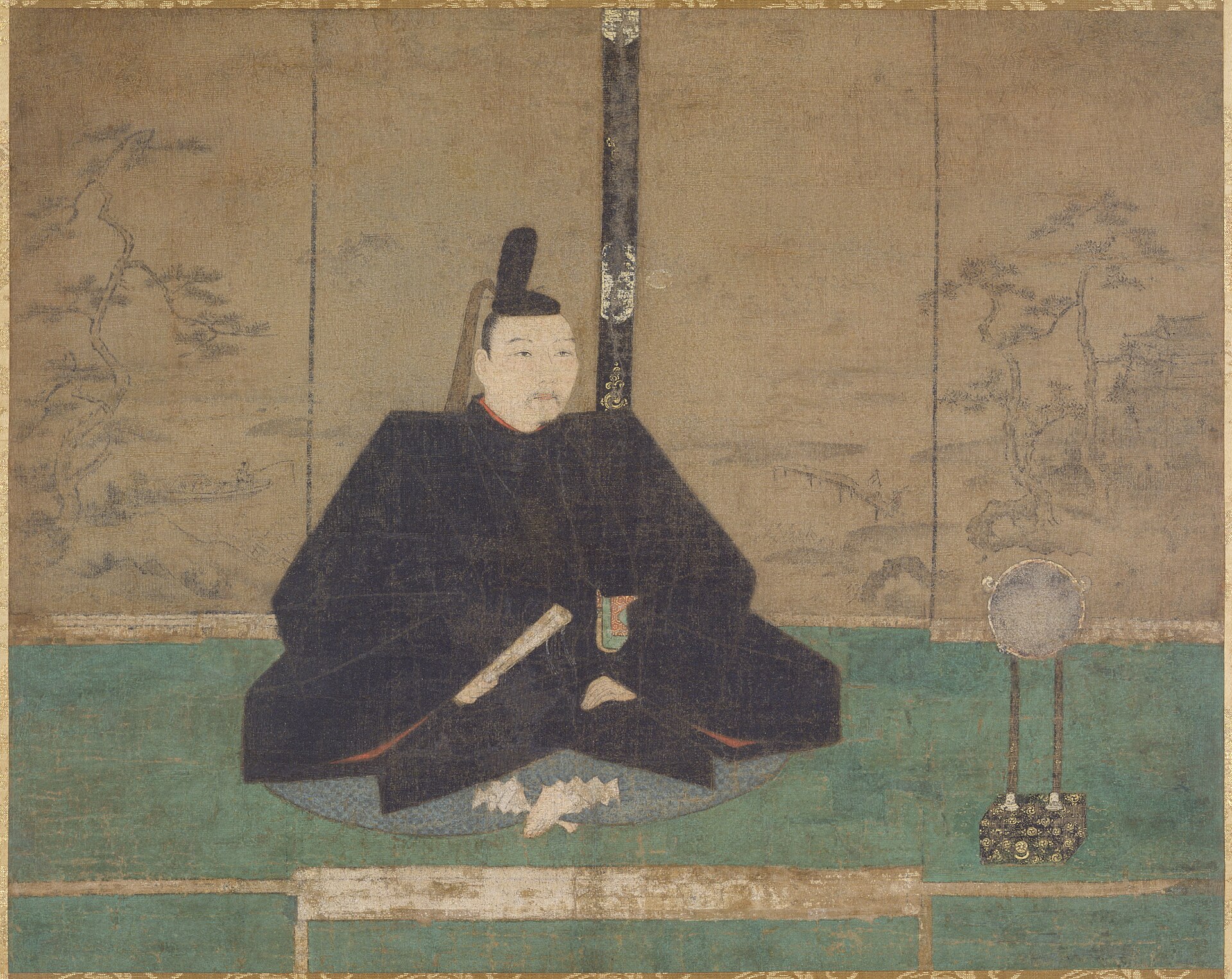
The man behind Ginkaku-ji was Ashikaga Yoshimasa (1436–1490), the eighth shogun of the Muromachi period and the grandson of Yoshimitsu, who had built the Golden Pavilion. As a ruler, Yoshimasa is usually judged a failure. His indecision over who should succeed him helped trigger the Onin War (1467–1477), a devastating civil conflict that burned much of Kyoto to the ground and plunged Japan into more than a century of warfare. Rather than master the chaos, Yoshimasa increasingly turned away from politics and toward art.
In 1482, having handed off power, he began building a retirement estate — the Higashiyama-dono (“Eastern Hills villa”) — on this site. Construction of the Silver Pavilion itself, the Kannon-den, began only in 1489. Yoshimasa did not live to see it finished: he died in 1490, and by his wishes the villa was converted into a Zen temple, taking the name Jisho-ji. The place we visit today, in other words, was a private refuge from a collapsing world before it was ever a temple.
Higashiyama culture: where “Japanese taste” was born
Here is why Ginkaku-ji matters far beyond its garden. The court of retired taste that Yoshimasa gathered at his Higashiyama villa gave its name to Higashiyama culture (Higashiyama bunka) — a flowering of the arts, steeped in Zen ideals and the aesthetic of wabi-sabi (a sense of beauty found in simplicity, imperfection, and the passage of time). Many of the art forms that outsiders now consider quintessentially Japanese were refined in this circle: the tea ceremony (chado), ikebana (flower arranging), ink-wash painting (sumi-e, whose greatest master, Sesshu, worked in this era), and landscape gardening.
The most concrete evidence stands in the Togudo, completed in 1486 as Yoshimasa’s private Buddha hall and now a National Treasure. Inside is a small study room called the Dojinsai, just four and a half tatami mats in size. It contains a built-in writing desk beneath a window (tsukeshoin) and staggered display shelves (chigaidana) — features that are considered the earliest surviving example of shoin-zukuri, the study-style architecture that became the template for the traditional Japanese room. That familiar image of a tatami room with an alcove and shelves — the room where the tea ceremony would later be perfected by masters such as Sen no Rikyu — has one of its roots in this modest four-and-a-half-mat space. It is not an exaggeration to say that the ordinary Japanese room was, in part, invented here.
Gold and silver: two pavilions, two worlds
Ginkaku-ji is best understood next to its famous sibling. The Golden Pavilion (Kinkaku-ji) was built by Yoshimasa’s grandfather, Ashikaga Yoshimitsu, in 1397, at the height of the shogunate’s wealth and confidence. It represents the earlier Kitayama culture (“Northern Hills culture”): outward, gorgeous, gold-leafed, a display of power. Ginkaku-ji, built by the grandson at the low point of the family’s fortunes, represents Higashiyama culture: inward, restrained, wooden, a display of taste.
Seen this way, the two buildings tell a single story about a change in Japanese values. Gold gives way to plain wood; spectacle gives way to suggestion; the confidence of a rising dynasty gives way to the quiet of a man who has lost his war and turned to beauty as consolation. Visiting both — ideally on the same trip — is one of the most rewarding contrasts in all of Kyoto.
Trivia — the “moon-viewing” sand is younger than the temple. It is tempting to imagine Yoshimasa himself gazing at the moon from the Kogetsudai sand cone. In fact, the Ginshadan and Kogetsudai in their present form are thought to date from the Edo period, roughly two centuries after his death, not from the fifteenth century. The garden we admire is itself a work of layered history — later generations shaping and reshaping the master’s retreat.
Visiting: the Philosopher’s Path and the seasons
Ginkaku-ji sits at the northern end of the Philosopher’s Path (Tetsugaku-no-michi), a canal-side walking route lined with cherry trees that runs south toward Nanzen-ji. Pairing the temple with a stroll along this path is one of the classic Higashiyama half-days. The temple is beautiful in every season: cherry blossoms along the canal in spring, deep moss green in the rainy early summer, fiery maples in November, and a rare, hushed elegance under snow. Because the design rewards slow attention rather than a single photo, an unhurried visit in soft morning light suits it best.
Practical visitor information
There is an admission fee (a few hundred yen), and the grounds follow a one-way garden path that takes roughly 30–60 minutes to walk. From Kyoto Station, a city bus (about 35–40 minutes) to the Ginkakuji-michi stop is the simplest route, followed by a short uphill walk past souvenir shops. As with the Golden Pavilion, early morning is the least crowded and most atmospheric time to arrive. Please check the temple’s official information for current hours and fees before you go, as they can change seasonally.
In closing
Ginkaku-ji rewards visitors who know its story. Without it, you see a plain brown building and some raked sand and wonder where the silver went. With it, you see the retreat of a shogun who could not hold his country together but who, in stepping away from power, helped shape the tea room, the tatami study, and the whole quiet aesthetic that the world now calls Japanese. The Golden Pavilion dazzles; the Silver Pavilion teaches. Stand before the Sea of Silver Sand in the morning light, and the absence of silver stops being a disappointment and starts to feel like the answer.


.jpg)


コメントを残す