Most visitors come to Ryōan-ji (龍安寺, “Temple of the Peaceful Dragon”) for one thing: a rectangle of raked white gravel with fifteen stones set on it, and nothing else. There are no flowers, no water, and no path into it. You sit on a wooden veranda and look. It is probably the most famous garden in Japan, and one of the strangest, because almost everything about it is uncertain. We do not know for sure who made it, exactly when, or what it is supposed to mean.
This article looks past the postcard. We will trace how a Fujiwara estate became a Zen temple, why a garden of bare stone came to matter so much, and what scholars actually do and do not know about it. We will also cover the parts of Ryōan-ji that crowds often skip: a famous stone water basin with a quiet message, a large pond older than the temple itself, and practical notes on visiting a place that is best seen before the tour buses arrive.
An overview: a small garden with a large reputation
Ryōan-ji sits in the northwest of Kyoto, in the Ukyō ward, a short distance from the gold-covered Kinkaku-ji. It belongs to the Myōshin-ji line of the Rinzai school, one of the main branches of Zen Buddhism in Japan. Zen (禅) is a form of Buddhism that stresses direct experience and seated meditation over scripture or ritual.
The temple’s fame rests almost entirely on its rock garden, a type of garden called karesansui (枯山水), literally “dry mountains and water.” A karesansui garden uses stone and raked gravel to suggest landscape, with no actual water and often no plants. Ryōan-ji’s version is small — roughly 248 square meters, about 25 meters wide and 10 meters deep, or a little smaller than a tennis court — yet it has shaped how people around the world picture Zen. It was added, along with the rest of the temple, to the UNESCO World Heritage list in 1994 as one of the “Historic Monuments of Ancient Kyoto.”
History: from Fujiwara estate to Zen temple
The ground was important long before the garden existed. In the 11th century the site was a country estate of the Fujiwara clan, the aristocratic family that dominated the court in the Heian period (794–1185). A large pond garden was laid out here as part of that estate, and it still survives as the Kyōyōchi pond on the lower part of the grounds.
In 1450 the estate was acquired by Hosokawa Katsumoto (1430–1473), a powerful warrior-official who served as kanrei (管領), or deputy to the Ashikaga shogun. Katsumoto turned the property into a Zen temple. Not long after, Kyoto was torn apart by the Ōnin War (1467–1477), a decade-long conflict between rival warrior houses that left much of the capital in ashes — and Katsumoto himself was one of its two main commanders. Ryōan-ji burned in the fighting. It was rebuilt in 1488 by his son, Hosokawa Masamoto.
Fire returned in 1797, destroying the main hall. Buildings were brought in from a sub-temple to replace what was lost. This long record of destruction and repair matters, because it is one reason the origin of the rock garden is so hard to pin down. The temple we walk through today is a survivor that has been rebuilt more than once.
The rock garden: what it is, and what nobody can prove
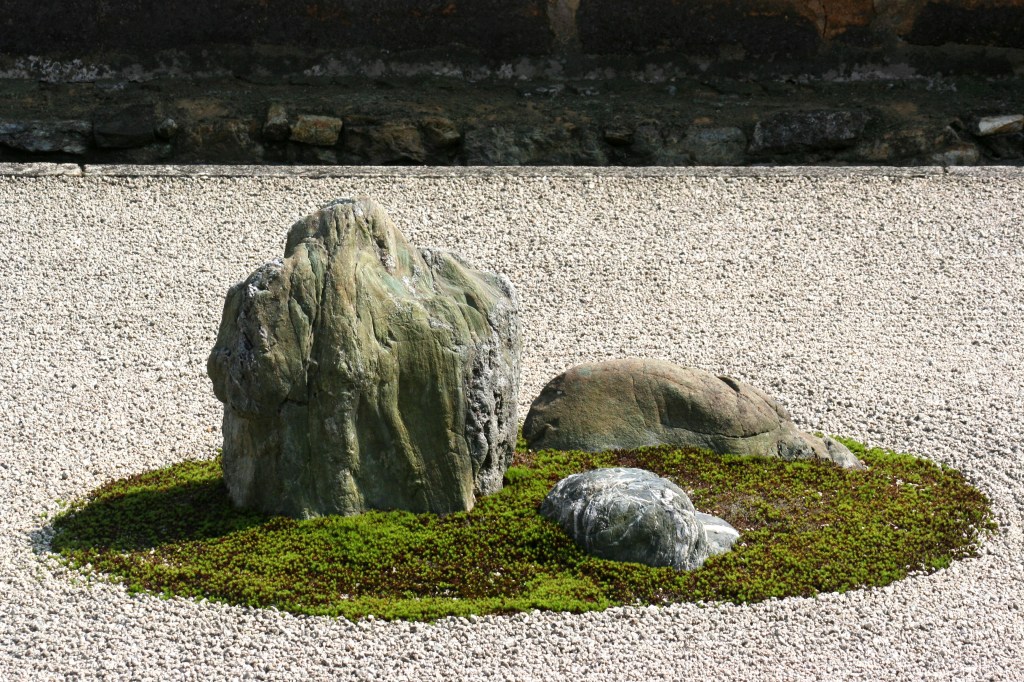
The garden is viewed from the veranda of the hōjō (方丈), the former living quarters of the temple’s head priest. In front of you is a flat bed of pale gravel, raked into straight lines and circles that the monks renew by hand. Fifteen stones of different sizes rest on the gravel in five groups — of five, two, three, two, and three stones — with patches of moss gathered at their bases. A low earthen wall runs along the far side. That wall was built from clay boiled in oil, and over the centuries the oil has seeped out to leave soft brown and orange stains, which many visitors mistake for a painting.
The garden’s most repeated feature is a tradition rather than a fact: from any single spot on the veranda, at least one of the fifteen stones is always hidden behind another, so a seated viewer can only ever count fourteen. People often say the whole set can be seen only from above, or only by someone who has reached enlightenment. This is best treated as a story that grew up around the garden, not as the designer’s proven intention.
Here is where honesty is more useful than confidence. We do not know who designed the garden. The most romantic attribution names Sōami (died 1525), a celebrated painter and garden designer of the age, but there is no solid evidence for it. Others credit Katsumoto or Masamoto. Two names, Kotarō and Hikojirō, are carved on the back of one stone; these were likely kawaramono, low-status laborers who did such work, though whether they designed or merely placed the stones is unknown. Strikingly, no clear written description of the rock garden survives from before the 1680s, and the garden was damaged in the 1797 fire, so some scholars argue the arrangement we see may date only to the Edo period (1603–1868) rather than the 15th century. In short, the date is genuinely disputed.
The meaning is disputed too. Over the years the stones have been read as islands in a sea, as mountain peaks rising above clouds, and, in a popular folk reading, as a tiger carrying her cubs across water. Some see an abstract composition meant only to still the mind for meditation. The temple itself does not endorse a single answer, and that openness is part of the point: a karesansui garden is made to be looked at slowly, and to give back whatever the viewer brings to it.
Zen and the dry-garden tradition
To understand why a plain rectangle of gravel became so admired, it helps to know where these gardens come from. The karesansui style matured during the Muromachi period (1336–1573), the same era when Zen Buddhism gained deep influence over Japanese art, tea, and design. Zen monks favored suggestion over decoration. A few carefully placed rocks could stand for mountains; combed gravel could stand for the sea or a flowing river. Nothing needed to move or bloom.
This restraint fits Zen practice. In Rinzai Zen, monks sit in zazen (坐禅), seated meditation, and work with kōan (公案) — short, often paradoxical questions that cannot be solved by ordinary reasoning. A garden that refuses to explain itself works in a similar way. It gives the mind nothing to grasp and no story to finish, which is precisely why it has been used for centuries as an aid to contemplation rather than as mere scenery. Ryōan-ji is the most famous example, but the same thinking shaped the sand cones and gravel “sea” at the nearby Silver Pavilion, Ginkaku-ji.
Beyond the stones: the tsukubai, the pond, and the kuri
Behind the main hall stands one of Japan’s best-known stone water basins, a tsukubai (蹲踞) — a low basin where guests rinse their hands and mouth before a tea gathering. Four characters are carved around its square central opening. On their own the characters are incomplete, but each one borrows the central hole, read as the character for “mouth” (口), to become whole. Together they read ware tada taru o shiru (吾唯足知), usually translated as “I learn only to be contented.” It is a compact statement of a Buddhist idea: that wanting less is its own form of wealth. The basin is a later addition to the temple and is traditionally said to have been given by Tokugawa Mitsukuni (1628–1701), the lord of Mito — though this attribution is a tradition, not a documented fact, and is worth treating with the same caution as the garden’s authorship.
Below the buildings lies the Kyōyōchi (鏡容池), the “mirror-shaped pond,” which dates back to the 12th-century Fujiwara estate and is far older than the rock garden. Its islands and seasonal water lilies make the walk up to the temple a garden in its own right, and one of its islets holds a small shrine to Benten, a deity associated with water, music, and the arts. The entrance to the temple buildings is through the kuri (庫裏), the kitchen and living quarters of the monastery — a reminder that Ryōan-ji is a working Zen temple, not only a viewing platform.
Visiting Ryōan-ji
Ryōan-ji is in northwest Kyoto and pairs naturally with Kinkaku-ji, the Golden Pavilion, which is roughly a kilometer away; the two are often visited on the same morning by bus or on foot. Ninna-ji, another World Heritage temple, is close by as well.
The single most useful piece of advice is to arrive early. The rock garden is small, and its effect depends on quiet. On the veranda at opening time you may have long minutes almost to yourself; an hour later the same space can be full of visitors and voices, and the stillness the garden is famous for disappears. Autumn foliage and early-summer greenery around the pond are especially fine, but they also draw the largest crowds, so an early start matters most then. Please check the temple’s current hours and admission before you go, as these change, and remember that this is an active place of practice: keep your voice low on the veranda and let others have their turn to sit.
In closing
Ryōan-ji rewards a kind of attention that is easy to forget while traveling. There is no single view to photograph and move on from, no plaque that tells you the correct answer. The garden was made — by someone, at some time, for some reason we cannot fully recover — to be looked at without hurry. Its lasting power comes partly from what we do not know about it. Sitting in front of fifteen stones you cannot all see at once, with a message nearby that says contentment is enough, is a fair summary of what Zen has offered Japan for centuries. The best thing a visitor can do is sit for a while and let the garden stay unexplained.
Trivia
The idea that only fourteen of the fifteen stones can be seen at once has been taken seriously by scientists as well as monks. In 2002, researchers publishing in the journal Nature analyzed the layout and argued that the empty gravel between the stone groups traces the shape of a branching tree — a pattern the brain may register without noticing — and that this hidden structure could be part of why the garden feels so balanced from the one spot on the veranda where visitors traditionally sit. It is one theory among many, but it shows how a garden of bare stone still invites people to keep asking what it means.
Related reading
- Kinkaku-ji: Kyoto’s Golden Pavilion — the gilded temple a short walk from Ryōan-ji.
- Ginkaku-ji: The Silver Pavilion and the Birth of Wabi-Sabi — home to another celebrated sand-and-gravel garden.
- Japanese Buddhist Schools: Zen, Pure Land, Shingon and Beyond — where Rinzai Zen fits in the wider picture.


コメントを残す